
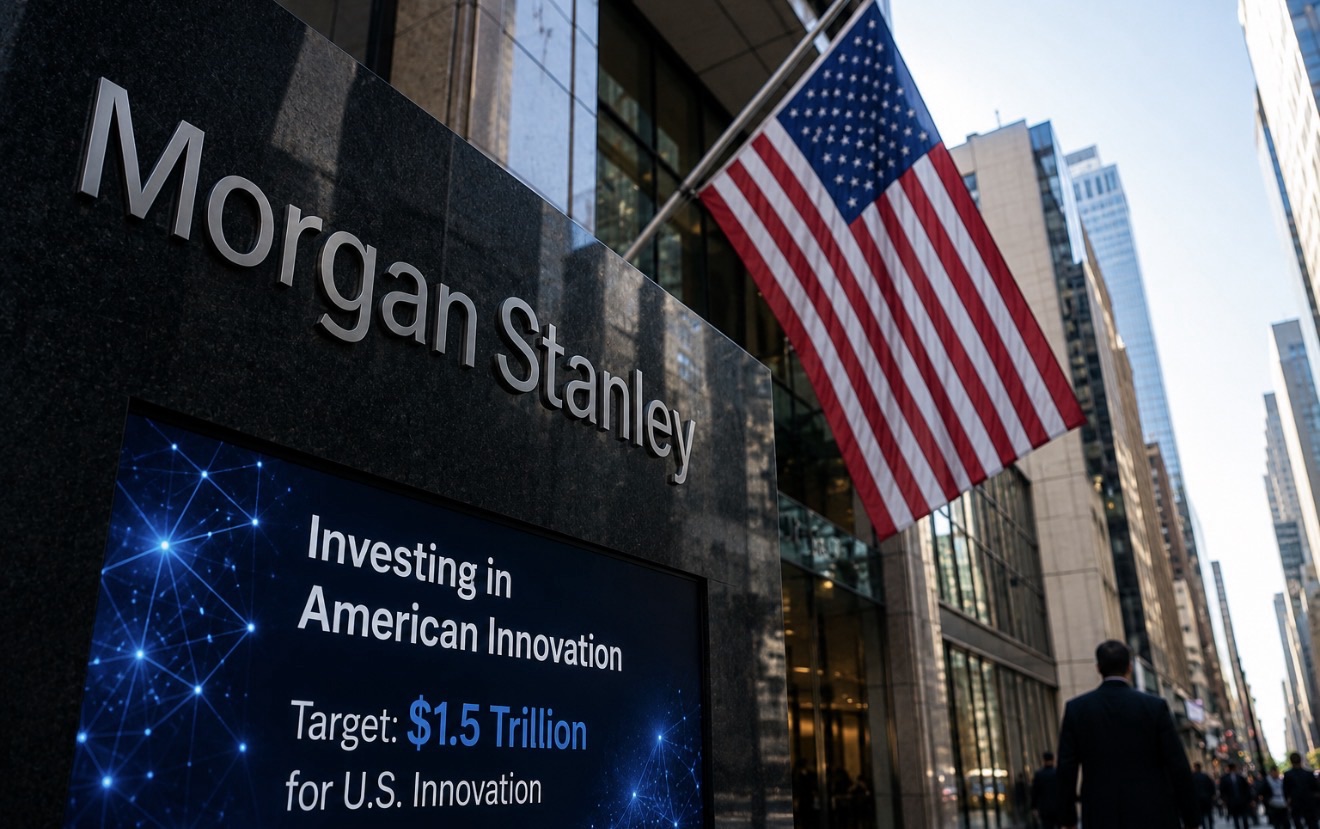

Morgan Stanley is not writing a $1.5 trillion check. What the bank committed to on Monday, Aug. 10, is arranging that much money over the next ten years — underwriting stock and bond sales, lending, advising on mergers, and steering client capital toward American technology and infrastructure companies. The bank earns fees on that activity; the money itself comes from investors, funds and lenders it brings to the table.
The program is called the U.S. Innovation Infrastructure Initiative, and Morgan Stanley says it intends to facilitate approximately $1.5 trillion of capital raising, financing, advisory and related investment activity over the next 10 years, timed to America’s 250th anniversary. It pulls together the firm’s advisory, capital markets, wealth management and investment management arms into one effort aimed at clients building companies and infrastructure the bank describes as central to U.S. economic and national security.
The initiative is organized around three buckets. The first covers technologies and businesses in artificial intelligence, advanced computing and software, quantum, semiconductors, data infrastructure, cybersecurity, aerospace and defense technologies, pharmaceuticals, critical minerals and secure supply chains. The second is the physical layer beneath all of it — financing and developing digital, physical and energy infrastructure for an economy that is becoming more compute-intensive and more power-hungry. The third is capital for founders and growth companies, from formation through scale, liquidity, public listings and access to government funding.
That middle bucket is where the real money lives. The compute buildout driving AI is fundamentally a construction and energy problem: data centers, transmission lines, generation capacity, chip fabrication plants and the supply chains that feed them. Those are long-dated, capital-hungry assets that need project finance, private credit and institutional equity rather than venture funding, and arranging that kind of capital is exactly what a full-service investment bank sells.
Dan Simkowitz, Morgan Stanley’s co-president, said the United States is entering a period of significant investment and innovation across technology, infrastructure and strategic industries, framing the anniversary as a moment to look at what will shape the country’s next chapter.
The competitive context matters as much as the number. JPMorgan Chase said last year it would direct $1.5 trillion toward industries that strengthen U.S. economic security and resiliency over the next decade, and Morgan Stanley’s announcement lands on the same figure and the same ten-year horizon. Wall Street’s largest firms are staking out identical territory, which tells you where they expect the fee pool to be: financing the reindustrialization and compute buildout that both parties in Washington have been subsidizing.
For businesses on the receiving end, the practical question is what actually changes. A commitment to facilitate is a commitment of attention and balance sheet capacity, not a fund with money to deploy. What it means in practice is that a semiconductor supplier, a grid equipment maker or a defense-adjacent manufacturer looking to raise capital should find a more organized front door at the bank, with the private-side and public-side teams working the same account instead of pitching separately. Morgan Stanley says the effort will run alongside its existing work with founders and growth companies, including private company research coverage and its Founders Summit.
There is also a wealth-management angle that is easy to miss. Morgan Stanley’s brokerage and advisory business manages trillions for individual clients, and folding that arm into the initiative signals an intent to route retail and high-net-worth money into private infrastructure and growth vehicles — a category that has been opening up to individual investors through interval funds, evergreen structures and private credit products. That is where a large share of the $1.5 trillion is likely to be sourced.
The obvious caution is that these pledges are measured on the bank’s own scorecard. There is no independent audit of what counts toward $1.5 trillion, and a decade of ordinary underwriting and lending to technology and infrastructure clients would go a long way toward the total on its own. A firm of Morgan Stanley’s size arranges enormous volumes of exactly this activity every year without announcing it.
What the announcement does establish is direction. The bank is telling clients, regulators and Washington that it intends to be the intermediary of record for the AI and infrastructure buildout, and that it will organize itself internally to win that business. For companies in those sectors trying to raise money over the next several years, that is a competitive dynamic worth using — because the other large banks are making the same bet.
JBizNews Desk | New York
© JBizNews.com All Rights Reserved. Reproduction or distribution without written permission is prohibited.