
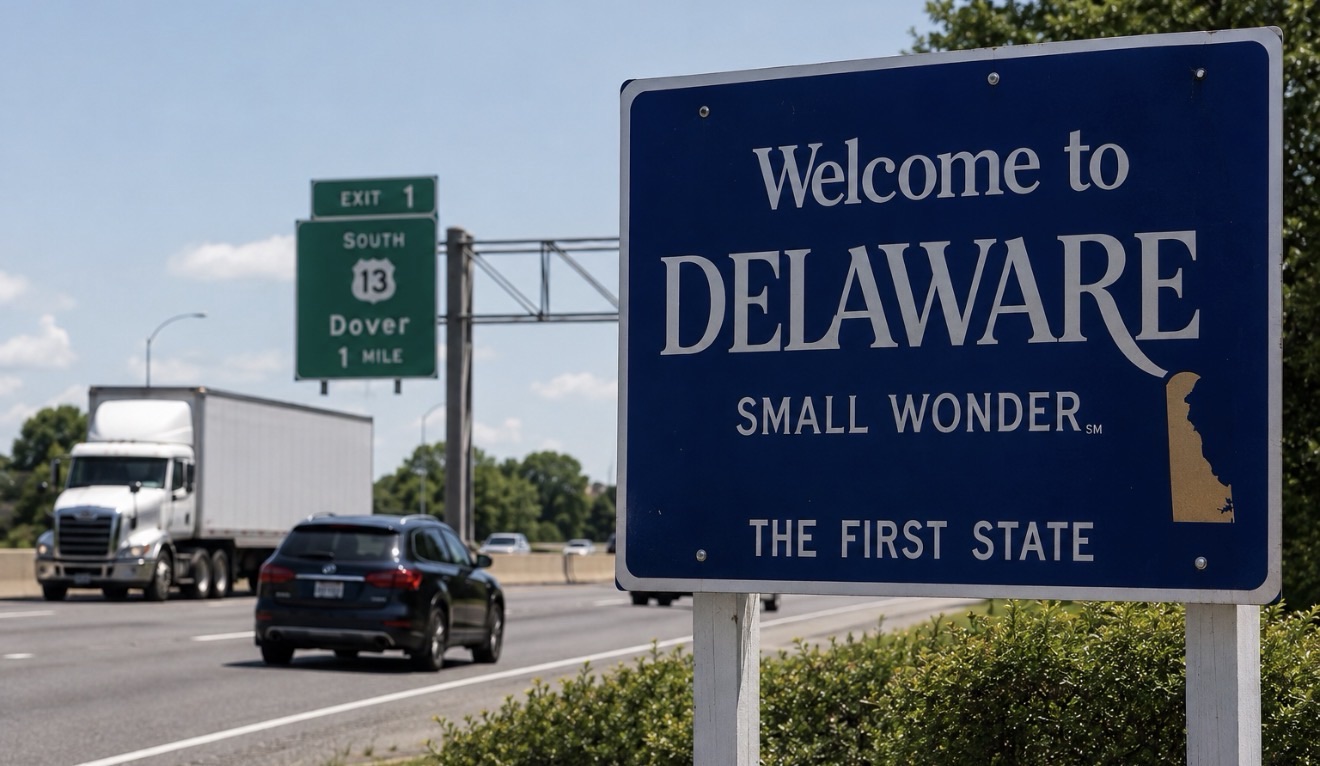

For more than a century, Delaware was the automatic choice for corporate America. Build a major company, prepare for an IPO or create a complex corporate structure, and Delaware was where you incorporated.
That assumption is breaking.
More than 60 public companies worth a combined $3 trillion-plus have left Delaware over the past two years, with Texas and Nevada emerging as the biggest challengers. The departures are no longer a handful of angry founders. They are becoming a measurable shift in where American companies choose to put their legal home.
And the list is still growing. DoorDash disclosed Tuesday that shareholders controlling 54.2% of its voting power approved moving the company from Delaware to Nevada. Its board unanimously supported the move, saying Nevada offered a more predictable, statute-based legal environment.
A company’s state of incorporation has little to do with where its offices or employees are located. It determines something potentially more important: which laws govern the company and which courts decide fights over mergers, executive compensation, shareholders and board decisions.
For decades, Delaware dominated because companies knew what they were getting. Its specialized Court of Chancery and enormous body of corporate case law gave boards, investors and lawyers something businesses value enormously: predictability.
Then Elon Musk helped turn that advantage into a national debate.
In 2024, Delaware’s Court of Chancery voided Musk’s roughly $56 billion Tesla compensation package. Tesla subsequently moved its incorporation to Texas, and other prominent companies began reconsidering Delaware as well.
Coinbase, Roblox, Dropbox and Simon Property Group are among the companies that have moved or pursued moves away from Delaware. Bill Ackman’s Pershing Square shifted to Nevada, while companies tied to the Dolan family — including AMC Networks, Madison Square Garden Sports and others — also chose Nevada.
Now the movement is showing up beyond companies already incorporated in Delaware.
ExxonMobil chose Texas as its new corporate home in March, moving from New Jersey rather than Delaware. That distinction matters: Texas is no longer merely competing for companies angry with Delaware. It is competing to become the first choice for corporate incorporation itself.
The battle is particularly important among new public companies.
For years, Delaware dominated U.S. IPO incorporations. That advantage has weakened as founders, boards and venture investors increasingly consider Texas and Nevada before a company ever reaches the stock market.
The reasons are straightforward.
Companies leaving Delaware frequently point to litigation risk, legal uncertainty, director liability and costs. Founder-controlled companies have been especially willing to move because they are more exposed to lawsuits challenging executive compensation and transactions involving controlling shareholders.
Texas and Nevada saw an opportunity and moved quickly.
Texas created a specialized Business Court for complex commercial disputes and adopted corporate rules designed to give management greater protection and make shareholder litigation more difficult. Texas can now restrict some lawsuits from smaller shareholders and offers companies mechanisms designed to keep internal corporate disputes inside its own courts.
Nevada has built its pitch around strong statutory protections for directors and officers and a corporate-law system that gives judges less room to second-guess management.
In other words, both states are selling something Delaware once owned almost exclusively: certainty.
Delaware has fought back.
In 2025, lawmakers passed Senate Bill 21, one of the biggest changes to the state’s corporate law in decades, providing companies and controlling shareholders clearer protections for conflicted transactions and limiting some avenues shareholders previously used to challenge corporate decisions.
But the departures have continued.
That does not mean Delaware is finished.
Its greatest advantage remains extraordinarily difficult to copy: generations of corporate case law. Lawyers can often predict how a Delaware court will treat a merger agreement, shareholder dispute or complicated contract because similar cases have already been decided.
Texas and Nevada simply do not yet have that depth.
A board leaving Delaware may therefore gain stronger statutory protection while giving up some legal predictability.
That trade-off is increasingly becoming part of investor negotiations.
Institutional investors and venture firms are paying closer attention to incorporation because the choice can determine how much power shareholders have if something goes wrong. What once amounted to routine paperwork is becoming a governance decision that founders may have to defend.
And Texas is aiming much higher than incorporation.
The state has been building a broader financial ecosystem to challenge traditional centers of American finance. The Texas Stock Exchange began operating as a trading venue in July, while Nasdaq and the New York Stock Exchange have expanded their Texas presence. Texas also surpassed California this year as the state with the most Fortune 500 headquarters.
The bigger threat to Delaware, therefore, is not simply the companies that have already left.
It is the companies that never arrive.
Every startup incorporated in Nevada, every founder choosing Texas and every IPO that skips Delaware weakens an advantage the state spent more than a century building.
Delaware remains America’s corporate capital.
But for the first time in generations, it has serious competition.
And $3 trillion worth of departing companies is difficult to dismiss as noise.
JBizNews Desk | New York
© JBizNews.com All Rights Reserved. Reproduction or distribution without written permission is prohibited.