
 Vos Iz Neias
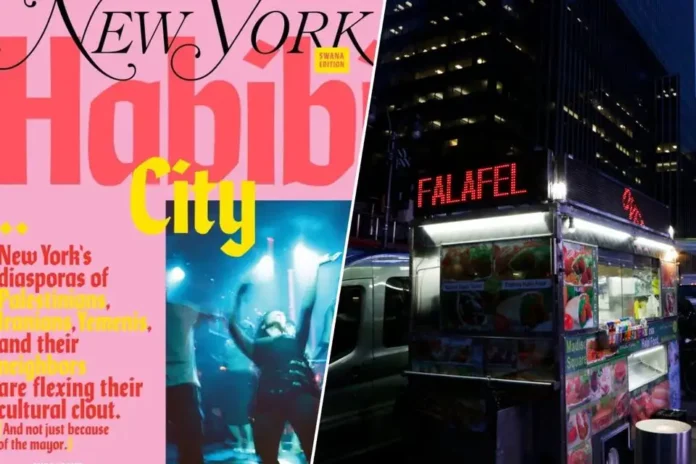
New York Magazine Special Issue Sparks Backlash Over Portrayal of Zionism and Israel
NEW YORK (VINnews) — A special edition of New York Magazine celebrating the rise of Arab and Muslim culture in New York has drawn sharp criticism from Jewish organizations, pro-Israel advocates and former contributors, who argue that the publication portrays Zionism as a form of oppression, embraces allegations that Israel is committing genocide in Gaza, and erases the history of Jews from the Middle East and North Africa.
The issue, titled “Habibi City,” features a six-part series exploring the South West Asian and North African (SWANA) community in New York. In its introduction, the magazine states that while the community has long been present, “over the past decade, and particularly following the war in Gaza, a new generation of artists, chefs, comedians, designers and others has built unprecedented cultural and political capital.” According to the editors, this cultural renaissance was “born out of the pain of the genocide in Gaza.”
The cover essay, written by author Zaina Arafat, presents the aftermath of October 7 primarily as the catalyst for the community’s political and cultural awakening rather than focusing on the Hamas massacre itself.
“In the months after October 7, we became more visible,” Arafat wrote. “We protested, boycotted and wrote opinion pieces. Slowly, out of that resistance, a cultural ecosystem began to flourish. Protests led to friendships, friendships led to dinner parties, and those led to new creative collaborations.”
Arafat argues that belonging to the SWANA community means embracing a shared set of beliefs, including that Palestinians deserve human rights, that Israel’s military campaign in Gaza constitutes “genocide,” and that social justice should take precedence over capitalist values.
Toward the end of the essay, she writes that members of the community continue to confront “xenophobia, Islamophobia and Zionism, along with the consequences of speaking out against them.” Critics say placing Zionism alongside prejudice and discrimination crossed a significant line.
The American Israel Public Affairs Committee (AIPAC) rejected that characterization, stating that equating Zionism with xenophobia and Islamophobia is fundamentally inaccurate.
“Xenophobia and Islamophobia are forms of prejudice directed at people because of their identity, ethnicity, nationality or religion,” the organization said. “Zionism is not. Zionism is the Jewish people’s movement for self-determination and the establishment of a state in its ancestral homeland.”
The controversy also extended to one of the issue’s food features, which examined Arab, Iranian and Israeli restaurants in New York.
Discussing Israeli cuisine, the article stated that its most popular dishes were Middle Eastern, Arab and North African in origin, noting that some were brought by Jewish immigrants while many were Palestinian. It also quoted an Israeli food editor who had previously argued that Israeli cuisine is based primarily on Palestinian and various Jewish diaspora culinary traditions.
The article further claimed that Israeli chefs in New York had long been able to promote their identity more freely than restaurateurs from other parts of the Middle East, particularly in the years following the September 11 attacks, allowing them to charge premium prices.
Former employees of the Israeli restaurants K’Far and Laser Wolf described the establishments as “safe spaces for Zionism.” One former employee alleged hearing customers say, “We should bomb them all from the air,” adding that the atmosphere struck him as “bloodthirsty.” Another claimed, “I realized everything we were doing was propaganda.”
A Palestinian restaurant owner argued that some Israeli restaurateurs are now distancing themselves from explicitly identifying their cuisine as Israeli because of Israel’s actions in Gaza.
“We’re expressing our national identity more openly, while they’re trying to identify less with theirs because their country is committing genocide,” she was quoted as saying. “If they want to distance themselves from that, it says everything.”
The Palestinian restaurant Ayat received favorable coverage despite featuring a tourist map labeling all of Israel as “Palestine.”
A consultant involved in preparing the food feature later told the New York Post that it amounted to “a hit piece against Jewish and Israeli chefs disguised as an article about Middle Eastern food and culture,” criticizing the magazine’s fact-checking process as deeply flawed.
The advocacy group End Jew Hatred described the issue as “dangerous,” arguing that it increasingly defines belonging to the Middle East according to one’s political position on Gaza while effectively excluding Mizrahi Jews whose families lived throughout the Middle East and North Africa for generations.
The organization also criticized the issue’s treatment of October 7, saying it highlighted the growth of pro-Palestinian activism without acknowledging “the massacre of Jews that actually occurred that day” or the ongoing threats posed by Hamas, Iran and Iranian-backed terrorist organizations.
“Jewish identity is not theirs to erase, and Jewish history will not be rewritten to fit a political narrative,” the group said.
Attorney Abraham Hamra, a Syrian-born Jew living in New York, argued that excluding more than 120,000 New Yorkers of Middle Eastern Jewish heritage from the region’s story “is not an accidental omission, it is exclusion disguised as inclusion.”
“As a Syrian Jew, I know what cultural erasure looks like,” he said.
Former New York Magazine contributor Jordana Horn announced she had canceled her subscription in protest.
“You are deliberately fueling hostility toward Jews in this city,” she wrote. “I have no intention of helping finance it.”
Jewish publication Tablet Magazine summarized the criticism with a pointed observation: “If you don’t believe Israel committed genocide, then, according to this issue, you’re not Middle Eastern.”