
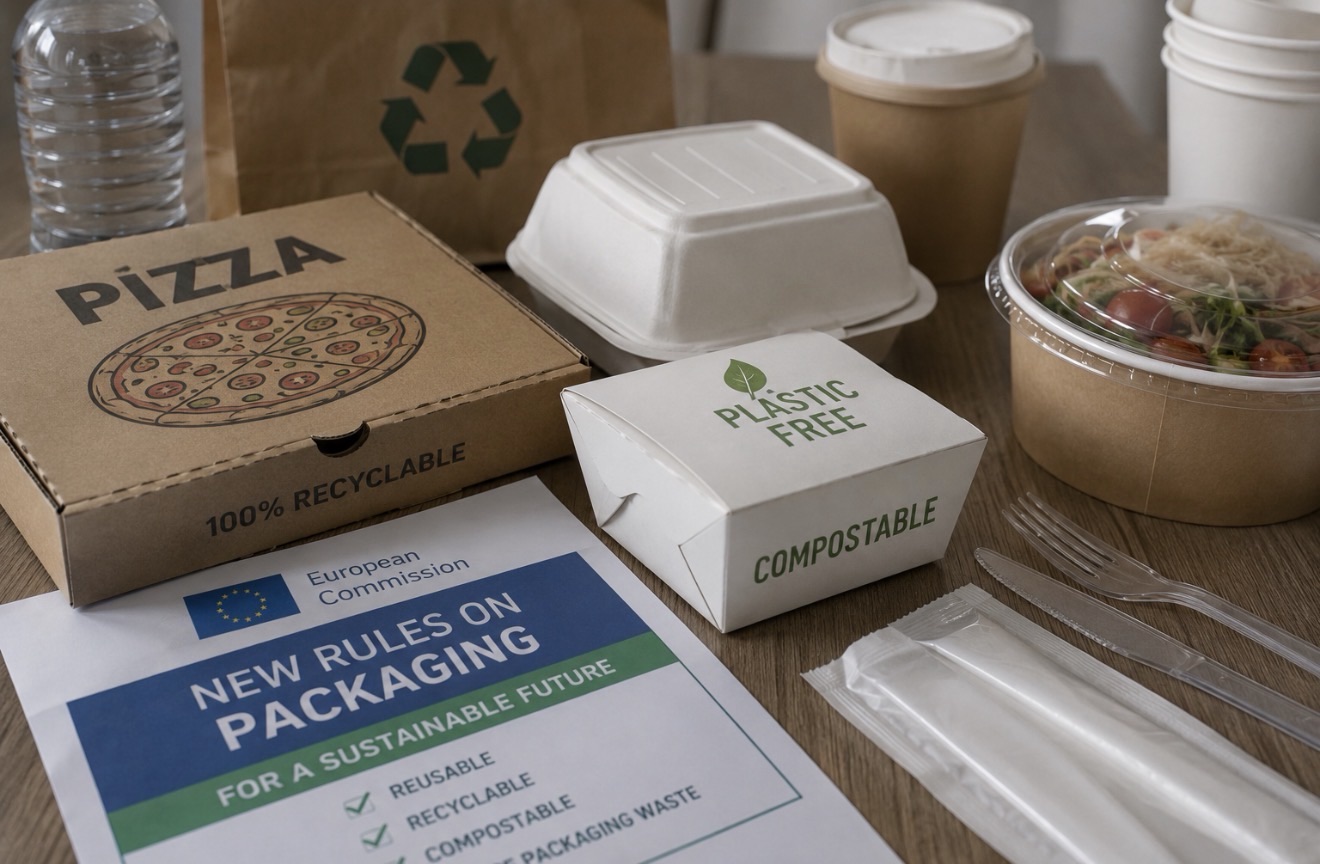

Starting Wednesday, the grease-resistant coating on a pizza box sold anywhere in the European Union has to meet a chemical limit that did not exist the day before — the first piece of a law that will eventually reach every package placed on the EU market, including those shipped in from the United States.
The Packaging and Packaging Waste Regulation takes effect Aug. 12, setting bloc-wide caps on PFAS, the so-called forever chemicals, in food-contact packaging, along with targets to cut waste, particularly oil-derived plastics. Manufacturers must also supply information letting authorities trace packaging back to its source if problems surface.
PFAS are in food packaging for a practical reason. The chemicals repel water and grease, which is why they have been used in takeaway containers, bakery paper and pizza boxes. They also show up in fast-food wrappers and microwave popcorn bags. They do not break down naturally, can contaminate water, air, soil and food, and researchers have linked their accumulation in humans to several cancers, kidney disease, immune disorders, pregnancy complications and developmental problems in infants.
The scale of what the law is trying to fix explains its reach. Packaging waste in the EU has risen more than 20% over the past decade, driven by online shopping and grab-and-go habits, and packaging accounts for roughly 40% of Europe’s plastic consumption — a dependence an EU official described as an economic vulnerability to major oil disruptions such as the Iran war. Europeans generate 180 kilograms of packaging waste per person annually, of which 35.3 kilograms was fossil-fuel-derived plastic, and only 42% was recycled in 2023. Without action, packaging waste was projected to grow 19% by 2030, with plastic packaging waste up as much as 46%.
For American exporters, the important structural point is that this is a regulation rather than a directive. It applies directly in all 27 member states with no national transposition, replacing a framework that let individual countries interpret obligations differently, and it covers any business inside or outside the EU that sells packaged goods into the bloc. A U.S. food manufacturer no longer faces 27 versions of the rules — it faces one, and compliance is not optional for market access.
The heaviest requirements are still ahead. A new EU-wide waste-sorting label arrives in 2028, and the most consequential measures land in 2030. The bloc is targeting a 5% waste cut by 2030 and 15% by 2040 against 2018 levels, with packaging required to be recyclable in an economically viable way, reuse targets, bans on certain single-use formats, a ceiling on empty space inside packages, and mandatory deposit-return schemes for cans and plastic bottles. Minimum recycled-content requirements for plastic packaging also begin Jan. 1, 2030, and member states must collect at least 90% of single-use plastic bottles and metal beverage containers by 2029.
The law progressively bans packaging judged excessive — double-bottom overwraps, boxes inside boxes, individual mini-portions and hard-to-recycle multilayer plastics — and prohibits single-use plastic packaging for fruits and vegetables that can be sold loose.
Brussels is signaling a soft landing on enforcement. The EU official said non-compliant products should not be pulled immediately and that member states should issue warnings rather than penalties, giving companies time to correct problems. The Commission will open a consultation on harmonized sorting labels later this year.
The commercial effect is a supply-chain problem before it is a legal one. Removing PFAS from a grease-resistant container means requalifying the barrier material, which changes how the box performs with hot food, how it runs through converting equipment, and what it costs. Companies selling into Europe need to redesign product lines, validate recyclability and adopt PFAS-free barriers to keep market access. Suppliers of bagasse, molded fiber and coated paperboard alternatives stand to gain; converters running legacy fluorochemical coatings do not.
A separate EU law regulating plastic waste exports took effect in May, aimed at ensuring the material is handled sustainably. Much of Europe’s plastic waste has been shipped to third countries for decades, and often dumped.
The regulation formally entered into force in February 2025, giving industry an 18-month runway before the first obligations bite this week.
JBizNews Desk | Brussels
© JBizNews.com All Rights Reserved. Reproduction or distribution without written permission is prohibited.