
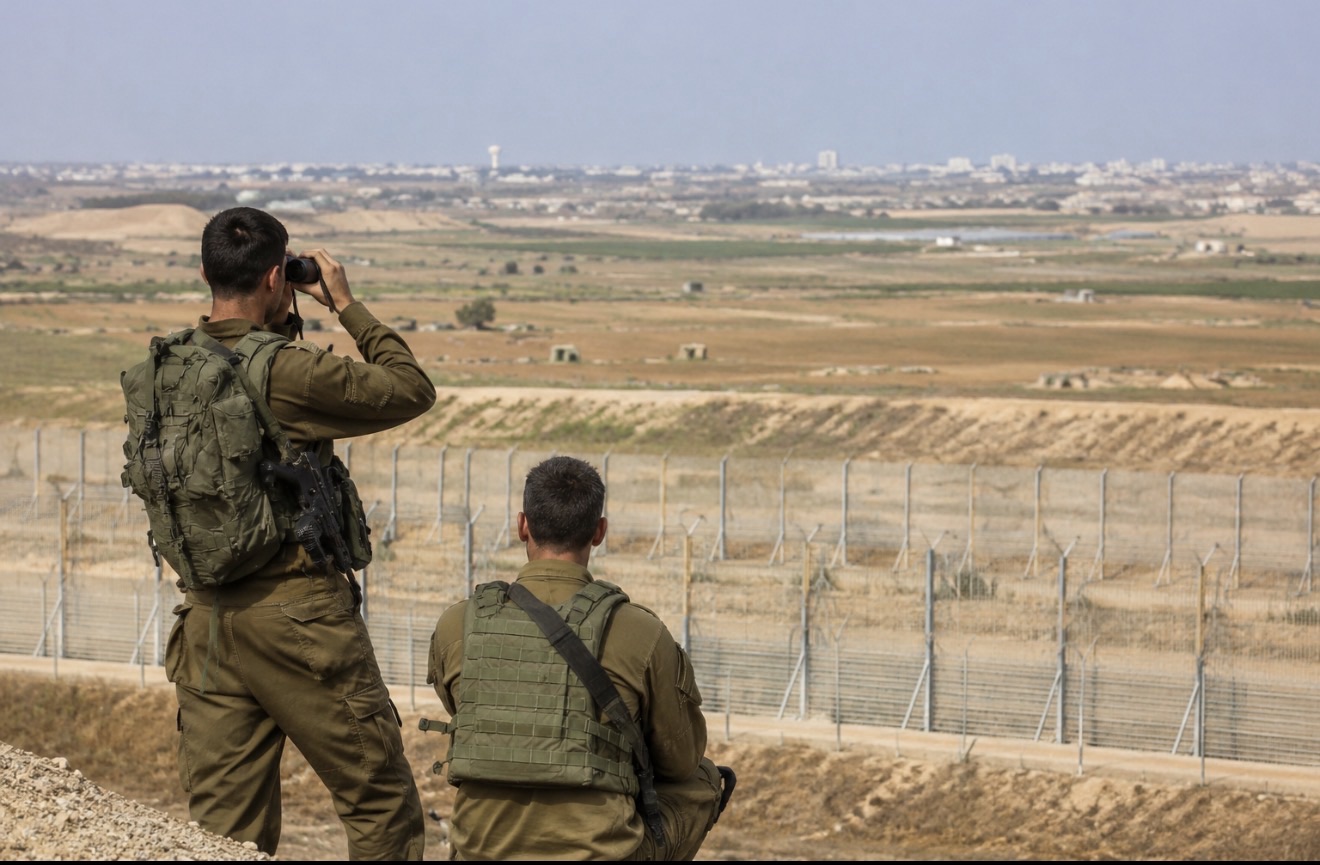

Israeli soldiers whose job is to sit and watch the Gaza border said Thursday that they are seeing armed men move freely and plant explosives on the Hamas side of the line — and that nothing is being done with what they report. Several told Channel 12 the feeling is the same one they had in the months before the October 7, 2023, attack, when their warnings went nowhere.
The line they are watching is the Yellow Line, the boundary drawn under the October 2025 ceasefire that splits Gaza between the area Israeli forces hold and the area Hamas still controls. Israeli troops sit on one side of it. The soldiers say armed operatives on the other side have worked out that they will not be fired on, and are testing that boundary a little further each day.
The complaint carries particular weight because of who is making it. The lookouts, known in Hebrew as tatzpitaniyot, are mostly young women serving in IDF Unit 414. Before October 7 they repeatedly flagged Hamas fighters rehearsing an assault, and were dismissed; some of them later said the fact that they were women was part of why. Five of them were killed and seven taken captive when Hamas overran the Nahal Oz base that morning. Noa Marciano was killed in captivity, Ori Megidish was rescued by troops, and the remaining five came home in later ceasefire exchanges.
Their frustration now is the same. One soldier said she feels helpless watching activity she cannot stop. Another questioned the point of monitoring a screen for eight hours a day if nothing follows from what she identifies. Others said their bigger worry is for the combat troops posted only a few hundred meters from the men they are watching.
The restraint they are running into is deliberate, and it is diplomatic rather than military. Israel quietly stopped striking in Gaza for more than a week while the United States pressed a plan to disarm Hamas. That pause ended Wednesday with a strike on a Hamas commander in northern Gaza. Strikes widened Thursday: the IDF said it killed a Hamas company commander, identified in Palestinian media as Hudhaifa Kawarea, in a hit on a motorcycle west of Khan Younis, and a second strike in Gaza City killed Jamal Abu Kamil, head of police for the Gaza City district, whom the army said took part in the October 7 invasion.
What is meant to fix the situation on the border is the disarmament plan itself, and next week it gets its most senior push yet. A Board of Peace official said Jared Kushner, board high representative Nickolay Mladenov and executive board member Tony Blair are due to land in Israel on Sunday, Aug. 16, before traveling to Cairo, where the Palestinian technocratic committee slated to administer Gaza has been meeting for months. The date is not yet locked down.
The trip has two goals. The first is to get Israel to reinstate its halt on strikes and to meet the humanitarian obligations it took on in the October 2025 ceasefire. Once that happens, the Board of Peace believes it can go to Hamas and start collecting weapons.
The obstacle is political. Hamas accepted the 15-point disarmament framework two weeks ago. Netanyahu then rejected it publicly, saying Israeli forces will not pull back any further until Hamas has actually given up its weapons. Board of Peace officials have signaled they are watching Israeli conduct rather than Israeli speeches, noting that the strikes had in fact stopped. An Arab diplomat familiar with the talks doubts real movement is possible until Netanyahu walks the rejection back, which is improbable with Israel’s election set for October 27.
The commercial stakes sit behind all of it, because reconstruction money does not move until the security question is settled. One piece did move Thursday: EU foreign policy chief Kaja Kallas said Israel has extended the mandate for the bloc’s monitoring mission at the Rafah crossing between Gaza and Egypt through the end of June 2027, along with an EU program that trains Palestinian police and advises on rebuilding Gaza’s court system. The mission, staffed by police from Italy, Spain and France, was set up in 2005, shelved for nearly two decades after Hamas seized Gaza in 2007, and restarted in February. More than 10,000 people have crossed since. Israel had let the authorization lapse in late June as relations with Brussels soured over the war.
For the soldiers on the border, none of that changes the view on the screen. They are watching a line that is being probed daily, under orders that keep them from responding — and saying out loud that they have seen this pattern before.
JBizNews Desk | Jerusalem
© JBizNews.com All Rights Reserved. Reproduction or distribution without written permission is prohibited.