
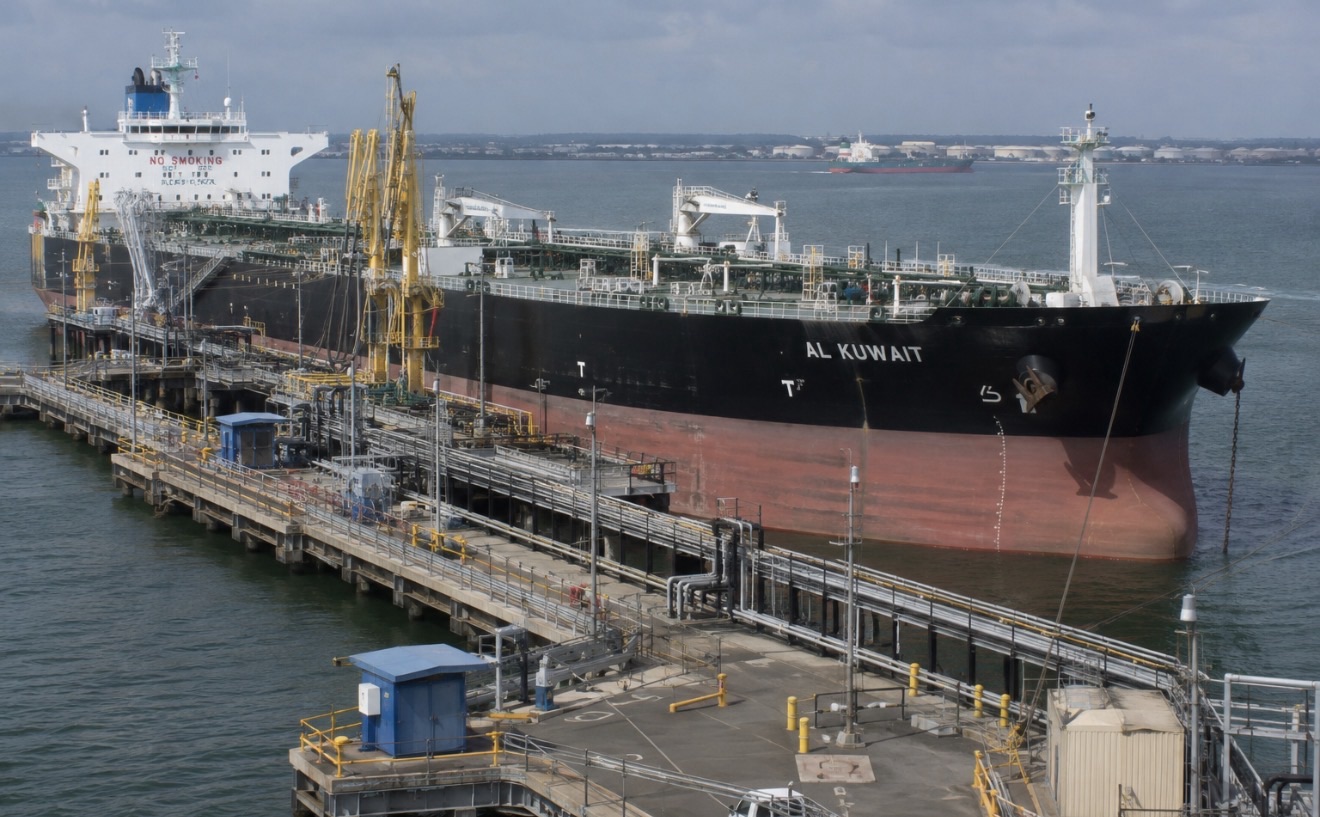

Crude oil from the Middle East is landing on American docks again for the first time in months, and the barrels have already shown up in the government’s books. U.S. crude imports averaged 7.3 million barrels a day in the week ended Aug. 7, up 1.14 million barrels a day from the week before — enough to push commercial crude inventories 17.4 million barrels higher, to 424.4 million, the largest one-week build since January 2023 against a market that had been looking for a small drawdown.
Put in everyday terms, the country took in roughly an extra day’s worth of refinery feedstock in a single week, after months of running the tanks down.
One of those cargoes came ashore in the tri-state area. The Liberia-flagged tanker Aqualoyalty, chartered by New Jersey refiner PBF Energy, loaded at Egypt’s Sidi Kerir terminal and unloaded about 750,000 barrels at Paulsboro, New Jersey. The supertanker Front Gaula took on Saudi crude at the Red Sea port of Yanbu and sailed for the United States by way of the Suez Canal.
Getting Saudi oil to America now takes a detour that would have made no sense two years ago. Instead of loading on the Persian Gulf side and running the Strait of Hormuz, Saudi Arabia pipes crude across the country on its East-West line to Yanbu on the Red Sea and ships it out from there. A fully loaded supertanker cannot fit through the Suez Canal, so the vessel offloads part of its cargo into Egypt’s SUMED pipeline on the Red Sea side, sails through light, and picks the barrels back up on the Mediterranean side. It is slower and costlier than the old route, and it works.
The other source of the surge was a window that opened and closed. A memorandum signed by Washington and Tehran in June briefly freed vessels that had been penned up at Hormuz, and American refiners and traders bought what came out. Combined with the Yanbu route, that puts U.S. imports of Middle Eastern crude on track for roughly 600,000 barrels a day this month, the most since the war started.
That figure is worth keeping in proportion. The United States averaged 490,000 barrels a day of Middle East Gulf crude in 2025, about 8% of its total crude imports — closer to 1 barrel in 13. Even at this month’s higher pace, Gulf oil is a supporting player in American supply, not the main event. What it does supply is a specific grade: medium sour crude that Gulf Coast and West Coast refineries are built to run, with the West Coast taking nearly half of it because it has little pipeline access to Canadian barrels.
The relief is real but uneven. Gasoline stockpiles fell by about a million barrels in the same week, to 208.7 million, and remain 6% under their five-year average, with distillate — diesel and heating oil — running roughly 12% under. Refineries were operating at 96.2% of capacity, which is close to flat out. Crude is arriving faster than the plants can turn it into fuel, so the surplus is sitting in tanks rather than showing up at the pump.
Prices moved the way the numbers suggest. Brent was near $88.52 a barrel when the inventory report landed and West Texas Intermediate was around $82.76, and crude slipped toward $82 on Thursday, ending a five-day advance. The International Energy Agency still sees the world short about 1.8 million barrels a day this quarter. A full American storage tank does not fix a global shortfall; it buys American refiners time.
The traffic is also running in the other direction. At least two dozen empty supertankers have been signaling U.S. ports as their destination, coming to load American crude for buyers in Asia and Europe who lost their usual Gulf barrels. Redirecting Saudi cargoes to the United States has tightened supply for Asian refiners, who have turned to U.S. oil to fill the hole. U.S. crude exports actually fell 627,000 barrels a day in the same reporting week, which is part of why the domestic build was so large.
Whether the flow holds depends on the strait. Gulf crude and condensate exports were still running about 40% below pre-war levels in July, at roughly 10.7 million barrels a day, with traffic through Hormuz and Bab el-Mandeb well under normal and attacks on vessels increasing. Talks on reopening the waterway remain stuck, and the administration is moving toward tighter sanctions and continued enforcement of the naval blockade on Iranian ports.
For now, the practical answer for American refiners is the one already on the water: buy the barrels that can reach the open sea without passing Iran, pay the extra freight and canal costs to move them the long way around, and keep the tanks full while the window is open. Paulsboro got its cargo. The next one is a longer sail than it used to be.
JBizNews Desk | New York
© JBizNews.com All Rights Reserved. Reproduction or distribution without written permission is prohibited.