
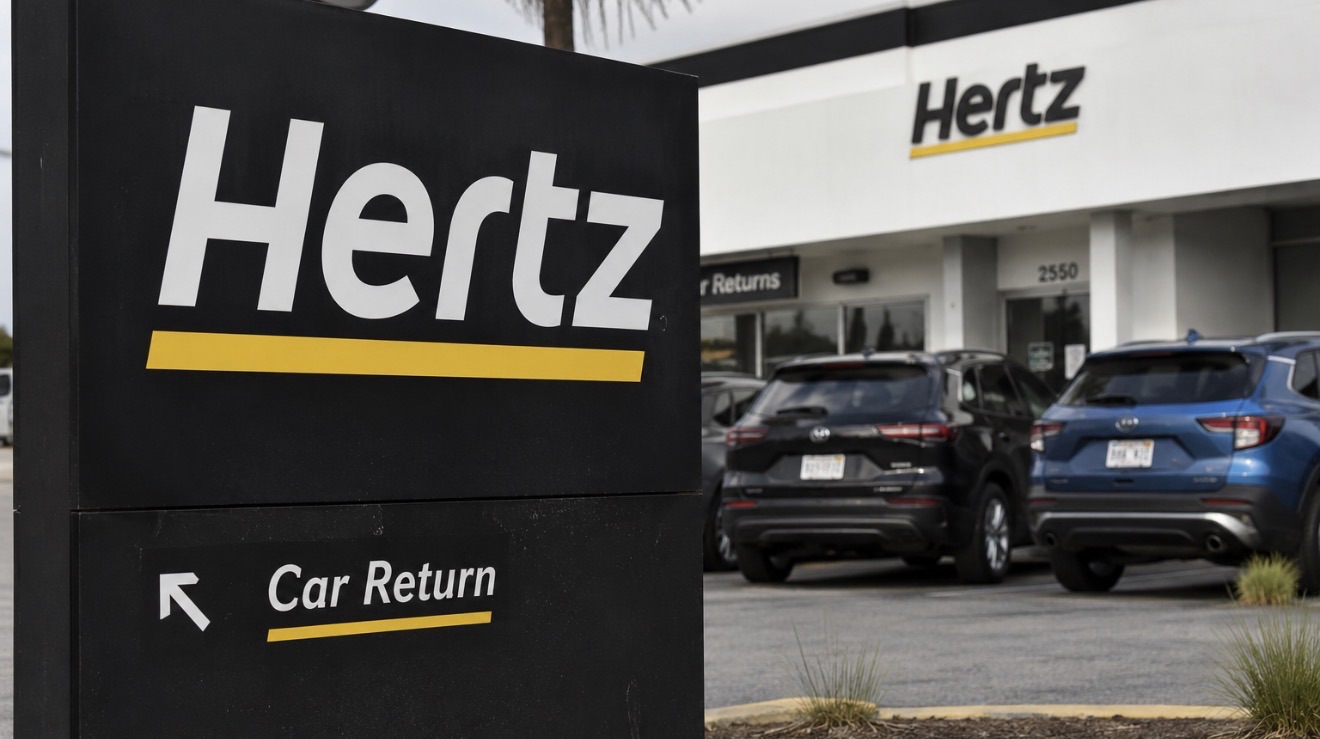

Hertz Global Holdings closed Thursday at $2.47, down almost 12%, after Bill Ackman’s Pershing Square Capital Management disclosed it had sold out of the car-rental company entirely. The stock was off as much as 16% during the session, wiping out an earlier gain. The decline put Hertz’s market value under $1 billion.
The disclosure came in Pershing Square’s interim report published Thursday, which said the firm exited Hertz in July. The sale itself is a month old. The market only learned of it Thursday morning, which is why a stale trade moved the stock.
The reason Ackman gave is more damaging than the sale. On a call Thursday, he said the firm closed the position after Hertz’s June equity offering of roughly 37 million shares priced at $2.70 and tied to exchangeable notes, calling the deal bungled and unnecessary. Chief Investment Officer Ryan Israel said Pershing lost confidence in management after a funding plan the firm did not think was needed, adding that it was unlike anything they had seen a company do. Pershing’s position was that Hertz had just posted solid first- and second-quarter results with strong liquidity, which made an overnight share sale on poor terms hard to explain. Ackman and Israel said they still like the operating team; the objection is to how management handles capital.
That distinction matters, because the operating numbers have been improving. Hertz reported second-quarter revenue of $2.4 billion against a $2.28 billion estimate, an adjusted loss of 11 cents a share where analysts looked for a 24-cent loss, and fleet utilization up 80 basis points to 79% on a 1% smaller fleet. Adjusted corporate EBITDA came in at $81 million, up from $18 million a year earlier and above the top of management’s revised guidance. Renting out a slightly smaller fleet slightly more of the time is exactly the lever a rental company has, and Hertz pulled it.
The June sequence is what broke the relationship. On June 24 the stock fell 41% after the company cut its second-quarter EBITDA guidance to a range of $50 million to $80 million, blaming weak used-car prices — a direct hit, since Hertz continually sells vehicles out of its fleet and falling resale values land straight in earnings. Alongside that, the company unveiled a $400 million financing package of $300 million in convertible senior notes and a $100 million common stock offering, with more than 37 million shares made available for hedging. Investors read that as dilution arriving at the worst possible price and sold.
Ackman’s complaint, in plain terms: the company raised equity cheap while telling the market its business was getting better, and did it in a structure that put a large block of borrowed stock into hedging hands. Thursday’s close sits 8.5% below the $2.70 offering price — meaning the buyers of that deal are also underwater.
The size of the position is worth keeping straight. Pershing held 15.2 million shares, about 5.84% of Hertz’s stock and the tenth-largest holding in its portfolio, but only about 0.27% of the firm’s equity book — roughly one dollar in every 370 Ackman manages. Against near $2.4 billion positions in Brookfield and Amazon, Hertz was a rounding error. It still cost him: the report showed Hertz subtracting 1.1% from Pershing’s gross performance this year through Aug. 11, one of the fund’s worst names. A small stake can do outsized damage when it falls far enough.
For Hertz, the arithmetic runs the other way. Losing a holder of one in every seventeen shares removes the most visible name on the register, and it interrupted something the company badly needed. The stock had been rallying on the earnings beat and on heavy short interest, a combination retail buyers had been pressing. Shares failed to clear $3 and reversed below $2.50, leaving the stock down roughly 52% for the year.
The balance sheet is where the real question sits. Hertz reported $984 million in liquidity, close to the entire market value of its equity — but fleet financing, the revolving credit line and secured noteholders all rank ahead of shareholders for that money. Equity holders are last in line, which makes the stock a bet on recovery rather than a claim on cash.
Management’s own outlook implies the second half has to do the heavy lifting. The company guided to adjusted corporate EBITDA of $275 million to $325 million for the third quarter with positive earnings per share, against a full-year range of $225 million to $275 million. A full-year target below a single quarter’s target only works if the first half was in the hole, which it was. Everything now depends on used-car prices holding up and on the summer rental season delivering. Ackman decided in July he did not want to wait and find out.
JBizNews Desk | Wall Street
© JBizNews.com All Rights Reserved. Reproduction or distribution without written permission is prohibited.