
 JBizNews
Ukraine Claims Strike on Novatek Fuel Plant at Russia’s Ust-Luga Port
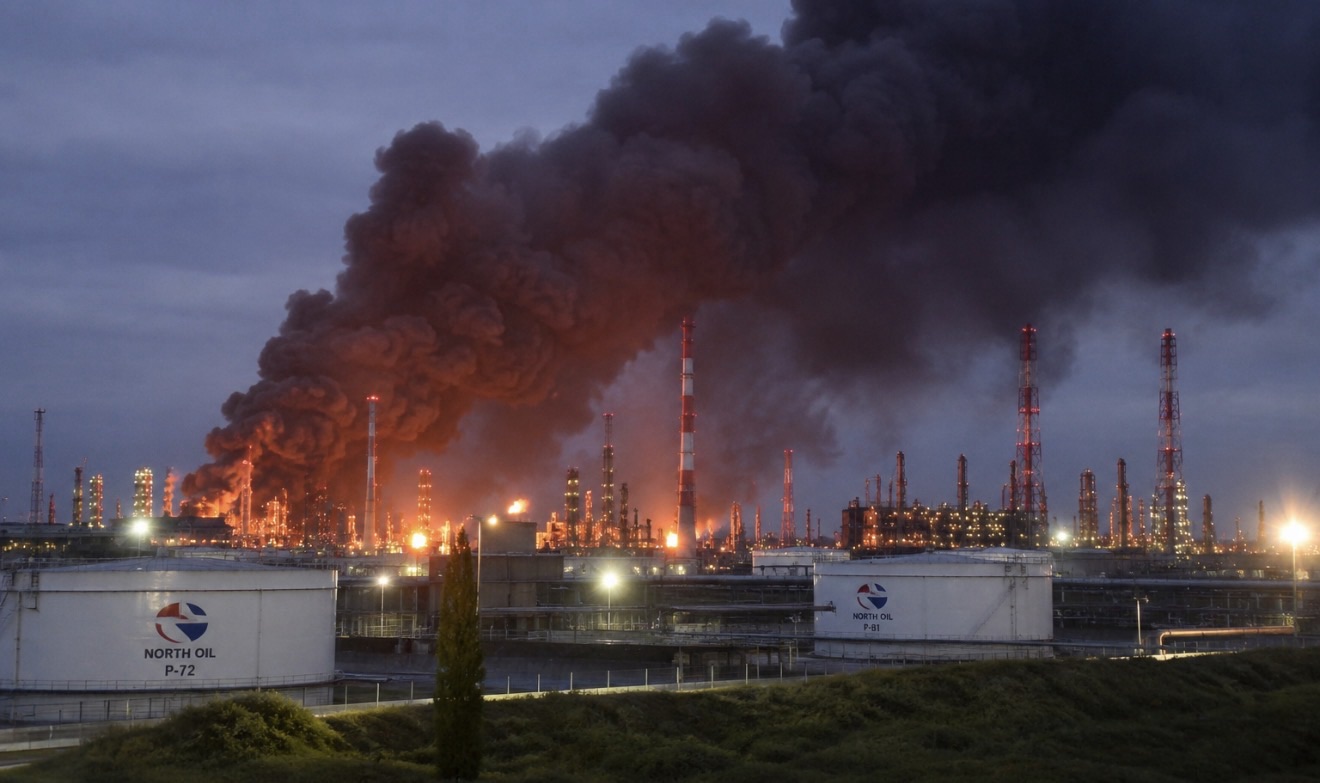
Ukrainian drones struck one of Russia’s biggest fuel-processing plants overnight into Friday, and the damage lands on a global market that already has no spare fuel to give. Ukraine’s General Staff said its forces hit the NOVATEK-Ust-Luga complex at Slobodka in Russia’s Leningrad Oblast, reporting a fire at the site and, on preliminary information, two processing units struck.
What that plant does is simple enough. Gas condensate — a light liquid that comes out of the ground alongside natural gas — arrives by pipeline from Siberia. The complex splits it into naphtha, jet fuel, gasoil and heavy fuel oil, then loads the finished product onto ships bound for foreign buyers. Its capacity runs to nearly 8 million metric tons of raw material a year, split across three processing units of roughly 3 million tons each. Knock out two of the three and roughly two-thirds of the plant’s output stops moving.
Russian officials described a night of heavy drone activity without confirming which building burned. Leningrad Oblast Governor Alexander Drozdenko said air defenses downed 51 drones over the region and that damage was recorded at the port, with firefighters responding; by morning he put the regional tally at 54. Moscow Mayor Sergei Sobyanin said 10 more were downed approaching the capital, with no casualties reported in either place.
This was not a one-off. It marks the sixth strike on Ust-Luga since March, following the first major hit on the NOVATEK complex overnight on 24–25 March and repeat waves on 27, 29 and 31 March, plus a July raid that reached the wider St. Petersburg port area. It also came two days after Ukrainian drones hit the Sheskharis terminal at Novorossiysk on the Black Sea.
The reason a fire in northwest Russia shows up on an American receipt is arithmetic. Ust-Luga is Russia’s largest Baltic port and handled 47.4% of the Baltic basin’s cargo turnover as of January 2026, and together with Primorsk it normally moves about 40% of Russia’s seaborne oil exports. Call it two barrels in every five that Russia ships by sea.
Russia has spent this year losing the ability to turn its own crude into usable fuel. Ukrainian strikes have driven Russian crude processing to its lowest level since 2005, forcing Moscow to halt exports of gasoline, jet fuel and diesel and to start importing fuel to cover its own drivers. The barrels Russia used to sell as finished diesel now have to come from somewhere else, and that somewhere else is already stretched thin by the Iran conflict and the Hormuz bottleneck.
The strain is visible in the data. Global refinery crude runs stood at 80.9 million barrels a day in July, nearly 5 million below a year earlier, and the International Energy Agency reported that tighter light and middle distillate markets pushed Atlantic Basin refining margins to record highs. The agency now projects a 1.8 million barrel-a-day oil deficit for the current quarter. Crude itself has been the calmer part of the story: Brent traded near $87 a barrel on Friday and West Texas Intermediate near $81. The squeeze is in the refined fuel, not the raw material.
American households are already paying for it. Gasoline averaged $4 a gallon and diesel $5.40 in the second week of August, both record seasonal highs, against $3.20 and $3.70 respectively a year ago. Gasoline is up roughly one dollar in four from last summer. Diesel is up close to half again — the fuel that moves groceries to the shelf, packages to the door and produce out of the field. Trucking companies do not absorb that; it arrives later as a slightly higher price on almost everything hauled.
There are offsets in motion. Refiners in the United States, India and the Middle East are picking up export business that Russia can no longer serve. American forces have expanded tanker escort capacity through the Strait of Hormuz, with Washington estimating as much as 9 million barrels a day still transiting the waterway, and US crude inventories jumped 17.4 million barrels last week. Both the IEA and OPEC have trimmed their demand forecasts, with OPEC cutting 2026 growth to 580,000 barrels a day in its fourth straight downward revision — high prices doing their usual work of cooling consumption. The Energy Department expects gasoline and diesel to ease later this year, though it still forecasts levels well above seasonal norms.
Repair timelines are the variable that matters next. After earlier strikes on this same complex, a single damaged unit took weeks to restart and the worst-hit equipment took months. Until those units are running, the barrels Ust-Luga was supposed to send to market simply are not there, and the American diesel pump keeps carrying the difference.
JBizNews Desk | New York
© JBizNews.com All Rights Reserved. Reproduction or distribution without written permission is prohibited.