
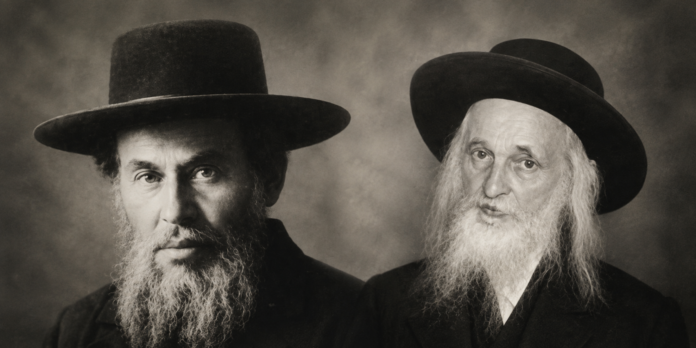

New York (VINNEWS/Rabbi Yair Hoffman) Two of the most important Torah works written in the shadow of the Holocaust ended up in opposite corners. Both were written by talmidei chachamim of the first rank, and both of the authors watched Hungarian and Slovakian Jewry destroyed.
Each one of these Gedolei Torah names an aveirah so serious that in their view the sin accounts for a punishment that has no parallel anywhere in Jewish history.
For The Satmar Rebbe Teitelbaum zt”l, the Satmar Rav, that sin was Zionism. It was the violation of the oaths recorded in Kesubos 111a. For Rav Yissachar Shlomo Teichtal Hy”d, the sin was the opposite one. It was the failure to stir Klal Yisrael to return to Eretz Yisrael, and the active discouragement of that return by Jewish leadership itself.
What follows is an article arranged as twelve numbered arguments culled from their writings.
Rav Yissachar Shlomo Teichtal (1885–1945) was the Rav of Pishtian, known today as Piešťany, in Slovakia. He wrote the teshuvah sefer known as Mishneh Sachir. He came out of the Hungarian-Chassidic world, and for most of his life he opposed the Zionist enterprise.
Then, while hiding in Budapest as Slovakian and afterward Hungarian Jewry were destroyed, and with almost none of his own seforim available to him, he wrote Eim HaBanim Semeichah. It was printed in Budapest in 1943. He was murdered in early 1945 on a transport out of Auschwitz.
The sefer is openly a retraction. He states that when rabbanim admit their mistakes, they are praiseworthy. The halachic authority he argues against by name, again and again and always with great deference, is the Minchas Elazar of Munkacs. He cites him from Divrei HaIggeres and from Teshuvos Minchas Elazar 5:12.
The Satmar Rebbe Teitelbaum (1887–1979) was the Rebbe and Rav of Satmar. After the war he became the leading voice of principled Torah opposition to the State of Israel anywhere in the world. He escaped Hungary in 1944, stayed in Eretz Yisroel for a bit and rebuilt his kehillah in Williamsburg, Brooklyn.
Vayoel Moshe was published in 1961. It contains three ma’amarim, or treatises: Shalosh Shevuos, on the oaths; Yishuv Eretz Yisrael, on settling the Land; and Lashon HaKodesh, on the Hebrew language. The introduction to the sefer compresses the whole theological argument into a few pages.
One difference between the two luminaries: Rav Teichtal wrote in 1943, in hiding, before the State existed and before anyone knew the full scope of the destruction. What he is writing about is permission granted by the nations, not yet a sovereign Jewish government. The Satmar Rebbe wrote after 1948, from America, and what he was facing was an actual state, with its institutions, its elections, and its Chief Rabbinate.
1. What Caused the Churban of European Jewry?
Vayoel Moshe
The Satmar Rebbe opens with a principle drawn from earlier generations. When disaster came, Jews responded by identifying its cause. He points to Rav Yosef Yaavetz, who wrote his sefer Ohr HaChaim after the Spanish Expulsion for exactly that purpose — and he adds a note that this is not the Ohr HaChaim of Rav Chaim ben Attar, who lived centuries later. He then points to his own ancestor, the Chavas Daas, who wrote in the introduction to his commentary on Eichah that there is no point in recounting suffering unless one also names its cause. That is why the Chavas Daas paired every affliction mentioned in Eichah with the sin that produced it.
In this generation, the Satmar Rebbe argues, no such search is necessary, because Chazal already told us what the punishment would be. Kesubos 111a records the oaths that Chazal derive from the repeated adjurations in Shir HaShirim (2:7, 3:5, and 8:4). Klal Yisrael swore not to ascend to the Land as a wall. Klal Yisrael swore not to rebel against the nations. And the nations swore not to oppress Klal Yisrael excessively. The consequence attached to breaking these oaths is that Jewish flesh would be made ownerless, like the gazelles and hinds of the field.
From there he argues from the shape of the punishment itself. Devarim 28:59 warns that Hashem will make the afflictions extraordinary, and The Satmar Rebbe applies that verse to a catastrophe with no precedent. Every earlier persecution came attached to a demand. Convert, or leave, or pay. This one carried no demand at all. Jewish blood was simply declared free for the taking. That, he argues, is precisely the punishment Chazal attached to this one sin and to no other.
Two historical precedents carry much of the weight. The first is the Bnei Ephraim, whom he describes as holy men, and who were destroyed for leaving Mitzrayim ahead of time. The sources are Sanhedrin 92b and Shemos Rabbah 20. What matters to him is that Chazal attribute their destruction to the oaths even though their error was an honest miscalculation of the date. The second is the generation of Ben Koziba, better known as Bar Kochba. That generation was saturated with Torah, and yet its losses exceeded those of the Churban of the Beis HaMikdash itself. He cites the Yerushalmi, which says the pride of Israel was cut off then and will not return until ben David comes, and Shir HaShirim Rabbah on the word hishbati, which ties that catastrophe directly to the violated oath.
Eim HaBanim Semeichah
Rav Teichtal accepts the identical obligation and arrives at the opposite verdict. In his second introduction he describes an exile that has turned into a prison. He invokes Bava Basra 8b on the verse in Yirmiyahu 15:2, where Chazal explain that each fate listed in the verse is worse than the one before it, and that captivity is the worst because it contains all the others. Earlier persecutions, he notes, were regional, and Jews could always find refuge somewhere else. He allows one exception in all of Jewish history: the decree of Haman, described in Esther Rabbah 7, when every gate was closed.
His thesis is stated flatly. The failure to stir Jewish hearts to long for the Land, and to strengthen its settlement, is the cause of the troubles that have come upon us. In his reading this is the sin of the Meraglim happening again — vayim’asu b’eretz chemdah, “they despised the desirable Land,” in Tehillim 106:24.
He then adds a halachic point of unusual force. The Magen Avraham, in his commentary Zayis Ra’anan on Yalkut Shimoni Yisro §292, explains Rabbi Nassan’s derasha on the phrase “those who love Me and keep My commandments” as referring to Jews who live in Eretz Yisrael. Inside the Land, Jews endured harsh decrees rather than leave. Outside the Land, a Jew who does not flee harsh decrees when he is able to flee bears responsibility for his own life. Rav Teichtal applies this directly to his own moment. A refuge exists, and the nations have opened it. Staying in the exile is therefore not the cautious choice at all.
2. Which Oath Is at Issue, and What Did It Say?
This is the argument that is most often reported incorrectly, and precision matters here more than anywhere else. Rav Teichtal does not claim that the oaths are merely aggadah. He does not claim that they lack force because the codes leave them out. He accepts them. But the oath he builds his case on is not one of the famous three.
Eim HaBanim Semeichah
Kesubos 111a actually contains two lists. The first is the list of three oaths, and that is the one everyone quotes. The second is Rabbi Levi’s list of six oaths, which adds three more: that the end not be revealed, that the end not be distanced, and that the secret not be disclosed to the nations. Rav Teichtal works from the second list. Specifically, he works from the oath called shelo yerachaku es haketz — that Klal Yisrael not delay the end.
Rashi in that sugya preserves two versions of the text. On the first version, Klal Yisrael swore not to delay the end through their sins. On the alternate version, the word is shelo yidchaku, from a root meaning pressure, and the oath is that they not press the end. Rashi explains that second version to mean that they not pray for it excessively.
Rav Teichtal presses hard on Rashi’s first version. If the oath were simply a general oath against sinning, why would a new oath be needed at all? Klal Yisrael was already adjured at Sinai not to sin. He therefore concludes that Rashi must be pointing to a sin connected specifically to the end itself. To support this, he brings Berachos 4a, which states that a miracle should have occurred in Ezra’s day but that sin prevented it, together with the Maharsha there, who explains that the sin in question was the failure of the exiles to return en masse. He adds the Yerushalmi in Yoma 1:1 (4b), which teaches that a generation that does not see the Beis HaMikdash rebuilt in its days is regarded as though it destroyed it. And he notes that sin in general is already covered by Devarim 12:4 with Rashi there, which makes a separate oath for it unnecessary.
His conclusion turns the standard reading inside out. What Klal Yisrael swore, on this understanding, is that when the nations permit an ascent to the Land, the Jews will seize the opportunity and go up together, rather than repeat what Ezra’s generation did. On this reading, declining the opening is itself the violation of the oath.
As for the alternate version of the text, the one about not pressing the end, he cites Teshuvos Chasam Sofer 6:86. The Chasam Sofer explains that Rashi’s word “excessively” refers to attempts of the kind made by Yosef Della Reina, who tried to force the redemption through practical Kabbalah. Ordinary daily prayer for the redemption remains a plain obligation. Rav Teichtal adds that he found the same explanation in the Yismach Moshe on Shir HaShirim 2:7, in Nevi’im u’Megillos, page 81a.
That last citation deserves a moment of attention. The Yismach Moshe was The Satmar Rebbe’s own ancestor, and Vayoel Moshe takes its name partly in his honor, as the closing pages of that sefer state explicitly. Both books, in other words, stand on the same man.
Vayoel Moshe
The Satmar Rebbe treats the oaths as binding law rather than as homiletics, and he takes on the obvious objection directly. Why do the halachic codes not record them?
His answer is that codifiers wrote down what was actually practiced in their own time and place. He gives examples. The Tur declines to treat the agricultural gifts of leket, shik’chah, and pe’ah at any length in Yoreh Deah 332, because in his time and place most neighbors were gentiles — even though those laws certainly applied somewhere, and The Satmar Rebbe notes that they apply today in many parts of Eretz Yisrael. The Tur likewise declines to treat terumos and ma’asros at length in Yoreh Deah 331, because they do not apply outside the Land, even though they certainly applied inside it. He supports the underlying principle from the introduction to Chovos HaLevavos, which rebukes a scholar for chasing an exotic question in the laws of divorce before he had mastered what a person is required to know every day. He brings Bava Metzia 114b with Rashi, on the orders of Zeraim and Taharos, to the same effect. And he cites Teshuvos Lechem Rav, which records that in places where the government barred Jewish courts from ruling on monetary matters, even the greatest local rabbanim were not fluent in dinei mamonos, simply because they never handled such cases.
The historical claim follows from the principle. From the time of Ben Koziba until the Rambam is roughly a thousand years in which nobody attempted anything of this kind. From the Rambam until Shabbesai Tzvi is another long stretch of the same. The question never came up in practice, so no codifier had reason to treat it. That is why it is not in the codes.
He adds a second point, which is that the oaths themselves are not subject to dispute. Within the sugya, Rabbi Yehuda derives a practical halachic ruling from them — that even a single individual may not ascend. Rabbi Zeira rejects that ruling, but he does not reject the oaths. He works hard to reconcile the oaths with his own position. There is no machlokes about whether the oaths exist and bind.
3. What Does “Ascending as a Wall” Mean?
Eim HaBanim Semeichah
Rav Teichtal’s central halachic move rests on Teshuvos HaRashbash, sections 1 through 3. The Rashbash was the son of the Tashbetz, and he writes that the mitzvah of settling Eretz Yisrael obligates individuals rather than the nation as a body. His reason is precisely the oath against ascending as a wall against the will of the kingdoms. In other words, on the Rashbash’s reading, the phrase “as a wall” describes going up against the will of the ruling powers, not going up in an organized way as such.
Rav Teichtal then presses a textual point that is rarely cited and that may be the strongest evidence he has. Chazal use this very phrase as praise. In Yoma 9b, Reish Lakish rebukes Rabbah bar bar Chanah over the failure of Babylonian Jewry to ascend in Ezra’s day. Reading Shir HaShirim 8:9, and explained by Rashi there, the rebuke is that had they made themselves into a wall they would have been like silver, which does not decay, and because they went up like doors instead — meaning in insufficient numbers — they were like cedar, which does. Shir HaShirim Rabbah 8:9:3 states the matter outright: had Israel ascended from the exile as a wall, the Second Beis HaMikdash would not have been destroyed. Rav Teichtal brings the incident recorded there of Rabbi Zeira in the marketplace, along with Teshuvos Chavos Yair 152. His point is simple. If the same phrase is a reproach in Kesubos and a lost opportunity in Yoma, then it cannot simply be the name of a forbidden act.
Vayoel Moshe
The Satmar Rebbe rejects the narrowing. In his reading the oath is not merely about the manner of arrival. It is about assuming sovereignty before the appointed time, and that is the real content of what Chazal call forcing the end.
4. What Does the Permission of the Nations Accomplish?
Eim HaBanim Semeichah
Rav Teichtal draws the natural inference from the Rashbash. If the national obligation to settle the Land is suspended only by the will of the kingdoms, then once the kingdoms grant permission, that obligation comes back — and it comes back as a communal obligation, not merely a private one. He applies this to his own moment. The mitzvah now falls on the entire nation. That is why he holds it must be funded from communal funds, and why he proposes that a donor state explicitly, when giving, that the gift is being given in order to fulfill the mitzvah of settling the Land.
He also brings Teshuvos HaRivash 101. The Rivash holds that aliyah is a mitzvah, and explains that when Yirmiyahu instructed the exiles to build houses in Bavel (Yirmiyahu 29:5–7) it was only because they were forbidden to return until Koresh gave permission. The Rivash then adds that in his own day the only obstacle is the oath not to ascend as a wall. From the Rivash, Rav Teichtal takes a further ruling as well: acquiring land in Eretz Yisrael is itself a form of the mitzvah of conquering it. The proof is Bava Kamma 80b, where the rabbinic prohibition of telling a gentile to perform work on Shabbos is set aside so that a deed of sale for land in Eretz Yisrael can be written. He supports this with the Yerushalmi in Moed Katan 2:4 (7b) and with Rav Tzvi Hirsch Kalischer in Derishas Tzion.
From all of this he presses a pointed question at the Minchas Elazar, who held that the redemption can come only through open miracles. If that is true, what exactly was the sin of Ezra’s generation? They were not refusing to be redeemed. They were declining a redemption offered through a gentile king rather than through open miracles — which is precisely what the Minchas Elazar says one should wait for. Yet Chazal do not excuse them. The Yaavetz, in Siddur Beis Yaakov (Sulam Beis El, page 14b), reads the aggadah of Eliyahu appearing to Rabbi Chiya as a fiery bear the same way: the heavenly prosecution continues against those who turned down Koresh’s permission. And Bereishis Rabbah 64:10 records Rabbi Yehoshua ben Chananya accepting a king’s permission to rebuild. Rav Teichtal’s conclusion is that when the nations grant permission, that permission is itself the will of the Creator.
Vayoel Moshe
The Satmar Rebbe answers the permission argument on two separate levels. The first is factual. The permission was not volunteered by anyone. It was obtained through sustained political effort by exactly the people the oath addresses, and a concession extracted by pressure is not the free consent of the nations. The second level is substantive, and it is the more important one. He cites Sanhedrin 98a, which states that ben David will not come until the malchus zalah — the lowly or insignificant sovereignty — has ceased from Klal Yisrael. Rashi explains this to mean any Jewish sovereignty at all, even the smallest and weakest. The Satmar Rebbe reads the Rambam’s Iggeres Teiman as saying the same thing. If the disappearance of Jewish sovereignty is the condition for the redemption, then no diplomatic instrument can make a state permissible. On this reading the state is not merely unauthorized. It is the obstruction itself.
5. Two Letters of the Rambam
Both authors build a central argument on a letter of the Rambam. They do not use the same letter.
Vayoel Moshe
The Satmar Rebbe builds on the Iggeres Teiman. The Rambam wrote to the Jews of Yemen about a man claiming to be the Mashiach. He told them the movement would bring only suffering once the government heard about it, and in the same letter he warned them about the oaths, explaining that Shlomo HaMelech foresaw through ruach hakodesh that people would try to force the end and would be destroyed for it.
The Satmar Rebbe draws a sharp inference. If the Rambam already knew that the attempt was doomed, and still called it a violation of the oaths, then the oath is broken by the attempt itself and not only by success. It follows that every act taken toward the goal is a breach in its own right. This also means the question of whether a person is judged for thought alone — a question The Satmar Rebbe raises from the Mechilta on Yisro and the Merkeves HaMishneh there — never has to be reached, because we are dealing with actions and not thoughts. He then cites Shevuos 39a, which teaches that for the other aveiros of the Torah the sinner alone pays, but for a violated oath his family and the entire world pay with him. A single person who breaks an oath draws punishment onto everyone. When most of a nation participates, the calculation is not a close one.
Eim HaBanim Semeichah
Rav Teichtal builds on a different letter — the Rambam’s letter to the sages of Marseilles on the subject of astrology, printed in Iggros u’Teshuvos LaRambam, Iggros Shonos, page 21. In that letter the Rambam writes that what abolished the Jewish kingdom, destroyed the Beis HaMikdash, and prolonged the exile was that our ancestors turned to books of astrology and did not study warfare and the conquest of the land.
Rav Teichtal presses the obvious question. Why does the Rambam not blame their failures in Torah and avodah? His answer is that Torah alone was evidently not the issue the Rambam had in mind. What the Rambam is faulting is a refusal to act within nature. He brings the Ramban in several places and the Rashba to the same effect, and adds Midrash Tanchuma (Buber) on Pekudei 8, commenting on Tehillim 127:1. That verse says that unless Hashem builds the house, its builders labor in vain — and the Midrash points out that the verse presupposes builders who are actually toiling. What it warns against is relying on one’s own labor alone, not the labor itself.
He then applies this to his own generation. The Rambam obviously cannot mean that Jews in exile should study warfare, which is impossible, and in any case Klal Yisrael is bound by the oath not to ascend as a wall. What the Rambam must mean is that we use whatever natural means become available to us — asking the nations for relief, acquiring the Land through purchase, and similar efforts.
6. Is It Still Too Early?
Vayoel Moshe
The Satmar Rebbe answers with Yalkut Shimoni on Bo, remez 191, commenting on the verse v’hayah lachem l’mishmeres in Shemos 12:6. The Midrash asks who redeemed Klal Yisrael from each earlier exile. From Media it was Mordechai and Esther. From Greece it was the Chashmonaim. And who will redeem us from the fourth kingdom? The answer given is natruna. The Zayis Ra’anan and the Magen Avraham explain the word to mean guarding and waiting. The Midrash then reads the continuation of the passage, al tochlu mimenu na in Shemos 12:9, as a warning not to eat the offering before it has been properly roasted.
The merit available to this generation, therefore, is patience itself. Those who take hold of the state’s rope are, on this reading, holding back the redemption rather than advancing it. The Satmar Rebbe grounds the mechanism in Rosh Hashanah 17a, where heretics are described as stretching out their hands against zevul. Chagigah 12b identifies zevul as the firmament that contains the heavenly Yerushalayim and Mikdash. The Yerushalmi in Yoma 1:1 makes the charge contemporary rather than ancient, since a generation that does not see the Mikdash rebuilt is regarded as having destroyed it. He notes that the Rambam brings this passage in Hilchos Teshuvah, chapter 3, and adds a phrase of his own — those who deny the coming of the redeemer. He illustrates the idea with a story from the Divrei Chaim of Sanz about the paroches missing from the Mikdash above, and with the Zera Kodesh of Ropshitz on Devarim 22:8, which explains that a Jew builds Yerushalayim through his daily avodah.
He frames the entire phenomenon through the Tosafos Yom Tov on Avos, chapter 5. Two combatants fight hardest when one of them is close to defeat, which is why a miracle was needed to protect the Kohen Gadol on Yom Kippur. He pairs this with Tosafos in Rosh Hashanah 16b, beginning with the word k’dei, on the destruction of the Satan after the great shofar is sounded. The conclusion he draws is that on the threshold of the geulah, the strongest possible counterforce is exactly what one should expect — and that it will not announce itself as opposition to the redemption. It will present itself as the redemption.
Eim HaBanim Semeichah
Rav Teichtal takes up the same question through the Mabit in Beis Elokim, Sha’ar HaTefillah chapter 17. The Mabit holds that the exile is a decree accompanied by an oath, and that it therefore cannot be annulled before its appointed time, even by the prayers of the many. His support is Sanhedrin 98a on Yeshayahu 60:22 — zachu, achishenah; lo zachu, b’itah. If they merit it, Hashem will hasten it; if not, it comes in its time.
Rav Teichtal disputes this on two fronts. Against the Mabit’s requirement of national repentance he brings Zohar Chadash on Noach, page 23b, which holds that even one group praying with complete devotion can awaken the redemption. Against the Mabit’s appeal to an unknown quota of prayers he brings Yalkut Shimoni 1:940, where Moshe Rabbeinu was stopped at his five hundred fifteenth prayer to enter the Land — the implication being that had he completed it, Hashem would have been compelled to answer. If that number was enough for Moshe, Rav Teichtal reasons, then the prayers of all the generations since have long ago passed it.
Then comes the chronology. Writing in the year 5703, he argues that the era of b’itah, the appointed time, has arrived on every reckoning.
- This is so according to the Arizal, who dates its beginning to 5335.
- It is so according to the Ohr HaChaim (on Bamidbar 20:8 and Devarim 3:25) and the Chasam Sofer (Teshuvos 6:61 and Derashos, Pesach 5560), who place the era of Mashiach at 5500.
And it is so on the simplest reckoning of all, since two thirds of the sixth millennium have already passed. He reads the Maharsha on Tehillim 102:12 as having been forced to take the word “evening” figuratively because he lived in the first third of the millennium, whereas his own generation can take it literally. His conclusion is not that the redemption has arrived. It is that something must be obstructing it, and that the obstruction has to be identified.
He brings one more source that has become famous. Sanhedrin 98a records Rabbi Abba saying that there is no clearer sign of the end than the verse in Yechezkel 36:8, where the mountains of Israel give forth their fruit to the people of Israel because they are soon to come. Rashi there reads it exactly that way. Rav Teichtal pairs it with Megillah 17b, where the Anshei Knesses HaGedolah placed the berachah for the ingathering of the exiles directly after birkas hashanim on the strength of that same verse. He adds the Maharalbach on the closed mem in Yeshayahu 9:6 and the open mem in Nechemiah 2:13, which hints that Jewish sovereignty is shut up so long as the walls of Yerushalayim are breached.
The Satmar Rebbe invokes that same sugya in Megillah, on the placement of birkas haminim, to argue that the heretics must cease to exist before the Mikdash is built. The two seforim take opposite conclusions from adjacent lines of a single Gemara about the order of Shemoneh Esrei.
7. Is Yishuv Eretz Yisrael a Binding Mitzvah Today?
Eim HaBanim Semeichah
Rav Teichtal does not rest his case on the Ramban, who counts settling the Land as a positive commandment in his additions to the Rambam’s Sefer HaMitzvos, mitzvas asei 4. He takes up the standard objection instead — that the Rambam himself omits it from the 613. Following Rav Yonah Dov Blumberg of Dvinsk in his work Yeshivas Eretz Yisrael (Vilna, 5658), he argues that the Rambam holds the mitzvah to be biblical and omits it under his own fourth shoresh, or governing principle, which excludes commandments that encompass the whole Torah rather than one particular act. The parallel he offers is the Ramban’s own explanation of why the Rambam omits tamim tihyeh, “you shall be wholehearted,” from Devarim 18:13. It is a general mitzvah rather than a particular one. He notes that the Ohr HaChaim on Nitzavim likewise treats settling the Land as a mitzvah that encompasses the entire Torah.
He then argues the reverse of what is usually assumed. On the Ramban’s view the obligation has only one dimension: it is one of the taryag mitzvos. On the Rambam’s view, once the sanctity of the Land is understood as permanent and entirely independent of whether the mitzvos are being kept there, the obligation is actually broader. He brings Teshuvos Chasam Sofer, Yoreh Deah 234, which infers from the Rambam’s treatment of kiddush hachodesh that a Jewish presence in the Land is indispensable — without it, the calendar calculations would not help us at all — and which explains on that basis why the Land’s inhabitants take precedence in tzedakah. He supports the underlying premise with Ruth Rabbah 2:11, which distinguishes between what Hashem does abroad for the sake of His Name and what He does in the Land for the sake of His people and His inheritance.
Vayoel Moshe
The entire second ma’amar of Vayoel Moshe is devoted to yishuv Eretz Yisrael, and The Satmar Rebbe does not deny that the mitzvah exists. He argues that its scope is a matter of dispute among the Rishonim, and that its performance is bounded by the oaths.
8. Can the Mitzvah Be Performed Through an Aveirah?
Vayoel Moshe
Settlement under Jewish sovereignty before the appointed time is not the mitzvah the Ramban described. It is the very act the oath forbids, carried out under the mitzvah’s name. A mitzvah cannot be performed through an aveirah. An enterprise built on a violated oath does not become permitted merely because the thing being built would otherwise be a mitzvah. He treats this as the most dangerous form the error can take, precisely because it is the form that recruits sincere people.
Eim HaBanim Semeichah
Rav Teichtal argues as follows: Suppose, he writes, that the Land could be settled only through an Aveirah. Perhaps even then one would conclude that the building should go forward and that the positive commandment should push the sin aside. His reasons are that the Sifri on Re’eh treats settling the Land as equal to all the mitzvos of the Torah together, and that the very existence of the nation depends on it, which he has established at length from many sources.
The halachic mechanism he invokes is the rule that an especially weighty positive commandment can override a positive commandment together with a prohibition — an asei together with a lo sa’aseh — and can do so even where the two are not fulfilled and transgressed at the same moment. His sources are Tosafos in Pesachim 59a, beginning with the word asi, and the S’dei Chemed in Ma’areches Ayin, klalim 35 and 42. The ordinary rule can be seen in the case of the kohen’s belt, the avneit, which contains shaatnez. He may wear it only during the avodah, because only then is the positive commandment being fulfilled at the same instant the prohibition is transgressed. A mitzvah of the magnitude of settling the Land, on Rav Teichtal’s reading, is not bound by that restriction.
He separately assembles a body of material on the theme of redemption arriving through unlikely hands. He cites the Shach on the Torah, in Vayeishev, in the name of Rav Yaakov Ariz; the Maggid Meisharim on Vayigash; the Noam Elimelech on Vayeishev; and the Alshich and the Iggeres Shmuel on Megillas Rus. The common idea is that a great and sacred matter is often wrapped in something unlovely, so that the heavenly accusers will not notice it and intervene.
The Satmar Rebbe holds that the sovereignty is the aveirah and that the settlement is simply its vehicle. Rav Teichtal is weighing whether a sufficiently weighty mitzvah could override an Aveirah. But that question only arises at all if the settlement and the sovereignty are two separable things, and that is precisely what the Satmar Rebbe denies.
9. Should the Observant Build Alongside Those Who Reject Torah?
Vayoel Moshe
The Satmar Rebbe’s objection is not only to the state itself but to the partnership. He argues that when religious Jews entered the Zionist framework with the stated intention of improving it from within, they built the bridge across which most of Klal Yisrael was carried into kefirah. Had the movement remained openly irreligious, far fewer would have followed it. He invokes Avodah Zarah 27b, which teaches that heresy is different from other sins because it draws a person along after it.
He develops the argument through the Ramban on Ki Sisa. The Ramban establishes that very few Jews actually worshipped the Egel. Most of the nation participated only indirectly, by gathering around Aharon and by contributing their gold, and they believed they were arranging for legitimate leadership in Moshe’s absence. The Satmar Rebbe cites the Targum on the phrase asher asu es ha’egel, which can be read as “because they served the calf,” and notes that the Ibn Ezra and the Baalei Tosafos read the episode similarly. Divine anger nonetheless fell upon the whole nation, because the majority had enabled it. He reinforces the point with the episode of Achan in Sefer Yehoshua, where wrath came upon all of Israel on account of one sinner who was not properly rebuked.
Eim HaBanim Semeichah
Rav Teichtal argues the reverse, and he does so as a direct refutation of the Minchas Elazar. His proof deserves to be set out, because it is rarely cited.
Bava Basra 60b records that after the Churban it would have been justified to decree that no one marry or have children, so that the seed of Avraham Avinu would come to an end on its own — but that the Sages concluded it is better to leave Israel alone. The Chasam Sofer explains this against the background of Shemos Rabbah 1:17, where Amram divorced his wife after Pharaoh’s decree, the righteous followed him, and Miriam told her father that his decree was harsher than Pharaoh’s. The Chasam Sofer’s reading is this. Had the entire nation adopted such a decree, Hashem would have been compelled to redeem them immediately, because the covenant with the Avos would have had no one left through whom to be fulfilled. But when only the righteous adopt it and everyone else does not, the seed of the righteous perishes while the seed of the others endures. The evil is then doubled: the redemption does not come, and the righteous disappear.
His talmid the Maharam Schick generalizes this into a rule, in Teshuvos Maharam Schick, Orach Chaim 70. Whenever tzaddikim detach themselves from something the community genuinely needs, while everyone else stays with it, the evil is doubled, and the enterprise takes on the character of those who remained. Rav Teichtal applies this without softening it. The Orthodox withdrew, the others built, and the character of the building followed accordingly. Had everyone cooperated from the beginning, he writes, a spirit of Torah and devotion would have pervaded the Land — for a little light drives out a great deal of darkness. He then observes that the Chasam Sofer and the Maharam Schick therefore disagree with the Minchas Elazar, and that the halachah follows the Chasam Sofer and the Maharam Schick.
On the theological difficulty of a redemption that begins through transgressors, he brings the kabbalistic principle that great matters are wrapped in unlovely coverings so that the accusers do not take notice. He cites the Shach in the name of Rav Yaakov Ariz on why the lineage of Mashiach appears as it does, and reads Sanhedrin 97b — where the Gemara asks who detains Mashiach and answers that middas hadin detains him — in that light. As for the builders themselves, he cites the introduction to Tanya, that even the lowest Jews are bound to the letters of the Torah and that their souls yearn to return to their source.
10. Gradual or Sudden?
Eim HaBanim Semeichah
Rav Teichtal grounds the gradualist model in Midrash Tehillim 18:36. There Rabbi Yudan resolves an apparent contradiction between two verses, one describing a tower of salvation and the other describing great salvation, by explaining that the redemption of this nation does not come all at once but grows little by little, because the people in their present state could not endure it otherwise. The Midrash compares it to the dawn, citing Yeshayahu 58:8 and Mishlei 4:18: the darkest hour is the one closest to morning, and if the whole sun rose at once every creature would be overwhelmed, so the morning star rises first.
He ties this to the two clauses of Sanhedrin 98a by way of the Mar’eh Yechezkel. If Klal Yisrael is worthy, the redemption is hastened and comes through open miracles, which are instantaneous — like the blossoming of Aharon’s staff, which happened in a moment, as against a tree, which needs seasons. If Klal Yisrael is not worthy, the redemption still comes, but through natural means, and natural processes require time to develop. He concedes openly that his generation is not in the category of the worthy. From that concession he draws not despair but obligation, since a natural redemption is by definition one in which human effort is a component.
Vayoel Moshe
The Satmar Rebbe does not dispute that the geulah has stages. What he disputes is what may be done during them. On his reading of the Yalkut, the avodah assigned to this exile is waiting, and a natural-process model that licenses political action collapses the distinction between preparing for redemption and forcing it. He brings Eichah Rabbah 3:19 on Eichah 3:21, where Hashem expresses wonder at how long Israel waited for Him, and Israel answers that without the Torah He gave them they would have assimilated among the nations long ago. From this he concludes that the waiting is itself the test, and that only Torah makes it survivable. A sign of the end, on this reading, is not a mandate to act.
11. Motives, and the Bribe That Blinds
The most unexpected symmetry between the two seforim is that each author accuses the other side of being unable to see straight, and each one reaches for the same pasuk to prove it.
The Satmar Rebbe writes that many people have been bribed, whether by honor or by money, and that others are simply afraid of their own congregations, and that such people therefore cannot admit the truth. He cites shochad ye’aveir einei chachamim, that a bribe blinds the eyes of the wise, from Shemos 23:8 and Devarim 16:19. He brings Kesubos 105 on how little it takes — even a bribe consisting of words alone. And he observes that a man whose sight has been impaired cannot see even the noonday sun, so how could he be expected to see the truth?
Rav Teichtal makes exactly the same move in the opposite direction. He asks who among us is greater than the Meraglim, whom the Torah itself testifies were fit and proper men, as Rashi notes on Bamidbar 13:3. His answer is that their desire for authority governed them. He brings the Zohar (3:158a) and the Shelah (Torah SheBichsav, Shelach, 2:68a), both of which explain that the spies feared losing their positions of leadership once the nation entered the Land. Then he applies it to his own contemporaries without softening it at all. This one holds a good rabbinical position. This one is an established Admor. This one has a profitable business or a prestigious job that gives him satisfaction.
All of them fear that their standing will decline in Eretz Yisrael — and such men, he writes, do not even recognize that it is their own prejudice speaking on their behalf. He supports this from his own responsa Mishneh Sachir, citing Rav Yeshaya Muskat of Praga in a hesped for Rav Meir Shapiro of Lublin, and from the Divrei Chaim on the eirev rav. He closes with the same principle The Satmar Rebbe used: that the Torah forbids a judge to take a bribe because a man with a stake in the matter can no longer judge truthfully.
Each author, in short, diagnosed the other camp with precisely the condition the other camp diagnosed in him.
12. The Obligation to Speak
The Satmar Rebbe works through Shabbos 55a, where the attribute of justice prosecutes the righteous for failing to protest against the sinners of their generation. He notes the obvious difficulty. The same passage credits those very people with having kept the entire Torah from alef to tav. If they failed to fulfill the mitzvah of rebuke, how can that be said of them?
His resolution runs through the machlokes in Arachin 16b about how far the obligation of tochachah extends. Rav holds one must rebuke until the sinner strikes him. Shmuel holds only until cursing. Rabbi Yochanan holds only until nezifah, a minor rebuke. The Rambam, in Hilchos Deos 6:7, rules like Rav, that one must rebuke until struck. The SMaG questions that ruling and rules like Rabbi Yochanan. The Hagahos Maimoni brings support for the Rambam from Midrash Tanchuma on Tazria, which faults the righteous of that generation for not having accepted beatings as the prophets did. The Satmar Rebbe’s answer is that while the attribute of mercy governed the world one could rely on the lenient view, and by that standard they had indeed fulfilled the entire Torah. Once the attribute of strict justice took hold, the stringent view became the law of the moment, and by that standard their protest fell short.
He then addresses the counter-principle from Yevamos 65b, that just as it is a mitzvah to say what will be heard, so it is a mitzvah to refrain from saying what will not be heard. Rabbeinu Bachya, at the start of his commentary on Shemos, lists three categories one is commanded not to rebuke: scoffers, fools, and the wicked. The Alshich on Mishlei 1:10 adds that a man brazen enough to invite others publicly to sin will certainly never accept rebuke.
The Satmar Rebbe’s answer is that this applies only to an individual or a defined group established by chazakah as unreceptive. It cannot apply to Klal Yisrael as a whole, because it is impossible to know that not one person among them would listen. If even one Jew is reached, the effort was worth making. He closes the argument with the Rambam in Moreh Nevuchim III:29, who writes that Avraham Avinu endured mockery and insult for the sake of Hashem’s Name and that the law requires a person to do so. He adds the introduction to Ma’ayan Ganim by the Bnei Yissaschar, who likewise wrote that he was not addressing the heretics themselves — whom Chazal forbade answering — but those who might yet be reached.
Rav Teichtal turns the identical obligation onto his own former camp, and he adds a line that has no counterpart anywhere in Vayoel Moshe: when rabbanim admit their mistakes, they are praiseworthy. He also states, in the course of his discussion of the Minchas Elazar, that had that gaon lived to see the decrees and the massacres, he too would have agreed that we must leave the exile. That is an assertion about a departed authority, and a reader may weigh it as he sees fit.
CONCLUSION
There is clearly a far-ranging dispute here. What should not be in dispute is the stature of the two Gedolim. Each possessed a mind of remarkable range and precision, capable of marshaling hundreds of sources across Shas, Rishonim, and Acharonim into a sustained halachic argument. And each possessed remarkable midos. They reached opposite conclusions, but both did so l’sheim shamayim.
Rabbi Yair Hoffman can be reached at [email protected]