
 Vos Iz Neias
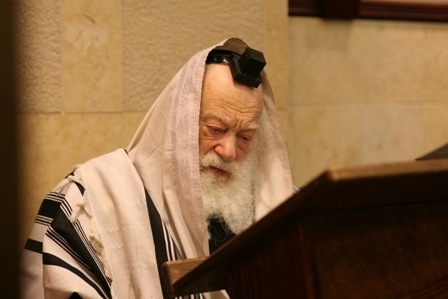
The Lion Who Never Left the Beis Medrash HaGaon Rav Shmuel Birnbaum zt”l Rosh Yeshivas Mir, Brooklyn on his Yartzeit – Shabbos the 28th of Taives.
by Rabbi Yair Hoffman
His life spanned vastly varied geographic areas. The cobblestoned streets of Knyszyn, Poland; the yeshiva halls of Baranovich and Mir; the frozen expanse of Siberia; the sweltering beis medrash in Shanghai, and finally to Ocean Parkway in Flatbush. Yet in truth, he never really moved at all. For Rav Shmuel zt”l was only in one place alone: the Beis Medrash with a blatt Gemara before him on a shtender. Sometimes the shtender was physical and sometimes it was figurative – but it was always there.
This Shabbos the 28th of Taives, marks the 17th yahrtzeit of one of the most towering Torah giants of the past century – a man whose legendary hasmodah and boundless love for his talmidim transformed thousands of American boys into bnei Torah. And a gadol whose radiant simchas haTorah illuminated the lives of all who knew him. He was one of the last binding links with the greatness, glory and grandeur of the Torah giants who learned and developed in the Eastern European Torah centers, and then came to the United States and reached out to American youth. Through this interaction, these marbitzei Torah helped transplant and create a flourishing Torah community in a place that had been a veritable Torah desert.
Forged in the Fires of Pre-War Europe
Born in Adar 5680 (1920) in the small Polish-Lithuanian town of Knyszyn (Kinishev), the young Shmuel Birnbaum entered a world still reeling from the devastation of the First World War. Poland had just regained its independence after over a century of partition among Russia, Prussia, and Austria, and the newly established Second Polish Republic was struggling to define itself. For Jews, who numbered over three million – the largest Jewish community in Europe – the interwar years brought both cultural flourishing and growing economic hardship, as antisemitic legislation and boycotts increasingly marginalized the Jewish population.
Yet amid these challenges, the great yeshivos continued to burn brightly as beacons of Torah. The young Shmuel made his way to the legendary Yeshiva Ohel Torah in Baranovich (Baranavichy), a railway junction city that had grown rapidly in the late nineteenth century at the intersection of the Warsaw-Moscow and Cracow-Minsk lines. Originally part of the Russian Empire, Baranovich had been incorporated into Poland after World War I. The city’s Jewish population comprised nearly half the residents, and the famed yeshiva, almost exclusively supported by the impoverished local population through the widespread practice of essen teg – where families would invite students to dine on different days – had become one of the crown jewels of the Torah world.
There, Rav Shmuel learned under Rav Elchonon Wasserman Hy”d for three years. Rav Elchonon, who had assumed leadership of the yeshiva at the direction of the Chofetz Chaim in 1921, was famous for demanding of his chavrusa – even a young bochur – that he not leave the beis medrash during their six-hour seder. Unlike other yeshivos that accepted only advanced students, Baranovich under Rav Elchonon’s leadership accepted students who had not yet achieved full proficiency and groomed them to learn the Talmud independently. This rigorous training would shape Rav Shmuel’s legendary hasmodah for the rest of his life.
In Baranovich, the young Reb Shmuel also developed a close relationship with the mashgiach Rav Yisroel Yaakov Lubchansky zt”l, son-in-law of the Alter of Novardok, founder of the vast Novardok mussar yeshiva network.
Even then, his rabbeim recognized his unique stature. Once, when poverty gripped the yeshiva and the bochurim were given only stale bread to eat, the students protested and refused the meager fare. Rav Lubchansky approached the young Shmuel with words of mussar, urging him to eat so he would have strength to learn. Then the mashgiach paused and added with emotion: “Vey tzu mir that I have to give mussar to such a choshuve bochur like Shmuel Birnbaum.”
From Baranovich, Rav Shmuel proceeded to the famed Yeshivas Mir, located in the small town of Mir in what was then eastern Poland (today Belarus). Founded in 1815, just twelve years after the establishment of the Volozhin Yeshiva, the Mir had grown into one of the premier Torah institutions in the world by the 1930s. Its reputation attracted students not only from throughout Europe, but also from America, South Africa, and Australia, and the student body grew to nearly 500. By the time the second World War broke out, there was hardly a rosh yeshiva of the Lithuanian school who had not studied in Mir.
In the Mir, Rav Shmuel became very close with the Mashgiach, Rav Yechezkel Levenstein zt”l. He joined the elite circle of talmidim who would later become the gedolei Yisroel of the next generation. His chaveirim from that golden era – Rav Nochum Partzovitz, Rav Leib Malin, Rav Aharon Kreiser, and others – remained bound to him like family throughout their lives.
Flight Through Fire and Ice
On September 1, 1939, Nazi Germany invaded Poland from the west. Sixteen days later, pursuant to the secret protocols of the Molotov-Ribbentrop Pact signed just weeks earlier, the Soviet Red Army invaded from the east. Poland was dismembered, and the world of Torah that had flourished for centuries was consumed in flames. The town of Mir now fell under Soviet Communist rule, making continued yeshiva operations impossible.
The Mirrer Yeshiva fled westward to Vilna (Vilnius) in Lithuania, which had briefly remained independent. For three anxious weeks, they waited for visas to escape the tightening noose. Lithuania’s Jewish population had swelled from 160,000 to approximately 250,000 as refugees from Poland streamed across the border. Then, on June 15, 1940, Soviet tanks rolled into the Lithuanian capital, and the country was forcibly annexed to the USSR. The Soviets announced that all foreign consulates would be closed by late August – and with them, any hope of escape.
The yeshiva dispersed to several small towns – Keidan (Kedainiai), Krakinova, Ramigola, Shat, and Krok – operating without official permission while Soviet authorities turned a blind eye. But everyone knew this was only temporary. Escape seemed impossible: rigorous immigration laws restricted entrance to the United States under the Johnson-Reed Act of 1924, and British-controlled Palestine was largely closed to Jewish immigration.
Through the intervention of Divine Providence, two unlikely saviors emerged. Jan Zwartendijk, the Dutch consul in Kaunas (Kovno), began issuing destination permits to Curacao, a Dutch island in the Caribbean that required no entry visa. And Chiune Sugihara, the Japanese consul who had been posted to Kaunas to monitor Soviet and German troop movements, agreed to provide transit visas through Japan – despite Tokyo’s explicit orders forbidding him to do so.
A young Mir student named Moshe Zupnik, borrowing a presentable suit from a fellow bochur, made his way to the Japanese consulate. After being turned away the first day due to massive crowds of desperate refugees, he returned the next day with a friend, bribed a guard, and was finally brought before Sugihara. When he requested over three hundred transit visas for the entire yeshiva, Sugihara’s German-born secretary declared it impossible. But Sugihara, defying his government, agreed to help. In an act of extraordinary courage, he spent the next two weeks issuing some 2,140 visas – saving the lives of thousands of Jews. [The original idea, by the way, was the brainchild of the mother of the famous Rubashkin lawyer, Nat Lewin.]
The yeshiva embarked on an odyssey that would last years. In groups of fifty, beginning in January 1941, they boarded the Trans-Siberian Railway for a grueling two-month journey across more than 5,700 miles of frozen Siberian wilderness – through the Ural Mountains, across sparse forests and frozen plains – to Vladivostok, the easternmost city of the USSR. One of my rebbeim, Rav Dovid Kviat zt”l, who also served as a maggid shiur along with Rav Shmuel, described it very emotionally to me.
From there, they sailed to the Japanese port city of Kobe, where the local Sephardic community – Jews originally from Baghdad – offered them a synagogue for their studies. They remained in Kobe for seven months until the Japanese government, under pressure from Germany and in the months leading up to the attack on Pearl Harbor, forced all Jewish refugees to relocate to Shanghai in Japanese-occupied China.
Shanghai was a city of contradictions – a crowded, unsanitary international settlement that nonetheless required no visa to enter, making it one of the only places in the world that unconditionally offered refuge to Jews fleeing the Nazis. Shanghai had accepted more Jewish refugees than either Canada, Australia, New Zealand, South Africa, or India. In fact, it accepted more than all of them combined. By the time the Mir arrived, the city already housed some 17,000 German and Austrian Jews who had fled persecution in the late 1930s.
In the sweltering heat of the Shanghai beis medrash in the Beth Aharon Synagogue – built in 1920 by Silas Aaron Hardoon, a prominent Sephardic Jewish businessman – Rav Shmuel was widely recognized for his total immersion in Torah study.
Rabbi Meir Ashkenazi, a Lubavitcher chassid who served as the spiritual leader of the Jewish refugees, had arranged for the yeshiva to occupy the synagogue. Temperatures regularly exceeded 100 degrees, and the diet consisted largely of rice. Yet Rav Shmuel maintained the same unwavering devotion to Torah that had characterized his years in Poland.
His roommate in Shanghai, the future Rosh Yeshiva of Beis HaTalmid, Rav Leib Malin zt”l, stood as a model of steadfast commitment. While other bochurim abandoned their jackets in the oppressive heat, Rav Leib insisted on proper dress at all times. Together, these young lions of Torah sustained fourteen-hour days of intensive learning, their sole sustenance being rice – and the life-giving waters of Torah. The Mir Yeshiva emerged as the only Eastern European yeshiva to survive the war intact.
Building Torah in America
Following Japan’s surrender in August 1945 and the end of World War II, the Jewish refugees began leaving Shanghai. Most emigrated to the newly established State of Israel or to the United States. Rav Shmuel arrived in America in 1947 with the rest of the Mirrer Yeshiva, landing first in San Francisco before making his way to New York. The yeshiva initially settled in Far Rockaway, then the New Lots section of East New York, and finally moving to its permanent home on Ocean Parkway in Flatbush, Brooklyn.
Rav Avrohom Kalmanowitz zt”l, who had escaped to America before the war and labored heroically to sustain the yeshiva in Shanghai by sending funds and hundreds of Gemaras, chose Reb Shmuel as a husband for his daughter, Reichel. The couple married in 1950.
When Rav Kalmanowitz passed away in 1964, Rav Shmuel Berenbaum and Reb Avrohom’s oldest son, Rav Shraga Moshe Kalmanowitz, were appointed as Roshei Yeshiva of the Mirrer Yeshiva in Brooklyn. For the next fifty-six years, Rav Shmuel devoted every fiber of his being to teaching Torah and nurturing thousands upon thousands of talmidim. Under his leadership, the Mirrer Yeshiva grew into one of the most prestigious centers for Torah study in America, with several hundred talmidim.
His remarkable full-time involvement in learning and presenting shiurim, coupled with his intense dedication to the well-being and progress of each talmid in the yeshiva, as well as his concern for interested ba’alebattim, created an unusual impact on all with whom he had contact.
The Essence of Hasmodah
Rav Shmuel’s hasmodah was legendary, becoming the very definition of what it means to be anchored to the beis medrash. He would sit in the last seat of the row closest to the seforim shelves, learning with an intensity that inspired all who witnessed it. His diligence was unparalleled – so immersed would he become in his learning that he often did not hear people knocking at his door.
A remarkable incident illustrates this total devotion. One year, on Asara B’Teves, a former talmid came to invite him to serve as sandek at his son’s bris. It was an hour and a half after the fast had ended. The Rosh Yeshiva was in his private office in the yeshiva – simply a room for learning in privacy – so absorbed in his learning that he did not hear the knocking. When finally reached, before the young man could explain his visit, he asked, “Would the Rosh Yeshiva like something to eat?” The Rosh Yeshiva replied matter-of-factly, “First, I must complete the sugya with the Rambam.” Torah was his lifeblood. Before he could nourish his body, he needed to feed his neshama with the sugya and Rambam.
This was complete devotion of body and soul to Torah. Rav Shmuel would not leave the yeshiva for any simcha or function until after second seder ended. Weddings across the Torah world were scheduled late into the evening so that he could serve as mesader kiddushin without missing a moment of learning. Even when doctors prescribed walks for his health in later years, those who observed him could see that he was completely immersed in learning as he walked.
His son, R’ Elchonon, testified: “My father never stopped shteiging! Even as he was constantly teaching Torah and worrying about his talmidim’s growth, he was never satisfied with his own level of learning. Rav Yitzchok Kleinman zt”l, one of his longtime talmidim, once commented that his rebbi, Rav Shmuel now, was a different person than his rebbi, Rav Shmuel of fifty years ago – he had become so much greater since then.”
The first two summers after his first heart attack, he was in South Fallsburg during bein hazemanim. He spent virtually the entire day learning in the beis midrash of Yeshiva Zichron Moshe. When Rav Elya Ber Wachtfogel asked him, “What about resting a bit?” the Rosh Yeshiva replied, “But I am resting! During the z’man, I prepare shiurim on Bava Basra; now I am learning Chullin.”
Once, during a visit to Eretz Yisroel, Rav Shmuel addressed a group of bochurim during bein hazemanim. With characteristic passion, he declared: “Rashi says that the world was created for the sake of the Torah. Without Torah, we are inferior to all other nations!” At the shiur’s end, when someone mentioned that the zman would begin the following Sunday, Rav Shmuel pounded the table: “Do not wait for the beginning of the zman! If you don’t learn now, how will you become great? I beg of you: Do not let a single minute go to waste.” Then he asked: “Will you agree to have a shorter breakfast tomorrow, and to use the time you save for learning?” When the bochurim nodded, Rav Shmuel beamed. “In that case,” he said with satisfaction, “it was worthwhile for me to come to Eretz Yisroel.”
Malchus – True Royalty
Rav Shmuel would often expound on the concept that Torah scholars embody true royalty. He noted that Hashem commanded Moshe Rabbeinu to make trumpets that would be sounded before him “as is done before a king.” Why should this have been done for Moshe Rabbeinu? According to Chazal, someone who learns Torah lishma is worthy of malchus, kingship. Since true royalty is embodied in the great talmid chacham, no one personified malchus more than Moshe Rabbeinu.
In the Rosh Yeshiva himself, one saw malchus – the nobility that comes from being totally immersed in Torah and living a life in which every step, every act and every word is a reflection of Torah. He was totally self-effacing; his humility was genuine, natural. Yet, anyone in his presence could easily perceive that he was head and shoulders above other people.
In our generation, the Rosh Yeshiva was the symbol of utter dedication to the study and teaching of Torah. He had no desire for anything outside of Torah and mitzvos. He derived indescribable pleasure from serving Hashem, especially from limud haTorah, and he had absolutely no need for anything material. When he would deride over-involvement in food (“Steak? Who needs it!”), everyone knew that the Rosh Yeshiva was far removed from such indulgence.
Just Visiting – A Life of Simplicity
The home of the Chofetz Chaim in Radin was the quintessential abode of one who truly lived as a “visitor” on this planet. As the Chofetz Chaim once told someone who expressed surprise at his home’s stark simplicity, “Does a traveler take his furniture with him? I am merely a traveler passing through this world.” His home had a set of table and chairs, a small bookcase and a few beds.
In his total disinterest for material things, the Rosh Yeshiva had a most fitting partner in life. Anyone who visited their home could not fail to be impressed by its utter lack of adornment. To everyone’s knowledge, the only new piece of furniture they acquired in some 50 years was a recliner purchased a few years before his passing when the Rosh Yeshiva, due to health problems, was unable to sleep in a bed. The Rosh Yeshiva was a true oved Hashem b’Simcha. He and his Rebbetzin had no need for what others consider necessities.
Yissachar’s Tranquility
Rav Shmuel would often quote Yaakov Avinu’s blessing to Yissachar, who represents dedication to Torah study. In that beracha, Yissachar is likened to a donkey that carries a heavy load. Yet, in the next pasuk, Yaakov speaks of menucha, tranquility, as being tov, good. The juxtaposition of a hard-working donkey without respite and menucha seems contradictory.
The Rosh Yeshiva would become excited as he explained: The world has a misconception about menucha. They think that “the easy life” – vacations, baseball, steaks, having a “good time” – is menucha, and that it is tov. But that is wholly incorrect. That sort of life is one of atzlus, laziness; it is not “good,” and it does not result in a feeling of tranquility and peace of mind.
On the other hand, true attachment to and growth in Torah does not come easily. One must be like a hard-working donkey in accepting upon himself the yoke of Torah. Easy? Certainly not. But it is this sort of dedication that results in true menuchas hanefesh, joy, and accomplishment.
A Father to Thousands
How did a man born and raised in pre-war Europe connect so profoundly with American boys? The answer, as his son explained, was simple: “With ahavah – love! He loved all his talmidim, sometimes even more than a father loves his son.”
When a talmid lost his wife and was left to care for young children alone, Rav Shmuel not only attended the levaya – he accompanied the talmid and his children in the car to the airport, escorted them into the house where they would observe shiva, made sure that they were settled and had whatever they needed, and offered precious words of comfort and chizuk. When he noticed that a talmid who traveled from Lakewood weekly to learn with him was wearing a frayed jacket, Rav Shmuel told him gently: “It doesn’t pas for a ben Torah to walk around with such a jacket. Here is money to buy a new one.”
Perhaps the most remarkable testament to his love was his willingness to fast for his talmidim. When a struggling bochur in Mir was on the verge of being expelled due to gambling and other problems, some yungeleit approached the Rosh Yeshiva to suggest that the bachur be asked to leave the yeshiva. It was the only time that talmidim ever saw the Rosh Yeshiva become flushed with anger. “Did you fast 40 ta’aneisim?” he demanded. “After you fast 40 ta’aneisim, then you can come to me to suggest that we send a talmid out of the yeshiva!”
From that day on, the Rosh Yeshiva took a special interest in this bachur. Due to his loving influence, the bachur underwent a complete transformation and is today an outstanding talmid chacham and marbitz Torah.
Years later, a mother who heard this story at a dinner thought to herself: “If Rav Shmuel can fast for a talmid, then I can surely fast for my son!” She did – and her struggling son transformed completely. The ripples of Rav Shmuel’s ahavas Yisroel continued to spread far beyond his immediate reach.
When a grandson came to inform him of the good news that his wife was expecting their first child, the Rosh Yeshiva responded, “And what is with…?” and he proceeded to say the Hebrew names (and mothers’ names) of five childless talmidim for whom he davened constantly. His heart never stopped carrying the burdens of his talmidim.
Emes – Truth Without Compromise
Rav Shmuel’s beloved chaver, Rav Aharon Kreiser, used to say about him that he was “vi a leib” – like a lion. This was true in all aspects. His driver and the one who took care of him once related to me after I had my defibrillator installed that Rav Shmuel also had a defribrillitaor that had shocked his heart back to activity several times, and he just dealt with it – like a lion. When it came to emes in Torah, Rav Shmuel also possessed unwavering strength. Once, during a shiur kloli given by a distinguished talmid chochom, Rav Shmuel disagreed with a point. He rose with passion and began arguing in the middle of the shiur, refusing to yield. When later asked how he could do such a thing, he replied: “If you would have seen how Rav Aharon Kotler zt”l hut geshlugen in lernen vi a leib, you would not have any questions!”
The Rosh Yeshiva did not engage in chanifa (flattery); he would never accord anyone special honor because of his wealth. To the contrary, he would sometimes tell a big donor, “Do not consider yourself a great ba’al tzeddaka. A person must give according to his means. And according to your means, you should be giving more.”
And this is precisely why many wealthy men in the Torah community were attached to the Rosh Yeshiva heart and soul. A number of them maintained regular, private learning sessions with him. They wept at his passing as a son would weep for a father, and some accompanied the coffin to Eretz Yisroel. He was kulo emes – his essence was truth. They were also taken by his ehrlichkeit, by the fact that millions of dollars of tzeddaka funds passed through his hands, but he would nevertheless take nothing for himself – even when he was clearly entitled to it.
His shiur was “kodesh kodashim.” Every word of the Gemara was carefully examined and analyzed – he expended much time and effort over the years on the study of Chumash with Rashi and derived scores of chiddushim from this limud. Talmidim who heard him describe him as making the most profound concepts simple and understandable, always with joy and often eliciting laughter.
Even in his final illness, when he was already a choleh mesukan, Rav Shmuel insisted on going to yeshiva to say shiur. Though he was so weak he could barely speak, the moment he began the shiur, he was like a new person – talking clearly, smiling, delivering Torah with his characteristic patience. The shiur gave him life.
The Measure of a Man
The Kohen Gadol wore the Choshen upon his chest. The face of the Choshen had twelve precious stones, the Avnei Milluim (Stones of Filling, for they filled the golden settings into which they were placed). The Rosh Yeshiva once asked: What makes this a name of distinction for precious stones? Do we call a diamond a “diamond,” or do we call it a “filling stone” because it fills its setting?
The Rosh Yeshiva explained: There is a message here. These stones, with the names of the Shevatim engraved upon them, represent Klal Yisroel. A Jew’s greatness is measured by how much he “fills” – meaning, he gives to others.
On Erev Yom Kippur, one year before his passing, the Rosh Yeshiva had a small snack after Shacharis and then visited someone who was hospitalized. From there, he went to a family burdened with the stress of a homebound patient who needed round-the-clock care, care that the government did not pay for. The Rosh Yeshiva visited, offered his beracha for the coming year, and quietly left an envelope on the table containing $15,000. When his driver asked what the Rosh Yeshiva would eat – it was almost Yom Kippur – Rav Shmuel replied with a smile: “Mir geit essen mitzvos! I will eat mitzvos!”
When his son Reb Leib was hospitalized in New York with cancer, the Rosh Yeshiva became friendly with a man whose teenage daughter was in the same hospital, in need of a refuah. One Motza’ei Shabbos, while walking from shul back to the hospital, the Rosh Yeshiva inquired about the man’s daughter. When the man replied that the situation did not look good, the Rosh Yeshiva responded, “Send me an invitation to her wedding – I’ll be there.” Baruch Hashem, a few years later, this young woman became a kalla. The Rosh Yeshiva made an exception by leaving the beis midrash during second seder to serve as mesader kiddushin. As soon as the chuppa ended, he returned to the Mir for the remainder of second seder.
Goodness to the Klal, Goodness to the Individual
Rav Shmuel would note a remarkable insight from the Torah: “And Yosef was the ruler over the land, and he was the provider to all the people of the land.” When in world history did a king, prime minister or president personally involve himself in providing food for his people? Even the best of presidents would not busy himself with such matters. For this, he has members of cabinet, chiefs of staff, heads of departments. But Yosef Hatzaddik was different. As viceroy, he was “the ruler over the land,” yet, at the same time, he was the “provider to all the people,” personally involved with the needs of the individual.
This was the Rosh Yeshiva. He was the great marbitz Torah, whose mind was forever preoccupied with Torah. Yet, in his last years, he accepted upon himself new responsibilities for the klal. He founded and oversaw a multi-million dollar fund for bnei Torah of Eretz Yisroel who had been hard hit by deep cuts in government funding. He became an “ambassador of Torah,” delivering brilliant shiurim in other yeshivos and kollelim in addition to his regular shiurim at the Mir. And yet, he was forever cognizant of the needs of the individual.
Through Personal Tragedy
Rav Shmuel’s life was marked by profound personal losses. He lost his entire family in the Holocaust – among the six million kedoshim, including the approximately 12,000 Jews of Baranovich who were murdered when the ghetto was liquidated in late 1942, and the nearly 90% of Lithuanian Jewry who perished – one of the highest rates in Europe. He overcame two massive heart attacks. Two of his sons were niftar – one, Chaim Shlomo, was tragically killed, and the other, Rav Aryeh Leib zt”l, passed away after an illness.
When he came to be menachem aveil a talmid chacham whose young child had been tragically killed in an accident, the Rosh Yeshiva said, “Twice the Satan took children from me to get me to stop learning, but he did not succeed.”
When he sat shiva for his son, Rav Shmuel shared a remarkable insight. “Rashi says that Yitzchak became blind in his older years because of the Akeidah. When the malachim saw Yitzchak being taken to be slaughtered, they cried, and their tears fell into his eyes. The lashon Rashi uses is ‘niftachu haShamayim‘ – the Heavens were opened – and through that, the malachim were able to see the Akeidah. But malachim can see everything from one end of the world to the other! Why did Hashem have to ‘open the Heavens’ for them?”
Rav Shmuel answered: “There are two ways to look at the world. We can look with heavenly eyes, from which everything makes sense. Or we can look with human eyes, from which tragedy is incomprehensible. When Hashem ‘opened the Heavens,’ He allowed the malachim, for one moment, to see the Akeidah through human eyes – and that is why they wept.”
Despite his suffering, the simcha that radiated from Rav Shmuel as he was mechadesh a chiddush in Torah never left him. His son testified: “He went through a few tragedies in his life, but the simcha that radiated from him as he was mechadesh a chiddush in Torah never left him. We watched him daven, literally omeid lifnei haMelech. He would beg the Eibishter like a child talks to his father. He was so real.”
After his first massive heart attack in 1972, in which eighty percent of his heart muscle was destroyed, the doctors said that the fact that his arteries were absolutely clean had saved his life. His family then revealed that several years earlier, the Rosh Yeshiva had stopped eating meat because of kashrus concerns. When this was told to his dear friend and chavrusa, Rav Nachum Partzovitz zt”l of Mir-Yerushalayim, Reb Nachum quoted the passuk “Shomer nafsho yirchak midavar ra – He who guards his soul will distance himself from anything of evil.”
The doctor had told him that he did not expect him to survive. The Rosh Yeshiva responded, “Have you ever been wrong before? This time, you’ll be wrong.” He defied the doctors’ predictions, and some six months later, resumed his intensive schedule of learning and delivering shiurim with no easing up at all. When his family asked him to allow time for more rest, he replied that according to the doctors, the fact that he was alive and functioning was a miracle, and in that case, he could assume that the miracle would allow him to learn just as before. It did.
His Final Journey
On the 28th of Teves 5768 (January 6, 2008), Rav Shmuel was niftar at his home in Brooklyn after battling illness. He was 87 years old. His levaya in New York, held the following day at the Mirrer Yeshiva on Ocean Parkway, drew tens of thousands of mourners. It began at 8:45 AM – the same time the Rosh Yeshiva himself would arrive early to seder to learn. Even in death, he taught by example.
His aron was then flown to Eretz Yisroel for kevura. At Ben Gurion Airport, hundreds waited to receive him, including HaGaon Rav Aharon Leib Steinman zt”l, who delivered a hesped at the airport. From there, the levaya proceeded to Yeshivas Mir in Yerushalayim’s Beis Yisroel neighborhood, where revavos (tens of thousands) gathered, standing in the rain to pay their final respects.
Among the maspidim were the Roshei Yeshiva of Mir Yerushalayim, HaGaon Rav Nosson Tzvi Finkel zt”l and HaRav HaTzaddik Rav Aryeh Finkel zt”l; HaGaon Rav Boruch Dov Povarsky; HaGaon Rav Shmuel Auerbach zt”l; HaGaon Rav Boruch Shimon Salomon, Rav of Petach Tikvah; the Mashgiach Rav Don Segal; the Novominsker Rebbe; and many others.
The scene was remarkable: Young men stood on rooftops around the yeshiva, straining to catch a glimpse of the gedolei Yisroel who had come to escort this giant to his final rest. Hatzolah volunteers had to remove dozens of bochurim from a dangerously unstable roof. It was a testament to the impact of a man who rarely left his shtender, yet whose light had reached the farthest corners of the Torah world.
Rav Shmuel was laid to rest in the Sanhedria Cemetery in Yerushalayim, near the kevarim of his two sons who had preceded him in death.
The Living Legacy
Rav Shmuel left behind a magnificent family of talmidei chachamim: his sons Rav Asher Dov (Rosh Yeshiva in Mir), Rav Meir Shimon, Rav Elchonon, Rav Avrohom, and Rav Yisroel; and his sons-in-law Rav Hershel Kaminsky, Rav Eliyahu Meir Sorotzkin zt”l (Rosh Yeshiva in Springfield), and Rav Reuven Schepansky (a rebbi in Mir Yeshiva).
He also left behind the Keren that bears his name, which continues to support thousands of yungeleit in Eretz Yisroel. In his final years, despite tremendous illness, Rav Shmuel traveled to Eretz Yisroel for fundraisers with mesiras nefesh. When Rav Chaim Kanievsky zt”l ruled that he should attend a crucial meeting despite his weakness, he was mevatel daas and went.
A Beacon That Still Shines
Mayor Michael Bloomberg’s statement upon Rav Shmuel’s passing captured what so many felt: “Today we lost Rabbi Shmuel Birnbaum, who led the Mir Yeshiva for nearly 50 years and built it into one of the largest centers for Torah study in the world. A Holocaust refugee who, as a young man, sought shelter in Shanghai from Nazi persecution, Rabbi Birnbaum’s love of learning and wealth of wisdom will live on through his tens of thousands of students worldwide.”
Talmidim knew four decades ago that in the Rosh Yeshiva, they were seeing the grandeur of Torah. And yet, as the years passed, he seemed to grow greater and greater before their eyes, broadening his horizons, embarking on new undertakings for the sake of Torah and its students. And all that time, he remained firmly anchored to his seat and shtender in the back row of the Mirrer beis midrash.
He learned and he taught until he literally had no strength. His lesson inspired and will continue to inspire an entire generation.
As one who was at the levaya wrote: “We will miss his shining example of hasmodah. Even when he used to take walks that his doctor prescribed, you could see he was araingetuhn in learning. One of the last of the shufra of that previous beautiful dor is no longer with us. The only way to have a ktzas nechama is for us to try to emulate his ameilus baTorah.”
The author can be reached at [email protected]