

Remembering Vel’ d’Hiv Deportations in France
Eighty-four years ago this week, on July 16–17, 1942, French police, acting on orders from the Vichy regime of Philippe Petain and Pierre Laval, carried out the notorious Vel’ d’Hiv roundup of Jews in Paris.
In two scorching days, 4500 policemen, led by Police Chief René Bousquet, arrested and interned over 13,000 Jews, including more than 4000 children between the ages of 2 and 16.
The Jews were jammed for five days into a sealed, sweltering stadium without food, water and bathroom facilities, before being shipped to Drancy internment camps, and ultimately to Auschwitz.
A Paris lawyer, Georges Wellers, who witnessed it, described the “appalling conditions” and “inhumanity beyond belief” to a BBC correspondent.
“All those wretched people lived five horrifying days in the enormous interior filled with deafening noise … among the screams and cries of people who had gone mad with fear, with hunger and thirst, and the injured and those who tried to kill themselves in despair—impossible to describe,” testified Wellers.
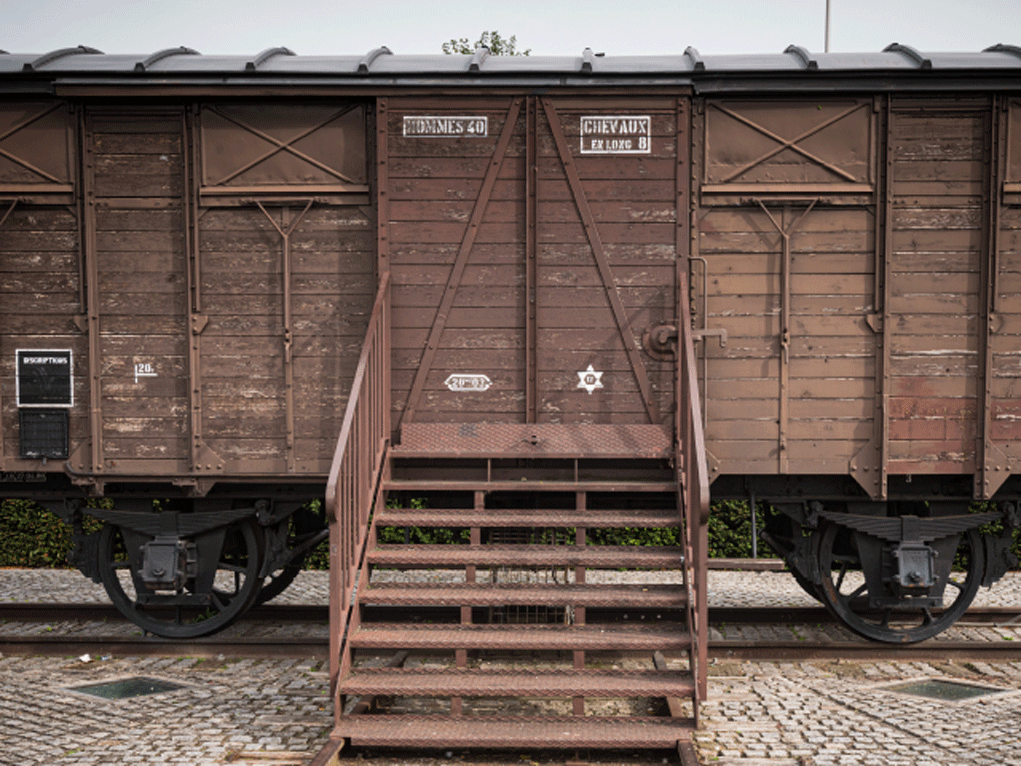
In the week following the arrests, the Jews were taken from the stadium to concentration camps in a region south of Paris, and to Drancy, near Paris. At the end of July and the beginning of August, they were deported in cattle-cars to killing centers—mostly to Auschwitz—and murdered.
In scenes of inhumanity that beggar the imagination, more than 3,000 babies and children were forcibly torn from their parents and left alone in the French internment camps while their anguished parents were shipped out.
At the end of August and during September, these children were deported alone in sealed railway wagons to Auschwitz, where they were murdered.
The Vel d’Hiv roundups, organized by the French authorities and carried out by French policemen, became engraved in Jewish memory as a symbol of the nation’s unspeakable cruelty and its culpability for the murder of tens of thousands of Jews.
Vichy Didn’t Wait For Nazi Orders
In the wake of France’s surrender to Germany in 1940, the Nazis took 2 million French prisoners of war and divided the defeated country into two zones. They controlled the northern zone from their headquarters in Paris; the Vichy regime ruled the southern “unoccupied’ zone.
As the Nazis’ tentacles encroached farther into southern France, Petain, Laval and their henchmen did not even wait for German orders. They independently introduced their own system of anti-Jewish legislation, implementing decrees aimed at identifying and isolating the Jewish population and ultimately deporting them to the death camps.
The Nazis issued directives to deport Jewish adults; they gave no orders regarding Jewish children. The Vichy government, acting on its own initiative, deported entire families—including more than 11,000 children.
While Nazi extermination camps were still being built, Vichy France established its own network of internment camps in the cities of Gurs and Drancy, rounding up tens of thousands of Jews, and holding them in brutal conditions until the Nazi extermination camps were in operation. More than 3000 Jews died in French internment camps from mistreatment and illness.
French police then began mass deportations of the imprisoned Jews to the killing centers. While Vichy initially focused on refugee Jews, the regime later readily agreed to hand over native-born French Jews as well.
Out of 76,000 Jewish men, women and children shipped to death camps under Laval and Petain, fewer than 2,000 survived.
‘Jewish Register’ Reveals Shocking Scale of Nazi Collaboration
For decades, the official narrative in France maintained that Vichy was an aberration, and the French state as a whole should not be accused of complicity in the Holocaust. Historians have confirmed, however, that the upper echelons of the French administration, judiciary, and police were willing participants in the persecution.
In 1992, French researchers discovered a “Jewish register” from the Holocaust era that was used in arrests and deportations of Jewish men, women and children across France. Research showed this register was compiled by French officials during the war, on their own initiative, without orders from the Nazis.
The long-buried document pointed to France’s prominent role in the extermination of tens of thousands of French Jews. But it wasn’t until 1995 that a French president actually admitted this fact.
“Yes, the criminal folly of the occupiers was seconded by the French, by the French state,” said past president Jacques Chirac, according to the NY Times. “These dark hours forever sully our history and are an insult to our past and our traditions.”
More recently, French President Emmanuel Macron addressed France’s role in the Holocaust, rejecting the long-standing claim that the Vichy regime was merely a helpless Nazi puppet, detached from the French nation.
“It is convenient to see the Vichy regime as born of nothingness, returned to nothingness. Yes, it is convenient, but it is false. We cannot build pride upon a lie,” Macron declared.
[The irony here is difficult to miss. Only weeks later, in September 2025, Macron formally recognized a Palestinian state, leading Israeli Prime Minister Netanyahu and U.S. Secretary of State Rubio to accuse the French leader of fueling antisemitism with that act. One cannot help but wonder why Macron, who rejected the myths about Vichy France, was willing to embrace an even bigger and more destructive lie—that of Palestinian “statehood.”]
Long-buried Documents Capture the Horror
As the tale of France’s betrayal of its Jewish community during the horrific Holocaust years began to surface, calls came from multiple quarters for the declassification of wartime records and archives.
In 2012, the Paris police opened their archives on the monstrous ‘Vel d’Hiv Roundup,’ and a new exhibition marking the largest roundup of Jews in occupied France and in all of Western Europe was put on display.
Historical information accompanying the exhibit informed visitors that although French police had already begun arresting refugees in 1941, the Vel D’Hiv raids in July 1942 brought the horror in France to a new level; they were the first roundups that saw, in addition to the arrest of thousands of Jewish men, the seizure of women, children, and the elderly.
Senior Vichy official Pierre Laval is reported to have categorically rejected pleas for mercy for the children, declaring, “Not a single Jewish child is to remain in France!”
Records from the time speak of “resistance” among some quarters of the French population to the arrest of their Jewish neighbors, the curator of the exhibit explained in a televised interview. “Many policemen had leaked the shocking plan the day before, enabling people to hide,” he said. “The Germans had hoped to arrest 27,427 Jews in and around Paris, but authorities arrested ‘only’ half that number, 13,152.”
Tragically, many tens of thousands more would be arrested, deported, and murdered before the Allies liberated France in 1944. However, the Jewish survival rate in France was comparatively high; roughly three-quarters of its Jewish population escaped the Holocaust, according to Yad Vashem. Historians credit this not to the Vichy authorities, but to the bravery of ordinary citizens and organized rescue efforts.
From National Heroes to Despised Traitors
After France surrendered to Nazi Germany and signed an armistice in June 1940, Philippe Petain, an 84-year-old WWI hero and virulent anti-Semite, was voted into office by a huge majority of the French parliament.
In a radio speech after signing the armistice, Petain addressed the French people: “I enter today down the road of collaboration,” he announced unapologetically. “This is my policy. My ministers are responsible to me. It is I alone who will be judged by history.”
Petain and his younger minister of state, Pierre Laval, would in fact achieve notoriety as two of Hitler’s most ardent collaborators in the Final Solution.
After taking office, Petain immediately dissolved the French parliament and set up a quasi-police state in which he wielded almost unlimited power. Under his regime, the press was censored, phone calls were monitored, and critics of the government were imprisoned and often executed.
The cancellation of the French Constitution left Petain and Laval free to enact hundreds of anti-Semitic laws against the Jews of France, progressively stripping them of their rights, their property, and their professions.
Minister of State Laval was also instrumental in the creation of a pro-Nazi militia, the Vichy Milice, a dreaded wartime police force known for its brutality. One of its key tasks was the arrest and deportation of Jewish families. Laval insisted that children as young as two years old be deported to meet the German demand of at least 50,000 Jews to be handed over from French territory.
The Milice also targeted members of the French Resistance, hunting them down and turning them over to the Nazis to be tortured and executed. Historians say this paramilitary force was more feared than the Gestapo.
Under the Vichy regime, France was bitterly divided. Some French citizens embraced Petain’s collaborationist government and believed in accommodating Hitler and the Final Solution. Others rallied behind the French Resistance, condemning those who had capitulated to the Nazi occupiers as despicable traitors.
Throughout France, Petain and Laval, once celebrated as national heroes, became symbols of betrayal. The name “Laval” became—and remains—virtually synonymous with “traitor” in the French language.
Downfall of a Traitor
From 1941 until France’s liberation, Marshal Petain was gradually eclipsed by the self-serving Laval, who surpassed his boss in slavish loyalty to the Nazis. Laval’s maneuvering paid off to the point where Hitler vested him with supreme authority in the French government, while Petain was demoted to little more than a figurehead.
Laval repaid Hitler’s confidence by deepening France’s collaboration with the Third Reich. He accelerated the deportation of French Jews to the Nazi killing centers, sent tens of thousands of French citizens to Germany as forced laborers, ruthlessly suppressed the French Resistance, and even declared that he hoped for Germany’s victory over the Allies.
Following the liberation of France, Laval fled to Germany, fearing retribution at the hands of the Resistance. After Germany’s surrender in May 1945, he escaped to Spain, hoping the Franco regime’s pro-Nazi sympathies would shield him from extradition.
Spain, however, expelled Laval, forcing him into hiding in Austria. The human monster who had relentlessly hunted Jewish children and persecuted countless of his own countrymen was now himself a desperate fugitive.
In late July 1945, he surrendered to American authorities and was extradited to France, where he stood trial for treason before the nation’s High Court of Justice. Found guilty, he was sentenced to death by firing squad.
Shortly before his scheduled execution, Laval attempted to take his own life by swallowing cyanide. Doctors intervened and succeeded in reviving him, so the court’s sentence could be imposed. On October 15, 1945, a French firing squad executed him by shooting him in the back—a final mark of disgrace reserved for traitors, and a fitting end for a reviled collaborator and mass murderer.
Marshal Petain, too, was sentenced to death for treason but due to his advanced age, was granted a commutation of his sentence to life imprisonment. The vast majority of Petain’s and Laval’s henchmen walked free.
***
Eyewitness to the Vel D’Hiv Raids
(Adapted from a 2022 article in “France 24.”)
Renee was born in Paris in July 1936 to Mordcha and Bluma Sieradsky, Polish Jews who had settled in France in 1931. Their lives unraveled in May 1941 when Mordcha was instructed to report for a “status check” at a gymnasium in eastern Paris—which turned out to be a trap to catch unsuspecting refugees.
Renee’s father was arrested on the spot, along with some 3,700 other non-French Jews. He was taken at first to an internment camp outside Paris and later deported with thousands of others to Auschwitz-Birkenau.
On July 16, 1942—Renee’s sixth birthday and the day before her father was deported to Poland—French police arrived at their home. Warned that refugee Jews were being rounded up, Renee and her mother slipped out the back door and hid in a neighbor’s apartment, trembling as the pounding at their door grew more and more menacing.
The two later found refuge with a cousin in a suburb of Paris and hid there for several days until it became too dangerous to remain. Jews hiding nearby were being caught by the police. Renee and her mother left the hideout, not knowing where to turn. Unexpectedly, they met a non-Jewish woman whom they barely knew, who miraculously offered them shelter.
For the next two and a half years, mother and daughter lived in a storage room at this woman’s home, sharing a single food voucher between the three of them.
After the war, Renee was among the few “hidden children” to experience the joy of seeing a parent return from Auschwitz-Birkenau. Until he died in 1983, her father was a tireless spokesperson for Holocaust victims.
In an interview with France 24, Renee displayed her grandparents’ beautiful silver candlesticks and spoke of their incredible journey.
“It was a custom passed down for generations among Polish Jews that when a young girl got married, she received a leichter from her parents, to use Friday night to usher in the Shabbat,” Renee explained. “My mother took these candlesticks with her on the day of the Vel d’Hiv roundup. How did she do it? Why? We were so limited in what we could take with us. But that is what she chose to save.”
“While we were in hiding,” Renee went on, “she sold everything to get us food, even her wedding ring. But she kept her leichter. It is the only link I have today with my grandparents who died in the war. When I light it, I feel like they are here with us.
***
France’s Long History of Anti-Semitism
A glance at the historical roots of French anti-Semitism reveals how the self-proclaimed “Land of Liberty, Equality, and Fraternity” could so readily betray its own ideals by collaborating with Nazi Germany’s campaign of genocide.
By the turn of the century, anti-Semitism was being promoted by a vigorous political movement called Action Francaise, which had a strong following in the Catholic Church, as well as in the army and the judiciary.
This movement drew on long-simmering anti-Semitism that exploded during the 1894 Dreyfus Affair, incited in no small part by Catholic institutions and publications.
The Dreyfus Affair centered on the wrongful conviction of Alfred Dreyfus, a Jewish captain in the French army, on false charges of treason. Accused of passing military secrets to Germany, he was sentenced to life imprisonment based on fabricated evidence. Even after the case against him began to unravel, Dreyfus remained condemned.
Prominent intellectuals, most notably novelist Emile Zola, argued that the military had made Dreyfus a scapegoat, exploiting anti-Semitic prejudice to hide the identity of the true culprit. After years of solitary confinement on Devil’s Island, Dreyfus was finally exonerated on July 12, 1906, when France’s highest court overturned his conviction and cleared him of all charges.
Yet the anti-Semitism unleashed by the Dreyfus Affair continued to roil French society long after the case itself had ended. Historians point to the role played by the influential Action Française movement, which pushed the belief that Jews could never truly integrate into a Christian nation and were inherently disloyal.
The 1936 election of the Jewish socialist Leon Blum to head France’s Popular Front government intensified anti-Jewish fervor. Blum’s rise to power fueled a venomous anti-Semitic campaign, as opponents portrayed him as the forerunner of a Bolshevik revolution supposedly orchestrated by Jews.
The specter of “Jewish Bolshevism” soon became a dominant theme in French political discourse. Pierre Laval justified his traitorous collaboration with Nazi Germany by claiming that a German victory was necessary to prevent a Jewish-Bolshevik takeover of Europe.
By 1939, France was home to Europe’s second-largest Jewish community, numbering approximately 330,000. Nearly half were recent refugees from Nazi-occupied Europe who had sought sanctuary in a country they believed would uphold its tradition of political and religious asylum.
As noted above, those hopes collapsed as France’s vaunted values of brotherhood and equality evaporated with its surrender to Germany, and the path it chose of collaboration with Nazi oppression and murder of Jews.
Dreyfus Affair Left Lasting Legacy
French President Macron this past week used the occasion of inaugurating a statue honoring Captain Alfred Dreyfus on the 120th anniversary of his exoneration to decry the ″demons of anti-Semitism that have darkened France’s past and present.”
“We know that the old demons of anti-Semitism have never completely disappeared from our country,” Macron remarked at the ceremony—a grim reference to both France’s history and the events unfolding that very day.
Just hours earlier, police had discovered a stolen vehicle containing military-grade weapons and ammunition near a shul, forcing authorities to evacuate about 300 people just hours before the ceremony.
Sarcelles, a Paris suburb where the shul is located, is home to one of France’s largest Jewish communities. An anonymous tip had warned authorities about a possible Islamist attack against a local shul, prompting prosecutors to open a terrorism investigation. No suspects have yet been identified.
The incident was a stark reminder that the struggle against anti-Semitism did not end with Dreyfus’s exoneration. On the contrary, this ancient hatred has persisted across generations, continually adapting to the times and resurfacing in new and ever more virulent forms.