
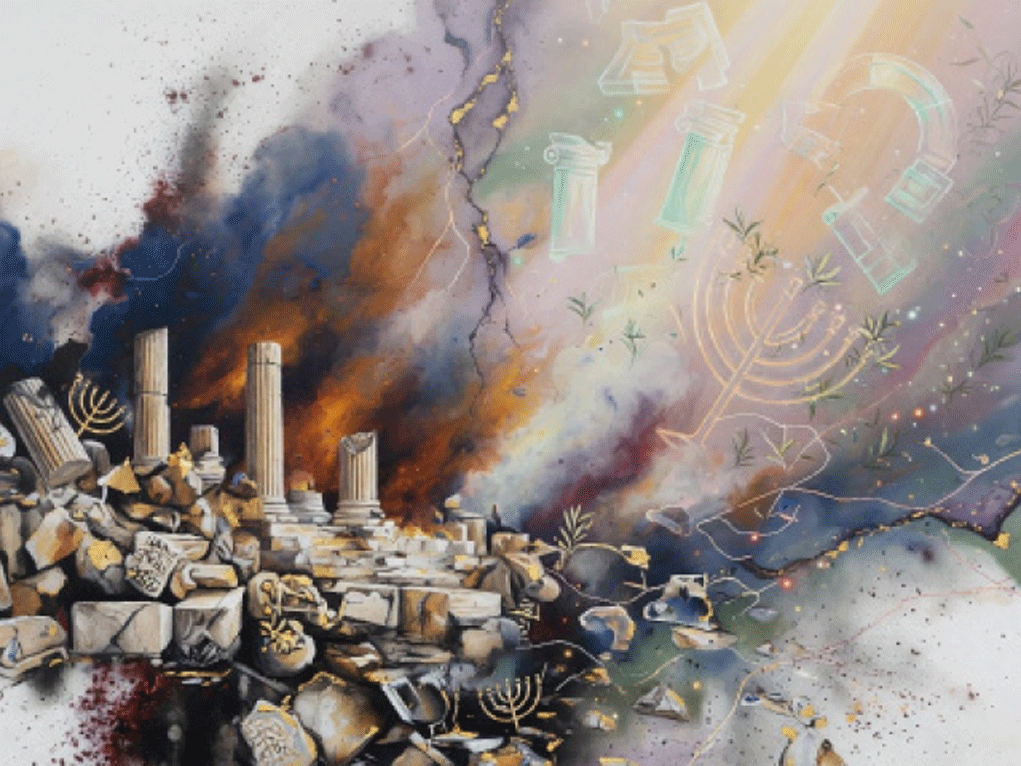

Of all the lines in Shas nogeia to the tragic story of Tisha B’Av that haunt me, the one that shakes me the most has nothing to do with sinas chinom and everything to do with humility.
We all know the story: Kamtza and Bar Kamtza, the mixed-up invitation, and the public humiliation at a public gathering. The slighted guest slinks off to Rome to plant the seeds of rebellion in the mind of the Caesar. It’s the story we tell when we want to personify the sinas chinom, indifference, and intransigence of a nation whose terrible middos and calamitous interactions were the cause of the churban.
But tucked into the margins of that same sugya in Maseches Gittin is a subplot that gets only a line or two in the larger picture, yet those lines hit us like a sledgehammer.
When Bar Kamtza returns with the Caesar’s korban, slightly blemished just enough to be posul according to the Torah but acceptable according to Roman law, the chachomim in the room understand exactly what’s at stake. Rejecting the korban of a foreign king is a diplomatic incident worthy of a Trump-like reaction. However, accepting a blemished korban is a halachic impossibility. Someone has to decide.
And the one in the room whose job it was to decide, Rabi Zecharia ben Avkulas, does neither. He does not offer the korban. He does not have Bar Kamtza quietly disposed of so that the whole episode disappears. He has good reasons for both sides. So he hesitates, weighing the halacha, weighing the politics, and weighing his own certainty, until the moment for deciding passes him by.
Bar Kamtza goes back to Rome. The Caesar is infuriated. He sends his legions, and the rest is history. Unfortunately, our history. From the exile through the Crusades, the Inquisition, Chmielnicki, the pogroms, the Holocaust, Gaza, and beyond, it still reverberates.
But here is the line that has never let me go. Rabi Yochanan says, in Gittin 56a, that the anivus, the excessive humility, of Rabi Zecharia ben Avkulas is what destroyed our home, burned our sanctuary, and drove us from our land.
I have read that line a hundred times, and it startles me every time. I simply don’t get it. Not the sinas chinom. Not the guest list. Not the years of pointless machlokes that came before it. Rabi Yochanan reaches past all of that and points a finger at Rabi Zecharia’s inability to make up his mind.
I understand, in theory, how a private critique of a gadol’s judgment might circulate in a bais medrash. There are disagreements among giants as well.
But this censure and condemnation of Rabi Zecharia is something that was recorded for posterity—not only for talmidei chachomim in Bnei Brak to read with the countless meforshim who try to decipher it, but for the 11-year-olds learning the story of Kamtza and Bar Kamtza in their summer learning groups. It’s a chastisement for posterity!
Why would Chazal take what we could have interpreted as an expression of exaggerated disappointment said in a private setting and have it become enshrined as part of the story of the churban—and as the reason for the churban, no less?
It would have been so much easier, so much more comfortable, to let the blame rest on Klal Yisroel’s sinas chinom in general and leave Rabi Zecharia’s name out of it.
Unless the discomfort is something we all must internalize.
This is not the only place that Rabi Zecharia ben Avkulas receives this treatment. There is a Tosefta, in Maseches Shabbos 17:4, that repeats those scathing words. There, Bais Hillel and Bais Shammai argue about how to remove bones and peels from the table on Shabbos. Rabi Zecharia ben Avkulas acted in a way that avoided both positions Rabi Yosi seems to dredge up the earlier misstep and adds: “The anivus of Rabi Zecharia ben Avkulas burned the Heichal.” Chazal do not let it go. They remember, and they remind us. It’s scary.
I could stop here and leave us all with a kashya, or I can proceed with something that I have gleaned from this, and I pray to Hashem that I am on the right track.
Chazal are not trying to pile onto a good man twice or vent their frustrations. Chas v’shalom. I think that they are giving us a lesson to internalize, one that can even serve as a life preserver in golus. It’s a lesson about indecisiveness. They are teaching us about the price of indecision and fear.
There are moments—and they do not announce themselves in advance—when a leader’s silence is not neutral. It is not a wise withholding of judgment until all the facts are in. It is itself a decision, dressed up as no decision at all, and it can cost everything. Rabi Zecharia’s anivus, his reluctance to be the man who takes a stand and lives with the consequences, was not humility in the way we usually praise it. It was a vacuum, and Klal Yisroel’s enemies are always happy to fill a vacuum.
I have been thinking about this Gemara a great deal these past months, watching elderly roshei yeshiva from Eretz Yisroel cross oceans and even boundaries to navigate a crisis that is costing them more than most of us will ever know. A seismic shift in the government’s attitude toward bnei Torah and limud haTorah prompted a crisis that forced yungeleit to run home in hiding, bochurim to live in fear, and yeshivos to shake their heads in shock and fear for their future existence.
And there was every reason to waver. There was tremendous political pressure, both from within and without, to “wait it out.” Hope for the best. Don’t rock the boat. Perhaps they will come to a resolution. Maybe they will unfreeze the hundreds of millions of shekolim they had once generously given to support yeshivos. Every practical incentive pointed toward compromise. Friendships built over decades frayed. Public opinion, even within parts of our own broader community, turned sharply critical.
And yet the roshei yeshiva said, “We are coming.” Some came in wheelchairs. Some left chemotherapy treatments.
From the onset of this campaign, they rallied, despite how hard and how uncomfortable it was. And people opened their hearts and their wallets, no matter how hard or how uncomfortable it was. The roshei yeshiva did not know how they would be received yet they came and saw how so communities supported their cause and the Keren Olam HaTorah in such an unprecedented and amazing magnanimous way.
The roshei yeshiva who convened in the wake of this crisis chose to plant a flag rather than wave it in surrender. They were prepared to pay the price, for better or for worse.
Of course, we do not have the right to critique the vacillation of Rabi Zecharia. But we can embrace the critique that the Gemara has left for the ages and try to springboard into action from its conclusion. I can’t imagine that bringing the korban, or killing Bar Kamtza, would have negated the reasons for the churban, and thus I will remain with some questions on pshat. But I still can glean something from the powerful words found in Gittin and in the Tosefta.
For some reason, Chazal wanted us to sit uncomfortably with the humble Tanna whose refusal to decide became, retroactively, an act that bore enormous weight. They wanted that discomfort to outlast him by two thousand years, so that the next generation of leaders, facing their own blemished korban, would remember what indecision costs and would choose to decide anyway.
And they may have wanted us little people to realize that life is about hard choices that may determine the future of our lives, our families, and of Klal Yisroel.
Just saying.