

Edited by B. Silberstein
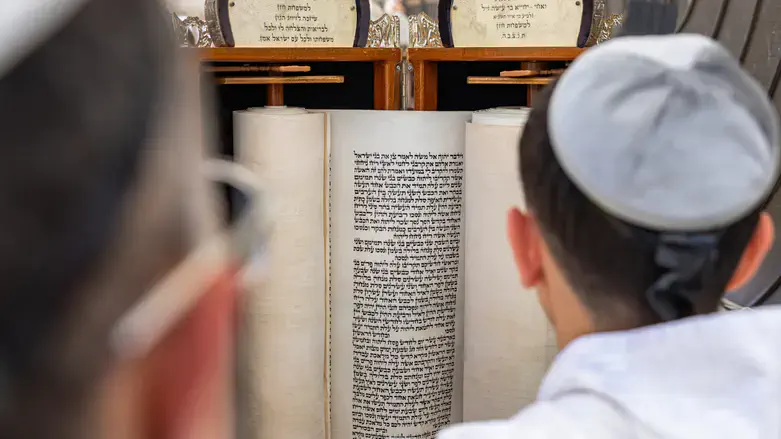
This week we begin the final Book of the Torah with the reading of Parshat Devarim. This constitutes Moshe’s last testament to the nation in whose formation he had played the leading role.
Moshe's Unique Role
Having confronted Bnei Yisrael (Children of Israel) when they were in danger of dissolution under Pharaoh’s enslavement, he had won them back to the religious beliefs of their forefathers. Moshe also boldly stood up to Pharaoh and conducted the negotiations that culminated in Yetziat Mitzrayim (the Exodus).
In addition to his political role, Moshe was the supreme religious leader and teacher. He brought down the Revelation-the Written and Oral Laws-from Mount Sinai and taught Torah to the leaders of Bnei Yisrael, who then passed it on to the ordinary people.
Moshe also oversaw and supervised the construction of the Mishkan (Tabernacle) and the initiation of the sacrificial service. He stood at the helm through very stormy times such as the sin of the Eigel HaZahav (Golden Calf) and the evil report of the Meraglim (Spies). He was steadfast in the face of Korach’s rebellion against his legitimacy and maintained effective control over the people during the ordeal of their 40-year trek in the wilderness. In sum, he was the greatest prophet, teacher, and leader that Bnei Yisrael would ever have.
Can Man Create Torah?
The Book of Devarim is different than the other parts of the Torah. Hashem dictated every word of the first four Books to Moshe, who functioned as a faithful scribe. In Devarim, however, the words are Moshe’s own. After he communicated his final teachings to the nation, Hashem told him to incorporate them into scripture. Moshe thereby became a creatorof Torah.
But how can the language of a mere mortal (no matter how elevated) attain the level of Torah, which everyone takes to imply Divinerevelation? How can any human’s thoughts and ideas be placed alongside the Word of G-d?
When Torah Becomes “His Torah"
Perhaps the answer can be found in the first chapter of Tehilim (Psalms). In it David extols the person who avoids the pathways of the wicked and whose “desire is toward the Torah of Hashem and in hisTorah does he meditate day and night." (Tehilim 1:2) All the commentators note that David initially designates it as the “Torah of G-d," but then characterizes it as “his," that is, the student’s Torah.
This verse delineates two distinct relationships with Torah. At the outset of one’s studies, it “belongs" to G-d. When we first set out to learn, we can’t form any opinions about the actual nature of the material, its beauty, relevance, or utility. All we know is that it’s from the Borei Olam (Creator of the Universe), and this forms the most compelling reason to study it. Could anything be more instructive than a glance into the “thoughts" of G-d?
But the Torah does not necessarily have to remain the exclusive province of the Creator. A miraculous transformation can occur, and it can become the Torah of man. This is because the Torah’s ideas are not mysterious, but correspond to the logical categories implanted in the human soul.
When a person studies in an honest and objective fashion, he gains access to and internalizes the Torah way of reasoning and its perspective on all vital matters of life. The Torah teachings become aligned with his own manner of thinking, and the Torah thereby becomes hisTorah. Thus, David declared that, while at the beginning of one’s studies it is Torat Hashem; after diligent efforts it becomes Torato (his own Torah).
The Creative Role of Torah Scholars
There is a Talmudic dispute as to whether a Rebbe (Torah teacher) can forgive the honor that is due to him. This hinges on the question as to whether it is hisTorah or that of Hashem. The Rabbis conclude that the Rebbe can relinquish his honor because, on the basis of the verse in Psalms, it is, indeed, hisTorah.
It is also significant that the Rabbis are able to create new Mitzvot and the Halakhic (Legal) formulations they encompass. The holidays of Chanukah and Purim, with all their manifold regulations, are purely Rabbinic creations. Many pages of the Talmud with extensive commentaries are devoted to these matters. When we study these areas, we are fulfilling our obligation to study Torah on the Biblical level.
In next week’s Parsha, VaEtchanan, Moshe alludes to the level of Torah study in which it becomes our own. He exhorts,
“You shall safeguard and perform them [the Mitzvot], for it is your wisdom and discernment in the eyes of the peoples, who shall hear all these decrees and who shall say, ‘Surely a wise and discerning people is this great nation!’" (Devarim 4:6)
If we can reach the level of understanding where we are able to expound Torah with clarity, admirably displaying its reason and profound wisdom, we will be sanctifying Hashem in the highest way possible.
May we merit to strive and succeed in our effort to render Torat Hashem into Torateinu.
Questions? Comments?
Please reach out to Mitch Rosner on WhatsApp at 054-426-3419 or by email at [email protected].