


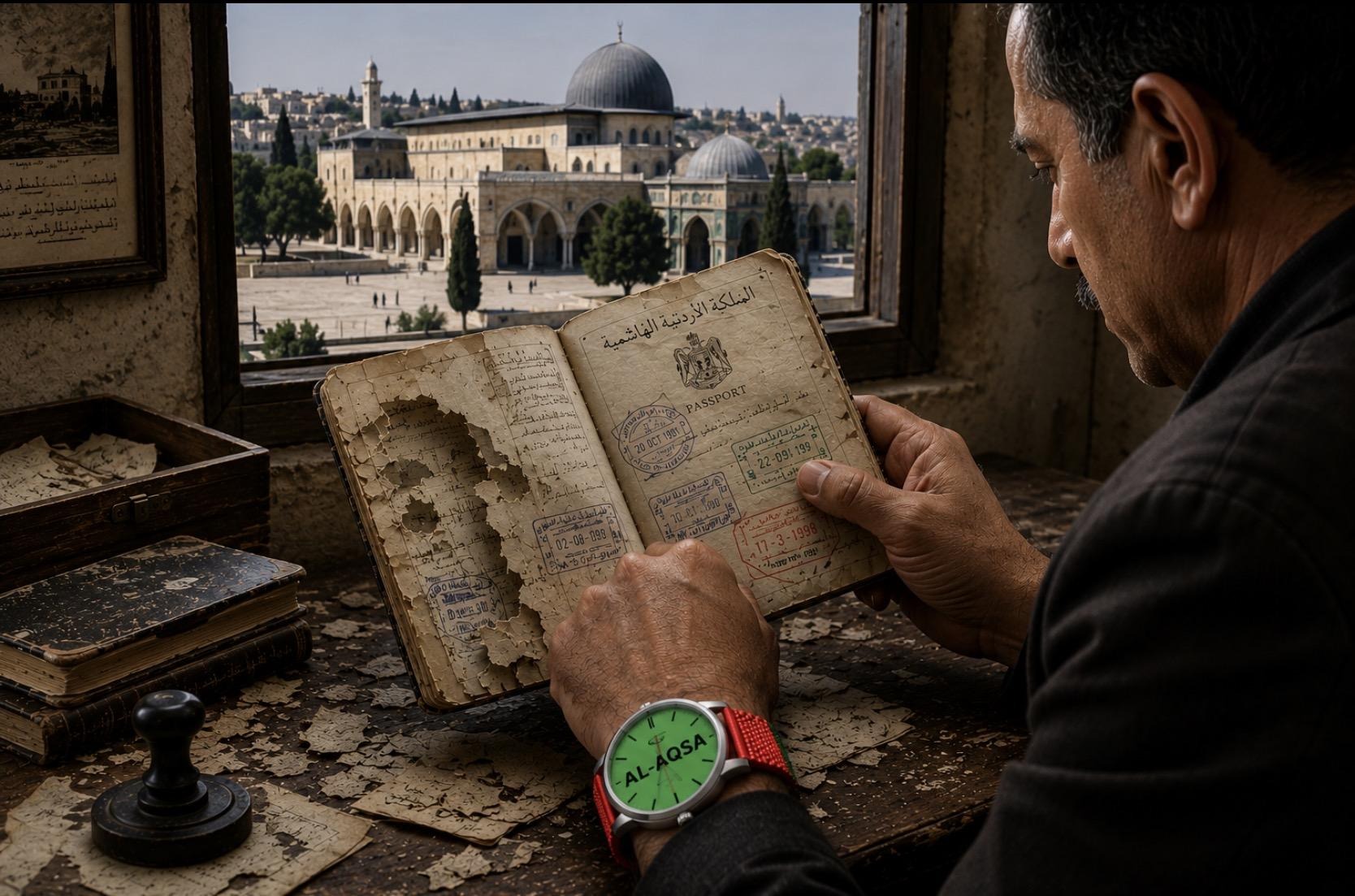
"If all others accepted the lie which the Party imposed-if all records told the same tale-then the lie passed into history and became truth."- George Orwell, 1984
Once there was a traveler who forgot his watch on the nightstand of a hotel in the Middle East.
More than ten years passed. He returned to the same hotel and recognized the old owner, who was wearing his watch. It was the same watch, but it now had a new strap.
“That watch is mine," he said hopefully.
“It is mine," said the hotelier, unmoved.
“Since when?" asked the traveler.
“Since a winged camel with a human face delivered it to me one night, flying over the courtyard. His name was Albarq - lightning."
The traveler smiled. He could not believe the story, but the hotelier did not smile. A few seconds passed, and the traveler repeated:
“But the watch is mine."
A religious man from the neighborhood who had been watching the dispute came closer and confirmed the account of his friend, the hotelier:
“Yes," he said, “there is a tradition, passed down from generation to generation, though unwritten in its earliest times, according to which certain watches descend upon the wrists of the righteous through the mediation of Albarq, the illuminated winged camel."
The traveler asked for proof. He was told that doubting the tradition was an offense to the faith of the entire neighborhood. Meanwhile, other religious men from other neighborhoods joined in confirming it, not because they had seen the camel, but because denying their neighbor’s story might cast doubt on their own tradition.
But the story needed something more in order to prevail: institutional legitimacy. Everyone should respect that Albarq had existed and not doubt, as the unbelieving traveler did.
And then the inevitable happened: the bodies responsible for resolving disputes over heritage, traditions, and watches - bodies made to vote, not to investigate - placed the matter on their agenda and, gathered in assembly, voted:
The watch belongs, in fact, to whoever is wearing it.
The wearer becomes its original owner. No one asked about the manufacturer or the purchase receipt; no one requested the serial number. It was put to a vote.
No one was surprised that this criterion applied only to certain watches.
The traveler, still perplexed by the decision, watched the sky from the window of his room. Perhaps Albarq was not a legend after all, but instead of a camel flying through the sky, all he saw was rubble in the hotel’s back courtyard.
His instinct drove him to approach and clear it away, until among the debris he found the watch’s original strap, worn but real, bearing the same mark.
He did not move the strap from its place. It would be his perfect proof the next day, when the members of the bodies came to inspect. As he returned to his room, he saw a shadow slip away.
The next day, the rubble was gone. Someone had removed it. The explanation was simple: the hotel’s structures needed reinforcement.
The traveler wondered: after more than ten years? On that very night? Then he remembered the shadow and understood.
The evidence was of no use before the international bodies. The winged camel carried more weight.
And just as it had been voted once, it was voted on again at the next session, and at the one after that, each time citing the previous resolution as if it were proof. Until dozens of resolutions piled one on top of another, each more certain than the last about something none of them had ever demonstrated.
Then the hotelier, now emboldened, did what every story needs to survive scrutiny: he filed off the original mark on the mechanism. It was no longer possible to read the manufacturer's name, the country of origin, or the date stamped on the back. "An accident of wear," he explained - and gave it a new name: Sa'at al-Yad al-Aqsa(The Farthest Wristwatch).
“An accident of use," he explained. And he gave it a new name: Sa’at al-Yad al-Aqsa, the Farthest Watch.
A name that evoked a mythical distance, a sacred destination reached in a single night’s flight. From then on, whenever anyone mentioned it - the tour guide, the diplomat, the cartographer drawing the map of the neighborhood - they simply called it Sa’at al-Yad al-Aqsa, without realizing that, by naming it so, they had already accepted, without ever questioning it, the entire story carried within the name.
Meanwhile, the traveler continued explaining at every assembly that the watch bore his name engraved in places that had not yet been completely filed away, even as he presented the purchase receipt and the warranty paper he had kept out of habit.
But by then the room was already busy debating whether it was politically expedient even to hear that part of the story. They also remembered that “doubting the tradition was an offense to the faith of the entire neighborhood," and offense came at a high price, a very high price.
To reaffirm this blind faith, they named the wall at the entrance to the city Albarq, a decision that was also approved by the international bodies, displacing the original name.
The traveler, now alone, tried to make sense of what had happened: Could the body vote on this? Can a vote substitute for the evidence the matter requires?
Democracy had granted majorities the right to decide, but at some point, someone confused that right with the power to determine the truth. A majority could decide what to do tomorrow without acknowledging what had happened yesterday
Yet if minds could be manipulated, majorities could be manipulated as well, and once the vote had been cast, the legitimacy of the procedure began to blur into the truthfulness of what had been voted upon.
The name Jurispolitics flashed through his mind like lightning, and then he remembered the meaning of Albarq: lightning.
The lightning reminded him of Baruj, his teacher and Guide, who had taught him the Moreh Nevukhim, where Maimonides affirms that metaphysical truth does not shine continuously, but rather that “truth communicates its splendor to us as though it flashed like lightning," plunging us afterward back into darkness.
MORAL OF THE STORY
Do not allow the splendor of Maimonides’ lightning to be extinguished by the darkness of Albarq, or by sophistries, post-truths, and complicities.
In that moment, the traveler committed himself to stripping bare all jurispolítica and recovering his original watch.
Leon J. Halac is an accountant and businessman. He is also a great-grandfather, Argentinian, and Zionist who has been publishing opinion pieces in Iton Gadol and AJN since 2025.