

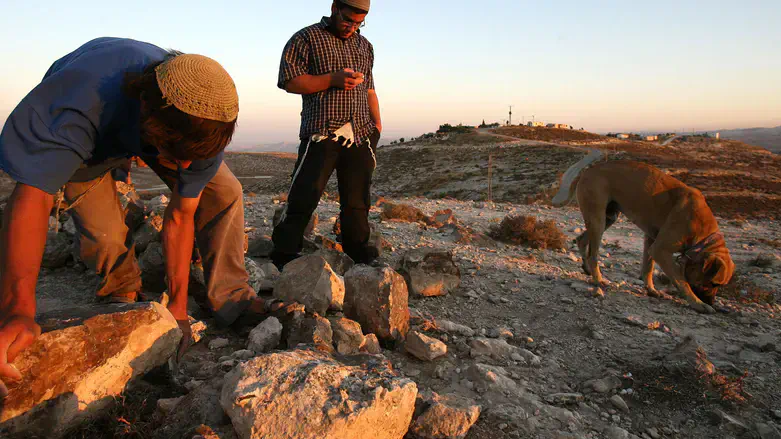
Remember those math lessons years ago about the X-axis (north-south) and Y-axis (east-west) that are perpendicular to one another but intersect at the “origin" - called point (0,0)? Well, on a recent day’s trip to three Israeli geographic start-ups, more commonly known as hilltop communities, each hilltop I reached seemed point (0,0) of just such a coordinate system, and from it I looked at what was to the north, south, east and west.
These were hilltops in Gush Etzion, the historic and thriving Etzion Bloc south of Jerusalem. The hiilltops are part of Area C in Judea and Samaria, under complete Israeli governance according to the Oslo Accords, are located about 15-45 minutes south from the more familiar city of Efrata and not far from the city of the Patriarchs, Hevron.
What was the catalyst for the proliferation of these hilltop communities, farms and sheep ranches in Judea and Samaria - a count of a whopping 360 outposts and agricultural farmsas of mid-2026? And what made Israel’s current government, at the initiative of Finance Minister Bezalel Smotrich, whose other position is additional minister within the Ministry of Defense for civil issues, encourage them (except for when it doesn't, see below)?
It began in 2009, when Salaam Fayyad, then Prime Minister of the Palestinian Authority, told the NY Times:
“We have decided to take the initiative, to accelerate the end of the occupation through hard work, and to create facts on the ground that are consistent with the idea that the establishment of a state is not something that can be ignored. This is our agenda, and we intend to implement it with determination."
Fayyad's plan, titled “Palestine: Ending the Occupation, Establishing the State," declared blatanty that, ignoring the Oslo Accords, the PA would work toward establishing “an independent Arab state with full sovereignty over all of the territory of the West Bank and Gaza Strip in the 1967 borders, with Jerusalem as its capital" and explained in detail how that would be accomplished.
The detailed plan remained under the radar and only became public recently, but Regavim, the public movement dedicated to preventing illegal seizure of state land which Minister Smotrich founded before turning to politics, warned about and described the dangers by 2016.
Regavim then published a thoroughly researched position paper in 2019, writing: “Fayyad described the vision and the blueprint for the de facto, unilateral creation of the Palestinian state. Basing itself on the Oslo Accords’ division of the territory and the PA’s already-established jurisdiction in Areas A and B, Fayyad explained that the establishment of the State of Palestine would be made possible by, among other things, the creation of territorial contiguity between the Arab population blocs in Area B of Judea and Samaria through massive construction and land-seizure in Area C. These projects would draw the borders of the State of Palestine as a fait accompli whether these borders were agreed upon or not."
And with the help of generous support provided by the European Union and its constituent states, as well as Arab states, the Palestinian Authority advanced a series of national initiatives through large-scale illegal construction, including buildings adjacent to and overlooking main traffic routes, massive agricultural projects in strategic locations and the attempted creation of contiguity between Arab towns and villages in Area C, intended to turn Israeli towns and villages into isolated dots on the map, and in effect, strangle them.
The Fayyad Plan did not remain a theoretical paper, but it took Israel time to realize the overall threat and begin to respond.
That is why Israel’s hilltop communities and farms in Judea and Samaria were founded, with idealistic young couples and youth managing to thwart key aspects of Fayyad’s plan. When the horrors of October 7 turned almost all Israelis against the very thought of a Palestinian Arab State alongside Israel, the government realized the need for the farms and sheep ranches spread over the empty expanses of land. It saw how hilltop communities would block Arab attempts to create contiguity - all this, I remind you, in Israel-controlled Area C.
Eventually those in favor of expanding already existing Jewish communities, a primary goal of settlement efforts, realized that doing so is contingent on their not becoming isolated enclaves. (Note: The left's opposition to settling Judea and Samaria coninues unabated - and what better way to fight this endeavor than to paint all of its activists as violent towards Arabs, despite that sweeping accusation’s being authoritatively disproven. See Regavim's position paper, Gadi Taub in Tablet, Jonathan Tobin on Arutz Sheva, and others)
And now that you know the background -
Imagine yourself joining our small group of mostly Americans, led by popular tour guide Shalom Pollack ([email protected], who asked each spokesperson what the pressing needs of his community are and then asked the group to donate towards one of them - from a Ranger to a water tank - which they most willingly did), and organized by Menachem Gottlieb (creator of the Hilltop Maccabees chat which already has over 300 friends. For more info on the hilltop communities, write [email protected]).
Here are your virtual vistas, one by one:
(Apologies for the Hebrew map, the only one available. Hilltop communities are in yellow and our visit is to the 2nd, 6th and 7th counting from the bottom of the map )

If you are at point (0,0) on the hilltop called Beit Anot (2nd from bottom on map), to your north is the large Arab city of Halhoul, to your south is Israel’s Route 35 which goes from Ashkelon to Kiryat Gat, Lachish, Beit Guvrin and Arab Tarqumiyah (several horrific terror attacks led to the closing of Route 35 exits to Arab towns - alternate roads exist) and joins Route 60 near Halhoul. To your east is more of Halhoul, and on to your west is Israel’s crucial Route 60 (officially the ‘Bible Road’) stretching from Beer Sheva to Nazareth. All this from the top of one hill.

Eitan Kalimeon, resident and spokesperson, explained how easy it would have been for Halhoul to expand, taking over this hill all the way to route 35 and route 60, and turning these major routes into death-traps for Israeli drivers. It is to prevent that scenario, while settling more of the Holy Land, that he and his wife, along with two other idealistic young couples, their children and a group of teenage volunteers, have made their homes on this barren hilltop.

Beit Anot was demolished, its three homes and synagogue, watchtower and water tank, by Border Police accompanied by Civil Administration inspectors, and Arab workers to empty those home, in the early hours of Thursday, June 25, although its strategic necessity is clear.
"We woke up in the middle of the night to a crazy and surreal event," Yaron Klav, a resident who was given minutes to evacuate from his home along with his wife and eight children, said to Arutz Sheva on Thursday morning. "Hundreds of police officers surrounded our house in a complex operation as if we were leaders of a crime organization. They gave us 10 minutes to get the children out, and then Arab workers simply started throwing all of our furniture and personal belongings outside - the baby's crib, the beds, the clothes, the kitchen utensils, everything. The children were in shock."

The cheerfully energetic teenage volunteers (hilltop youth to the mainstream media), whose days are spent working to develop the hilltop and whose nights are spent guarding it, told us they started to rebuild with supplies given to them by Elisha Yered, legendary head of the Frontline Hilltop Administration, and managed to finish an entire structure - the one in which we sat for refreshments and a talk - before Shabbat!
Since the process needed for Beit Anot’s gaining legal standing is not different from that of other communities, many of which were recognized retroactively, we hope it will soon become one of them. And that the establishment of a new Border Police battalion in the Gush Etzion area is to protect its Jewish communities.
On to the next hilltop:
If you are at (0,0) on the hilltop called Tsur Yehuda (third yellow rectangle from the top on the map) and look north, you see the Arab city of Beit Ummar, to the south you see Halhoul, to the East is route 60 and to your West the Israeli town of Carmei Tsur. Elya Guber, a founder of Tsur Yehuda, is especially proud of the Beit Midrash where each day begins with Torah study before attending to the arduous work at hand.
Elya grew up in Carmei Tsur, surrounded by a barbed wire fence no one dared to cross, but Arab plans to connect Beit Ummar and Halhoul, turning Carmei Tsur into a threatened, isolated community were thwarted by the establishment of Tsur Yehuda and residents can now walk beyond the fence without fear. A young, Melbourne-born shepherd shared his experiences with us. Sheep-herding, he said, need large expanses of land and are an important aspect of farms and hilltop communities.

And continuing southward:
Your next hilltop stop is Gefen Ami (second from top of map), where you can see Arab Beit Omar to the northwest, Arab El Aroub to the northeast, and discover that you are actually standing on a hill between the two parts of Route 60 which splits into two distinct paths: the older route passing through the Al-Aroub town center and the modern one avoiding Arab towns and known as the Beit Ummar/Al-Aroub Bypass.

Yair Harel Ben Baruch tends sheep and grows organic produce there. His wife Ayala, an up-and-coming influencer with nearly 40,000 followers and the farm’s co-founder, is part of a growing cohort of women using social media to showcase daily life on the strategic hilltops - a rural lifestyle focused on nature, shepherding, and organic produce. In fact, the volunteers we saw there were all young women who will spend the summer working as volunteers at Gefen Ami.
These are the young people of Israel, going off uncomplainingly to army service or bouts of reserve duty, settling barren hilltops and living in conditions demanding perseverance, courage and ingenuity. Many of their parents built what are now towns and cities in Judea and Samaria, and they have decided to act to make the fences around their childhood homes unnecessary.
As well-known activist Elisha Yered said in an interview:
"If we, the hilltop youth, are not there, we will get a terrorist state and end up battling on every hilltop in the entire country. Our enemies love land, and when Fayyad’s plan became public, people realized that we, too, must show our love for the land. Today there are 250 families and thousands of young people involved. Before Fayyad’s plan become known, there were 30." Am Yisrael Chai.