

Weekly Story: It Will Be Beneficial For You
by Rabbi Sholom Dovber Avtzon
Chassidim don’t need a reason to farbreng, but nevertheless there are occasions that demand a farbrengen. There are the Yoma d’Pagras (auspicious dates in our calendar), as well as other dates, such as every Shabbos Mevorchim, which the Rebbe mentions twice in HaYom Yom that chassidim should farbreng every Shabbos Mevorchim.
Every mashpia or chossid that speaks at a farbrengen has their own sweetness and insights.
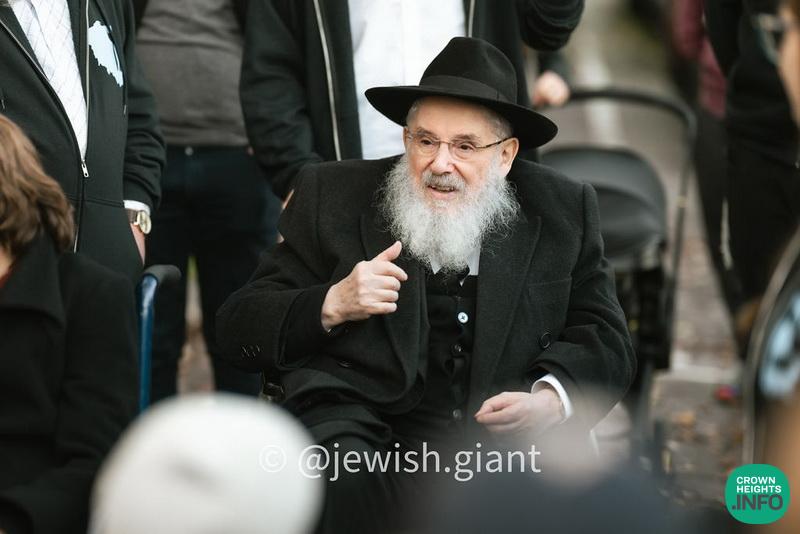
This week I will note a few insights that Rabbi Nissan Mangel sheyichye mentioned last Shabbos at his weekly Shabbos farbrengen, to give the readers a taste of a farbrengen.
As always, your feedback and comments are greatly appreciated and most welcomed.
In honor of Chof Av, we will begin with a story connected to the Rebbe’s father, HaRav Levi Yitzchok, which I [Rabbi Mangel] heard directly from Reb Leizer Nannes.
In 5678 (1918), I [Reb Leizer] visited the Rebbe RaShaB in Rostov. Towards the end of my yechidus, the Rebbe asked me how am I returning home. After hearing my reply that I am taking a certain train, the Rebbe said, “That train passes by the city of Yektrinislav, so would you be able to deliver for me a letter to HaRav Levi Yitzchok?”
“Yes”, I replied. The Rebbe than said, “Come back later and I will give you the letter.”
Arriving in Yektrinislav, I immediately began walking to Reb Levi Yitzchok’s house and proceeded to give him the letter. After he concluded reading it, Reb Levi Yitzchok asked me if the Rebbe [RaShaB] said a ma’amar on Shabbos. When I answered yes, he requested that I review it for him.
After hearing me review it, he asked me if I could stay for Shabbos, and in his drosha (sermon) he will explain the ma’amar according to Kabbalah. I remained for Shabbos and heard his explanations.
On Sunday I took leave of him. After wishing me a safe trip he said, come with me, I would like to show you something. He led me to a room, slowly opened the door and told me, “take a good look”.
I noticed that his son, the Rebbe, was immersed in his learning and in all probability, did not realize that his father and I had opened the door and looked into the room.
Reb Levi Yitzchok then told me, look at him as it will be beneficial to you. Over 50 years later when I [Reb Lazer] was finally allowed to leave Russia after my 20 years of imprisonment etc., I was zocheh to have a yechidus with the Rebbe. The Rebbe said to me, you knew my father, please tell me something about him. I then repeated to the Rebbe the above-mentioned story.
The Rebbe smiled and then asked me, “Was it indeed beneficial to you?”
“Rebbe, you see that I am here!”, was my reply.
*****
The word עקב is not a common word when one wants to say “because,” so the question becomes why does the possuk use it here? Rashi explains that עקב also has the meaning of heel, and the possuk is guiding and instructing us to meticulously fulfill even those mitzvos that one may think that are not really so important and therefore some trample on them, but no, we should carefully follow them too.
The Ba’al HaTurim notes that the numerical value of עקב is 172, and he continues that there are 172 words in the Aseres HaDibros (the ten Commandments). In other words, the Torah is alluding that we all should be very careful with every mitzvah [as all mitzvos are included in the Aseres HaDibros].
Rabbi Mangel added that 172 is twice 86, and we know that the Hebrew word Elokim has the numerical equivalence of 86, and as Chassidus explains in great depth, that Elokim has the meaning of concealment. So, in essence, Hashem is telling us, that even when a Jew is living in a time when there is a double concealment on G-dliness, even in those dark hours, one should be careful to fulfill every mitzvah in its minutest detail.
However, we all must remember what the Alter Rebbe tells us on the words of בחוקותי אם, that the fact that Hashem is requesting that we fulfill His Mitzvos, that itself is giving us the strength to do so. As our sages tell us, Hashem does not give anyone a challenge that He did not give them the ability to overcome it.
A Taste of Chassidus
אני לדודי ודודי לי Likutei Torah Devorim P. 32A
In general, in this section I normally write a concept that is discussed in the first ma’amar of Likkutei Torah on the parsha. However, being that in this week’s ma’amorim is the ma’amar of Ani l’Dodi, a ma’amar which I studied and wrote extensively on, I decided to focus on additional aspects and insights that we can glean from the Moshol of מלך בשדה – The King is in the Field.
Besides for the final thought noted here, which I note as my personal understanding, the thoughts and insights are based upon the numerous Ma’amorim and Sichos that the Rebbe said on this concept.
B’Ezras Hashem next week, being that there are no ma’amorim on Parshas Shoftim, I will write part 2. That part will focus on another aspect of the ma’amar, about those who are in the wilderness.
In this ma’amar the Alter Rebbe explains the now famous parable of מלך בשדה – The King is in the Field.
The first letter of the four words אני לדודי ודודי לי, spell out the word אלול. We have to understand what is the connection and message of these words to our conduct and service of Hashem in the month of Elul.
The meaning of these words is:
I draw close to my beloved and my beloved draws close to me. In Kitzur Shulchan Aruch, it is noted that we learn from these words that in the month of Elul we are to add [both in quantity (i.e. additional tefillos, such as לדוד ה’ אורי from the first day of Rosh Chodesh) as well as in quality (meaning, davening with more concentration), as that is how one draws closer to Hashem.
In Chassidic terminology this is defined as isarusa d’le’ttata isarusa di’le’eila – the Jewish people draw closer to Hashem, and that causes that Hashem comes closer to us.
The ma’amar begins with the statement that in the month of Elul, Hashem reveals His thirteen attributes of mercy/compassion upon us. So the question becomes, why isn’t every day of this month considered a Holiday? After all, on the other days that Hashem’s thirteen attributes are revealed (such as on Rosh Hashanah and Yom Kippur), they are holidays.
He explains, that while the thirteen attributes are out there and helping us, they are not openly revealed in a manner that is discernable – that all can actually see it, and subsequently, although one should be happy, tachanun is recited.
He demonstrates how this can happen (that there is a revelation and at the same time it is not revealed) with the following moshol.
A king, on his way to his palace, passes through the fields wearing his civilian clothing unaccompanied by his large and impressive entourage. The people working in the field hear that the king is in their vicinity and go to greet him. The king greets/receives them graciously and smiles to them. And they then escort him to his palace and are invited inside.
One of questions that the Rebbei’im ask about this moshol is, how can you say that it is an initiative that comes from the people when the only way they are able to go and greet the king is because he traveled there without any guards to stop them from coming close to him. So, isn’t it Hashem’s initiative (an isarusa di’le’eila) that came first? [So technically, this is like the other possuk in Shir HaShirim that states לו ואני דודי לי – that Hashem made the first initiative.]
The Rebbe answers that when we speak about whose initiative came first which causes a response, that is saying that the response comes automatically. [For example, when one believes or understands that something is good for them, they desire it, and when they feel that something is dangerous, they distance themselves from it.] However, here the king’s presence in the field does not force, or even cause, the people to come and greet him, as many people could decide not to. The only thing it did is, it gave the people the ability to (and perhaps the thought of whether they should) seize the opportunity and greet the king.
Therefore, it is completely through their own initiative.
As noted, around twenty-five years ago I wrote a booklet explaining many of the Rebbe’s insights on this Moshol.
Now based on what I gleaned from studying the Rebbe’s numerous Ma’amorim and Sichos on this topic numerous times for many years, I would like to note what I came to realize is the deeper intent of the moshol.
The moshol begins with the king on his way to his palace but doesn’t mention from where the king is coming from. Additionally, the Alter Rebbe does not say that he is returning to the palace (city), just that he is going there, seemingly for the first time. Furthermore, if his intent is to go to the palace, why did he intentionally first go to the field? Couldn’t he have gone directly to the city and enter his palace?
In my opinion as I understood it being alluded to in the Rebbe’s words, this is not merely a moshol explaining what the month of Elul is, a month where Hashem openly displays His tremendous love for His people, and subsequently He openly embraces us on Shemini Atzeres and Simchas Torah, but in the larger sense it is a moshol on the purpose of creation.
Before Creation, there was no time or place, so one cannot say where the King is coming from. But what is the goal, destiny and purpose of creation, it is that not only can Hashem reside in His palace – which is this physical world – in His full glory and essence without any concealment, but that the people of the field can also be present there, as will be explained.
When Hashem created the world, He chose to create it in a way of concealment that His essence not be automatically felt by the creations, as then they would be naturally nullified because of His overwhelming greatness. But rather, that they on their own choose to nullify themselves to Him.
Therefore, the King came without His royal entourage and garments, which will demand respect, but in civilian clothing, and the people chose on their own to show respect and greet Him.
But as the Rebbe explains the possuk םלך לשדה נעבד- A king is dependent on the field, that the reason He came to the field is because the King and his citizens (subjects) who live in the city need the food that is produced in the fields. The same thing is true in Creation; Hashem chose that the only way that the world could be elevated, is by us humans working with the material aspects of this world and utilizing them to honor and glorify Him.
That is accomplished by taking an animal and sacrifice it on the Mizbei’ach, while using an animal hide to create parchment upon which a scribe would write a mezuzah, tefillin or sefer Torah. As well as using the food we eat to serve Him.
Only when we serve Him on our own accord and demonstrate that we recognize that everything is G-dliness (so essentially, we saw through the concealment) does His essence become completely revealed even on the earth, and He enters His palace, where He dons His royal garments and is surrounded by His entourage. Meaning that only when we finish our task of revealing this truth, can Hashem’s essence be openly revealed in this world (as well as in the higher supernal worlds (something that never happened before)). Therefore, it is the first time He is entering with His full essence revealed into His permanent dwelling place on this world.
And then those who worked in the field, while remaining humble, are allowed to enter the palace with the king, and are able to see Him in His true essence and remain intact (and not being completely nullified).
And that will happen speedily in our days with the coming and revelation of Moshiach Tzidkeinu.
Kesiva V’Chasim Tova, L;Shana Tova U’Mesukah
Rabbi Avtzon is a veteran mechanech and the author of numerous books on the Rebbeim and their chassidim. He is available to farbreng in your community and can be contacted at [email protected]