

 Jewish Breaking News
Pentagon Orders U.S. Arms Makers to Ramp Up Production as Iran War Drains Critical Missile Stockpiles
The Pentagon is pushing America’s defense industry to dramatically accelerate weapons production as months of fighting with Iran eat into some of the U.S. military’s most important missile and interceptor stockpiles.
Deputy Defense Secretary Steve Feinberg gave defense industry leaders just 21 days to submit plans for significantly faster deliveries or increased production of critical weapons, according to a Pentagon memo obtained by The Washington Post. “Years-long development cycles are not acceptable,” Feinberg wrote, calling for an immediate expansion of production capacity.
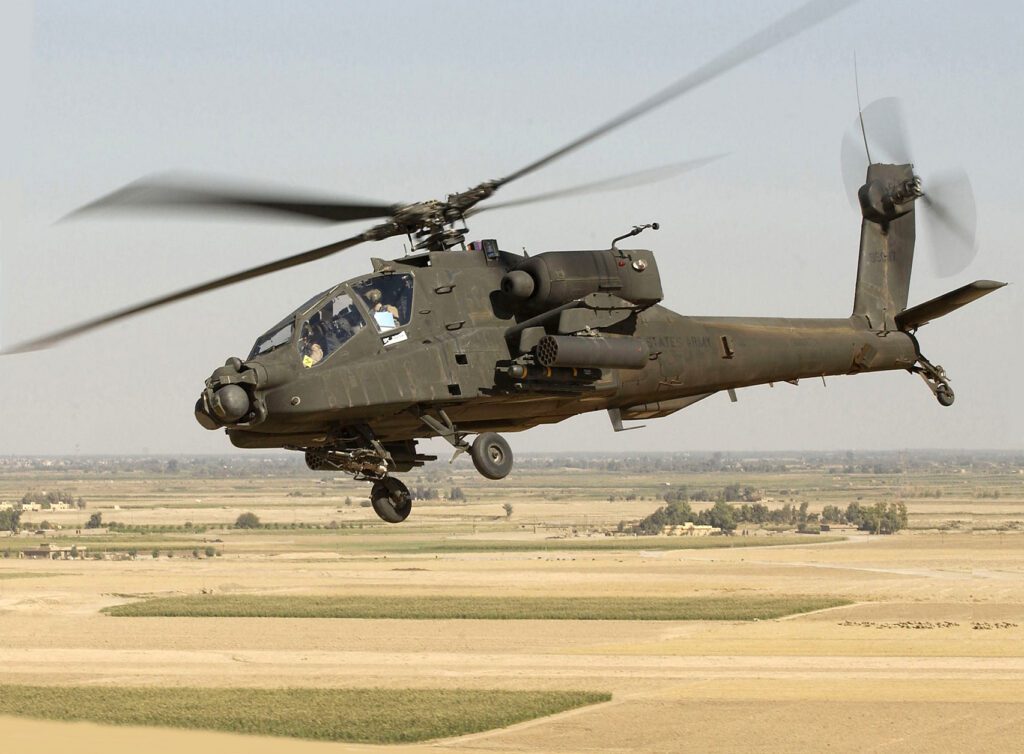
A U.S. Army AH-64D Longbow Apache, 1st Battalion, 101st Aviation Regiment, Fort Campbell Ky., provides ground forces with air support from Forward Operating Base Speicher Iraq, Oct. 21, 2005, during Operation Iraqi Freedom. (U.S. Air Force photo by Tech. Sgt. Andy Dunaway) (Released)
The 1st Battalion, 101st Aviation Regiment, the “Expect No Mercy” Battalion, is the premier attack helicopter battalion in the United States Army. Its lethal fleet of 24 Ah-64D Longbow Apaches is currently conducting combat operations in Northern Iraq, caring on a long tradition of excellence among Army Aviation.
1-101st first gained notoriety during Operation Desert Storm in 1991, when it fired the first shots of the Gulf War during Operation Normandy, destroying key Iraqi radar sites and creating a safe corridor for US aircraft to commence the air campaign. The battalion again proved itself during Operation Iraqi Freedom in 2003-2004, conducting several mobile strike deep attacks during major combat operations followed by eight months of quick reaction force (QRF), reconnaissance, and VIP security missions during stability and support operations (SASO). After a rigorous 19 months of training and maintenance back at Fort Campbell, Kentucky, the “Expect No Mercy” battalion deployed to Iraq for its second OIF tour.
Since arriving in Iraq, the battalion has conducted an aggressive Relief-in-Place/Transfer-of-Authority (REP/TOA) with 8-229th Aviation Regiment from Fort Knox, Kentucky. The battalion is on track to fly over 1000 combat hours in October, and is already making an impact on operations in Iraq. Initial combat missions involved teams of two “No Mercy” aircraft along with one 8-229th aircraft conducting local area orientations (LAO) to familiarize aircrews with the environment, geography, and unity on the ground. By no means was an LAO an administrative mission though: while on orientations, aircrews participated in numerous reconnaissance
The order highlights the enormous strain the Iran war has placed on America’s arsenal, particularly its advanced missile-defense systems. An analysis by the Center for Strategic and International Studies estimates the U.S. Patriot interceptor inventory has fallen from roughly 2,330 before the war to between 759 and 827 following the latest fighting, a decline of at least 65%. THAAD interceptor stocks are estimated to have fallen from 452 before the war to roughly 234-278.
Those systems are among Washington’s most important defenses against Iranian ballistic missiles and are difficult to replace quickly. CSIS has previously estimated that rebuilding Patriot and THAAD inventories to their prewar levels under existing production plans could take three years or more, raising concerns about U.S. readiness for another major conflict, particularly in the Indo-Pacific.

Pentagon spokesman Sean Parnell confirmed that Feinberg’s directive is real, saying the department is seeking to deliver weapons “at the pace the threat demands.” He argued, however, that the effort is part of a broader campaign to rebuild the American defense industrial base rather than evidence that the military is unable to fight.
The move comes amid increasingly public disagreement over the condition of America’s stockpiles. President Donald Trump has insisted the United States possesses “massive amounts” of munitions and says manufacturers are rapidly producing replacements. Defense Secretary Pete Hegseth has also rejected reports suggesting some key interceptor inventories have been nearly exhausted.

But the Pentagon’s demand for faster production underscores a broader lesson from the Iran war: even the world’s largest military can expend sophisticated weapons far faster than industry can replace them.
For Israel and American forces across the Middle East, the consequences are particularly important. Iran has repeatedly relied on large missile and drone barrages designed in part to pressure advanced air-defense networks. Replenishing those interceptor stocks could become critical if large-scale fighting resumes.