
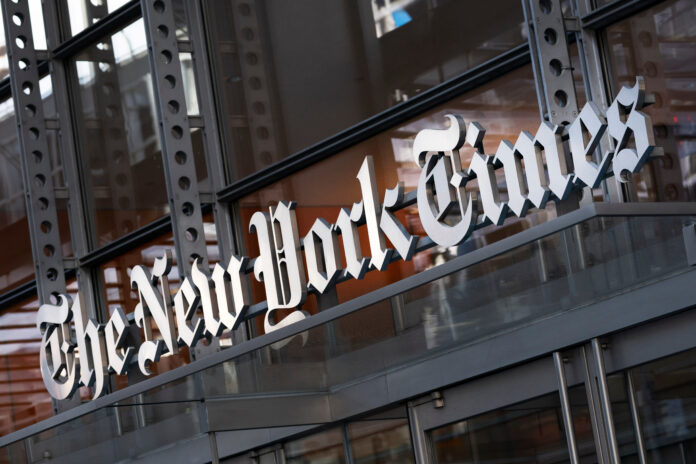

New York (VINNEWS/Rabbi Yair Hoffman) Something unusual appeared in the New York Times this morning: a long, warm, photograph-rich feature about Holocaust survivors in Borough Park. It followed a tzadeikes, Rizy Horowitz, of the Nachas Health and Family Network, who has served the survivor population there since 1990, and it centered on the hundredth birthday party of Reb David Einhorn z”l, an Auschwitz survivor who was niftar four days after the celebration.
The tone was unusually affectionate. The chassidishe crowd was portrayed quite positively and appeared accurately as devoted, joyous, and multigenerational. Rav Dovid Goldwasser shlita’s retelling of the cabbage that rolled to Mr. Einhorn’s feet before Yom Kippur 1944 was reported without a raised eyebrow.
For readers in Borough Park and across the tri-state area who have spent the last several years reading a rather different New York Times, the question forms instantly: why this article, and why now?
The conjecture offered here is that the piece functions, whether consciously or not, as a kind of ballast. It is an attempt to restore what the paper has been steadily losing — credibility with Jewish readers, and specifically with Orthodox Jewish readers — at a moment when that erosion has become expensive.
The most immediate example is that Israel’s Consul General in New York, Ofir Akunis, ordered the cancellation of every New York Times subscription held at the Israeli Consulate in New York. Akunis accused the paper of publishing “false blood libels” against the Jewish state, said it consistently demonizes and delegitimizes Israel, and charged that it leans on anonymous sources while turning to anti-Israel activists and even Hamas figures when it does name them. Someone in management must have said, “Okay, let’s run that positive piece Helene Stapinski was working on.”
In 2022 and 2023, the Times ran a sustained series attacking chassidishe yeshivos in New York. The series was experienced in Borough Park and Williamsburg as an assault on a community’s right to educate its children according to its mesorah. It generated regulatory pressure, legislative hearings, and a durable sense that the paper of record was anti-Semitic and regarded the chassidishe world as a serious problem rather than a community to be understood.
It had also depicted Israel as a cruel caricature attacking Gazans, and not as acting in self-defense against the largest anti-Jewish murder spree since the Holocaust. In April 2019, the international edition published a cartoon depicting the Israeli prime minister as a dog on a leash held by a blind, yarmulke-wearing American president. The paper apologized and subsequently ended syndicated political cartoons in that edition altogether. The image itself was drawn from a visual vocabulary with an unmistakable lineage.
In October 2023, the Times fronted casualty figures from the Gaza health ministry regarding the al-Ahli hospital blast, attributing them in a headline before verification. An editors’ note followed, conceding the paper had relied too heavily on unverified claims.
And underneath all of it sits Laurel Leff’s Buried by the Times, the scholarly account of how the Sulzberger-era paper systematically minimized and back-paged the destruction of European Jewry as it was occurring. That history is documented, and is known to every literate Jewish reader over the age of thirty.
THE ACCUMULATED RECORD OF PROTEST
The consulate cancellation is the latest entry in a file that has been thickening for years, and the identity of the complainants are the central institutions of Jewish communal and political life.
Prime Minister Netanyahu has made the Holocaust-coverage history an explicit part of his standing indictment of the paper. Responding to a Times editorial about his incoming government, he wrote that the paper had buried the Holocaust on its back pages for years and demonized Israel on its front pages for decades, adding that he would simply ignore its advice. That is a head of government invoking Laurel Leff’s thesis as settled fact.
He has since gone further, telling Fox News that he was examining whether a country can sue the Times, calling its Gaza reporting clear defamation. The occasion was a front-page photograph of an emaciated Gazan child; the paper later issued a correction acknowledging that the child had a preexisting medical condition contributing to his appearance, a fact omitted from both the article and the caption.In May 2026, a Nicholas Kristof opinion piece alleging that Israel used dogs to attack in unprintable terms Palestinian detainees drew a threatened lawsuit and was dismantled by HonestReporting’s Rachel O’Donoghue in the Wall Street Journal, who showed that the central claim rested on Euro-Med, a Hamas-linked NGO with a documented record of provably false assertions.
Professional media monitors have reached the same conclusion from the inside of the industry. Zvika Klein, editor-in-chief of the Jerusalem Post, said American coverage was strong in the days after October 7 but that the Palestinian narrative quickly took over, and named the Times as by far the worst offender — systematically anti-Israel, and dramatically more so than any other outlet.
On the yeshiva series, the communal response was organized, sustained, and unusually public. Agudath Israel of America mounted an aggressive media and billboard campaign — the billboard placed within sight of the Times building itself — under the banner “Know Us,” calling the coverage a smear campaign that presented a grossly distorted picture of the yeshivos and of chassidishe life generally. When the paper ran a front-page piece on special education funding, Agudah’s response noted this was the thirteenth such front-page article in three and a half months, and observed that attacks on visibly Jewish New Yorkers had risen sharply over the same period.
Rabbi Chaim Dovid Zwiebel, Agudath Israel’s executive vice president, addressed the substance directly. He described the yeshivos as warm learning environments that transmit the mesorah, said the portrait of children subsisting in a cruel and abusive setting was simply untrue, and pointed out that the data showed them to be safer than the public schools. Agudah also noted the state’s public comment period had produced some 350,000 letters, overwhelmingly from parents asking that the yeshiva system be left alone — and asked whether the Times could not have found a single one of them to interview.The Anti-Defamation League — no one’s idea of a chassidishe advocacy group — issued its own statement of concern, following earlier criticism from Jonathan Greenblatt. The ADL warned that with hate crimes against visibly identifiable Orthodox Jews rising sharply, such stereotyping can add fuel to the fire, and asked that the paper’s readers refrain from generalizing about these communities.
The ADL raised the alarm twice, even while acknowledging that the yeshiva system warranted scrutiny.The Know Us campaign eventually took its case to the Pulitzer committee in an open letter alleging bias and ethics violations, noting that the Times had quoted Yaffed board members without disclosing their affiliation and had claimed credit for state policy changes that were years in the making.
Read together, this is a decade’s worth of the Jewish world’s most established institutions — a sitting prime minister, a consul general, the Agudah, the ADL, the editor of Israel’s English-language paper of record — telling the same newspaper the same thing.
Clearly, an institution carrying that cumulative record, and facing organized cancellation campaigns from Jewish subscribers and institutional advertisers, has an interest in producing coverage that demonstrates warmth toward precisely the community it has most alienated. A feature about beloved elderly survivors in Borough Park, with a righteous nonprofit administrator at its center and no policy argument anywhere in it, is close to an ideal instrument for that purpose. Nobody can object to it. It costs the editorial page nothing. And it can be pointed to.
THE OTHER SIDE
Aristo, whom the Rambam writes was the smartest person that had lived, writes that one should always state the other side when presenting an argument or a theory and then analyze its arguments.
First, the Times has run human-interest features on Holocaust survivors for decades, including during periods when no one was accusing it of anything. The Claims Conference’s Vanishing Witnesses data — half of living survivors expected to be gone within five years, ninety percent within fifteen — is a legitimate news hook that any paper would recognize. The story of a man who lives to see his hundredth birthday and is niftar four days later writes itself.
Second, the Times’ overall subscription numbers have continued to grow. A cancellation campaign that is loud is not necessarily a campaign that is large, and there is no public evidence of a subscriber exodus of the magnitude the conjecture requires. A consulate’s institutional subscriptions, however symbolically weighty, are a rounding error on the balance sheet.
Third, and most important: large newsrooms are not single-minded. The features desk that assigned this piece and the editors who handled the yeshiva investigation are not the same people, do not report to the same person, and in many cases do not speak to one another. Attributing coordinated strategy to an institution of that size usually says more about the observer’s need for coherence than about the institution.
WHAT REMAINS
The strongest version of the conjecture does not require a conspiracy. It requires only that even callous New York Times editors respond to sustained criticism — that a paper repeatedly told it has a Jewish problem becomes marginally more receptive to a pitch about Jews it can admire without complication.
But the community that the Times investigated in 2022 and the community it celebrated this month are the same community. The grandchildren in the photographs at the Seville Manor, in matching striped polos, attend the yeshivos the paper had spent two years describing as failures. The survivors being served falafel and knishes on 48th Street built those institutions deliberately, out of ash, as their answer to what had been done to them. A publication capable of holding both facts in view at once — that the schools and the survivors are one enterprise, not two — would not need any ballast.
Reb Dovid Einhorn z”l ate half a cabbage and saved the rest for after the fast. Whatever the Times’ reasons for printing that, it was worth printing, and there are fewer than 187,000 people left in the world who can supply such a story.
But what the New York Times did here was not Teshuvah. They have furthered the anti-Semitism that is visibly tangible to anyone, and for that they must do far, far more penance.
The author can be reached at [email protected]