
 Vos Iz Neias
‘Quiet Before The Storm’: Iran Using Lull In Hostilities To Prepare For Renewed Conflict
NEW YORK (VINnews) — Despite the signing of a memorandum of understanding between U.S. President Donald Trump and Iran at the Palace of Versailles in mid-June, a new report in the Wall Street Journal suggests based on interviews with Iranian and Arab officials that Tehran may have used the lull in hostilities to prepare for a broader regional confrontation rather than pursue a lasting diplomatic settlement.
The agreement reportedly offered Iran significant economic incentives, including sanctions relief, the ability to resume oil exports, access to billions of dollars in previously frozen assets, and the prospect of a $300 billion reconstruction fund. In return, the United States hoped Iran would reopen the Strait of Hormuz and help bring regional fighting to an end.
However, according to sources in Iran and several Arab countries, Iran’s leadership viewed the agreement as a tactic by the United States and Israel to buy time. They claim Tehran responded with a dual-track strategy: while its diplomats, led by more pragmatic figures such as President Masoud Pezeshkian, who reportedly supported an agreement to avert economic collapse, continued negotiations, Supreme Leader Mojtaba Khamenei allegedly began preparing the country’s security apparatus for renewed conflict.
According to the report, Arab intelligence agencies intercepted communications indicating close coordination between Iran’s Islamic Revolutionary Guard Corps (IRGC) and Tehran-backed militias throughout the region.
The alleged strategy quickly manifested itself, with attacks on commercial shipping in the Strait of Hormuz resuming and hostilities expanding into the Red Sea. Yemen’s Houthi movement, reportedly supported by the IRGC with intelligence, weapons, and operational guidance, declared the Bab el-Mandeb Strait closed to Saudi Arabia and began attacking Saudi-linked forces.
At the same time, Iraqi militias allegedly targeted Saudi oil facilities, while Iran reportedly launched advanced ballistic missiles toward Jordan, demonstrating what analysts described as improved precision capabilities.
Tehran-based security analyst Mohammad Hassan Sangtarash characterized the campaign as a “salami tactic”, a gradual escalation designed to wear down opponents before a much larger confrontation.
Behind the scenes, the report says Mojtaba Khamenei has carried out sweeping changes within Iran’s security establishment.
Veteran IRGC commander Mohsen Rezaei was reportedly appointed secretary of Iran’s Supreme National Security Council, while Hossein Taeb returned to lead the Basij militia, where he is expected to oversee an expanded domestic intelligence network aimed at suppressing potential unrest fueled by Iran’s economic crisis.
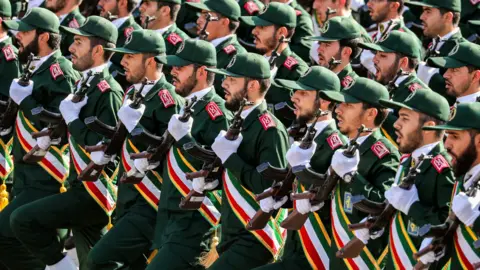
The report further claims that the IRGC, estimated to number around 200,000 personnel, has been granted expanded authority over Iran’s conventional military under the command of Ali Abdollahi. Newly appointed IRGC commander Ahmad Vahidi was reportedly instructed to prepare for “powerful offensive operations.”
According to the report, contingency plans now include possible sabotage of undersea internet cables in the Persian Gulf and efforts to stir unrest in countries with significant Shiite populations. Kuwait, for example, is said to be increasingly concerned after recently intercepting six IRGC operatives who allegedly entered its waters aboard a fishing boat.
The reported developments have heightened concerns among Gulf states, which fear Iran’s increasingly belligerent posture and what they view as the West’s inability to restrain Tehran.
President Trump, angered by the renewed attacks and reportedly describing Iran’s leadership as “sick,” is said to have suspended negotiations while waiting for economic sanctions to exert greater pressure.
According to the report, diplomatic efforts have stalled after the IRGC blocked attempts by Iranian negotiators to reach an agreement through Omani mediation on the gradual reopening of the Strait of Hormuz.
Meanwhile, Iranian officials are reportedly preparing the country for what they describe as a “survival economy.” Sources close to Iran’s negotiating team claim the current calm is merely “the quiet before the storm.”
A senior Iranian strategic adviser was quoted as suggesting that a deeper motivation behind Tehran’s continued confrontation is a “multi-generational blood revenge project” following the assassination of former Supreme Leader Ali Khamenei at the beginning of the war, an indication, according to the report, that Iran’s leadership is preparing for a prolonged conflict.