
 Vos Iz Neias
James Lindsay Warns DSA Is Trying to Take Over Democratic Party From Within
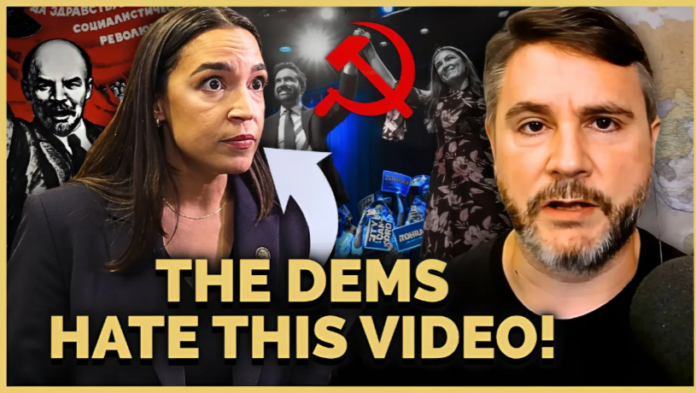
NEW YORK (VINnews) — Author and political commentator Dr. James Lindsay issued a stark warning about the growing influence of the Democratic Socialists of America, arguing in a wide-ranging interview with Rabbi Daniel Schonbuch that the organization is attempting to capture the Democratic Party from within and push the United States toward a far more radical political system.
Lindsay, co-founder of New Discourses and a longtime critic of Marxism and progressive ideology, compared what he sees happening inside the Democratic Party to the strategy employed by Vladimir Lenin and the Bolsheviks more than a century ago.
“The DSA’s openly stated goals are to hollow out and take over the Democratic Party apparatus,” Lindsay said. He argued that a separate revolutionary socialist party would have little chance of succeeding nationally, making control of an established political party and its resources a far more effective strategy.
Schonbuch pointed to a series of proposals discussed during the interview, including abolishing the Senate, fundamentally changing the presidency and Supreme Court, abolishing ICE, eventually eliminating national borders, defunding the Pentagon, transforming the prison system and expanding public ownership of major corporations. Lindsay said these ideas draw inspiration from a mixture of Marxist, Leninist, Maoist and other communist traditions.
According to Lindsay, one of the most misunderstood phrases in American politics is “democratic socialism.” He argued that the word “democratic” can conceal a fundamentally different conception of democracy than the traditional American understanding of equal political rights.
Lindsay traced that conception to Leninist political theory, arguing that under revolutionary socialism, political rights historically became increasingly reserved for those supporting the socialist project while opponents could lose political influence, property rights and freedom of expression.
The conversation also focused heavily on New York and the ability of the DSA to organize nationally while fighting elections locally.
Lindsay argued that the movement’s strength is not simply ideological but organizational. He described a system in which activists and resources from around the country can be concentrated on individual local races.
“Their ground game is of national scale at the local level,” Lindsay said, warning that establishment Democrats have been too weak to resist the movement while Republicans have often failed to appreciate the sophistication of its organizing operation.
But Lindsay rejected the idea that the DSA’s rise is inevitable.
He argued that dramatically higher voter participation—particularly in lower-turnout congressional, state and local elections—could stop socialist candidates and simultaneously empower moderate Democrats to challenge the DSA’s growing influence within their own party.
“If we show up,” Lindsay said, voters “can actually block this.”
The interview also turned to another threat Lindsay believes Americans are badly underestimating: information warfare and foreign manipulation of social media.
Lindsay argued that hostile foreign actors do not necessarily need to directly pay prominent American influencers. Instead, networks of bots and coordinated accounts can artificially amplify particular messages, increasing engagement and indirectly encouraging creators to produce increasingly sensational content because that content becomes profitable.
He specifically discussed Russia and Iran, describing sophisticated efforts to manipulate Western perceptions through social-media ecosystems.
The problem, Lindsay suggested, extends beyond the political left.
During the discussion, Schonbuch raised the influence of figures including Tucker Carlson and Candace Owens. Lindsay expressed concern about a faction of the American right that he described as increasingly isolationist and, in some cases, antisemitic. He warned that polarization could push mainstream Americans either toward political disengagement or toward increasingly radical alternatives.
For Lindsay, that possibility creates a dangerous cycle: radicalism on one side produces radicalization on the other, while the political center becomes increasingly paralyzed.
His central message, however, was that Americans still have a peaceful and democratic mechanism for stopping that cycle: participation.
The battle, Lindsay and Schonbuch agreed, must ultimately be fought at the ballot box. Schonbuch specifically urged the Jewish community and other Americans concerned about the country’s direction to become politically engaged rather than assume someone else will stop the movement.
“Without that action, without that activity, we cannot defeat the DSA,” Schonbuch said.
The full interview with James Lindsay was conducted by Rabbi Daniel Schonbuch, LMFT, host of the Viktor Frankl Podcast.
Follow Rabbi Daniel Schonbuch and the Viktor Frankl Podcast at YouTube.com/@rabbiforamerica