
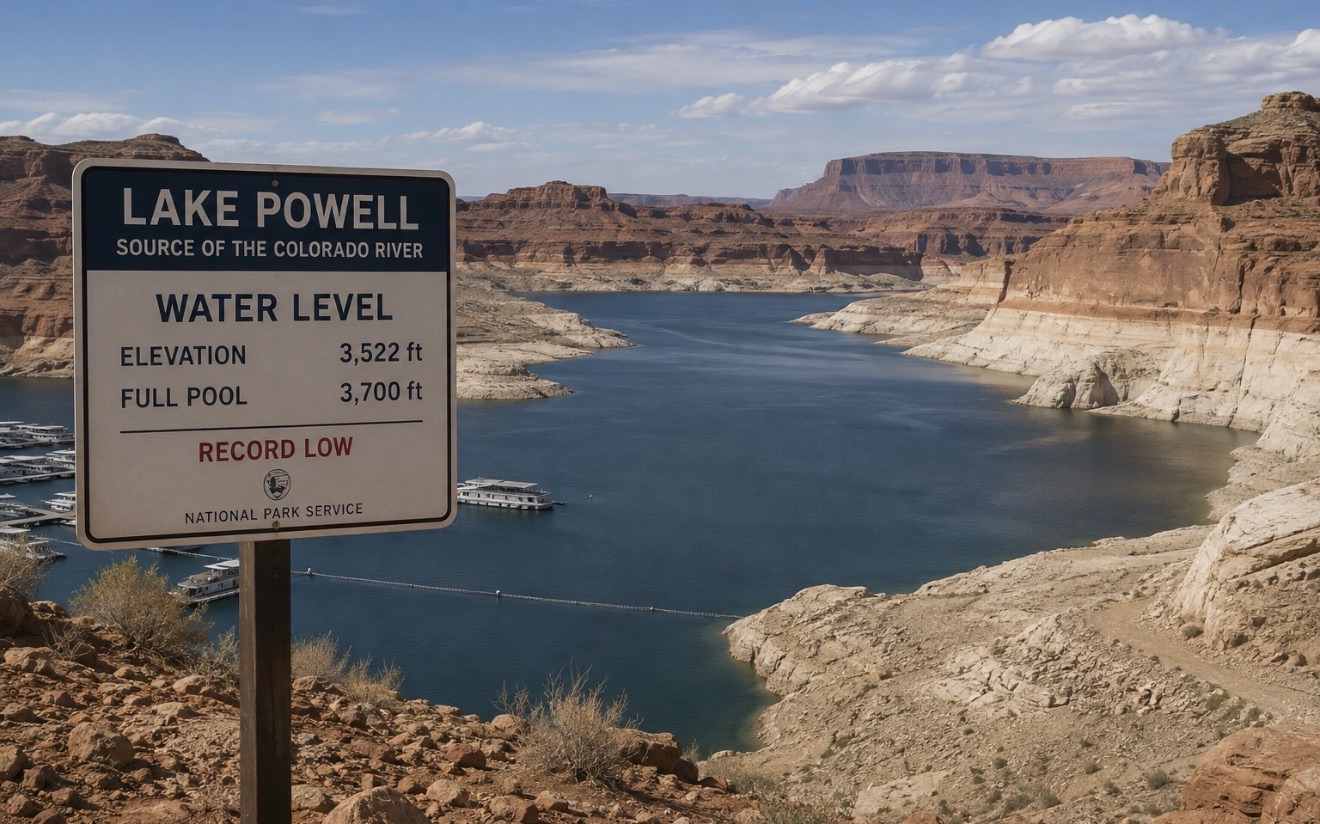

Lake Powell is now holding less water than at any point since it was built, which means less water for farms and cities across the Southwest and less electricity coming out of the dam that holds it back. The lake’s levels fell to 3519.91 feet on Saturday — low enough to break the record of 3,519.92 feet set in April 2023, according to a reading published Sunday by the Bureau of Reclamation.
The margin is thin enough that the number may move. Federal water officials caution that the daily water level figure is “provisional and subject to revision” and the new record could be walked back considering its razor-thin margin. But even if Saturday’s reading doesn’t hold, the lake’s downward trend means the actual record low is just days away.
Powell is one half of a system the West runs on. Plummeting water levels pose a major threat to the Colorado River Basin, which is a key resource for wildlife, hydropower and more than 40 million people in seven U.S. states. Those states — California, Arizona, Nevada, New Mexico, Utah, Wyoming and Colorado — have been trying for years to agree on how to divide a river that no longer delivers what the original math assumed.
The other half hit bottom first. Only a little over a week ago, Lake Mead also hit a milestone, dropping to its lowest elevation on record. It was sitting at 1,040.50 feet above sea level on Aug. 6 — which is the least amount of water in the reservoir since it was filled in the 1930s. The last time their combined storage was this small was in May 1957 when Glen Canyon Dam that holds back Powell was being built.
Put simply, Powell is running at roughly one-fifth full. The reservoir sits about 180 feet below its full mark and has dropped close to 32 feet in the past year alone. The number that matters for the electric grid is 3,490 feet — the point at which the dam’s turbines can no longer generate power reliably. The lake is now roughly 30 feet above it. Another year like the last one closes that gap entirely.
Timing works against a quick recovery. While Lake Mead usually starts to refill at this point in the season, Lake Powell won’t do so until spring. That leaves months of evaporation and drawdown before mountain snowmelt has any chance to help.
The commercial damage is already visible on the shoreline. The depletion has also impacted Lake Powell’s substantial tourism industry, forcing marinas in the reservoir to adapt. Boat ramps have closed or moved, new ones are being added and marinas have been temporarily relocated to deeper waters. For the towns around Page, Arizona, that boating season is the economy.
Fixes are underway but slow. The seven basin states and the federal government are still negotiating new sharing rules to replace guidelines that expire, and Reclamation has been holding back releases from upstream reservoirs to protect Powell’s power pool. Farmers in Arizona and California, who use the largest share of the river, are being paid to fallow fields and switch to lower-water crops.
For businesses outside the region, the exposure runs through produce prices and power costs. The Colorado River irrigates a large share of the nation’s winter vegetables, and hydropower lost at Glen Canyon has to be replaced with more expensive generation across the Western grid.
JBizNews Desk | New York
© JBizNews.com All Rights Reserved. Reproduction or distribution without written permission is prohibited.