
 Matzav
Degel HaTorah Weighs Historic Split From Agudas Yisroel as Porush and Zeibert Hold Secret Meeting
The possibility of a historic breakup within United Torah Judaism is being taken increasingly seriously, with senior Agudas Yisroel figures quietly examining whether the Chassidic party could cross the electoral threshold on its own if Degel HaTorah follows through on plans to run separately in the upcoming election.
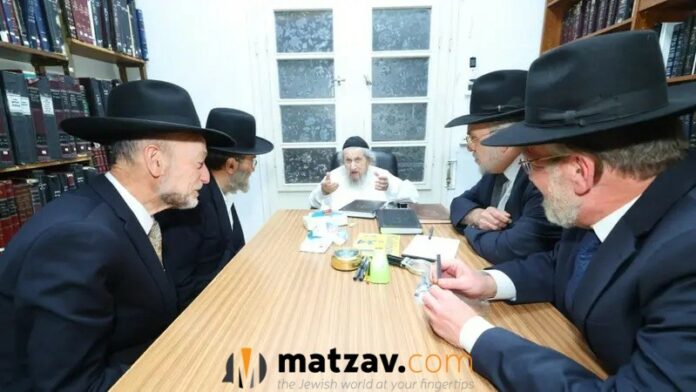
Against that backdrop, Shlomei Emunim chairman MK Meir Porush and Bnei Brak Mayor Chanoch Zeibert, a senior Gerer representative who also serves as secretary-general of Agudas Yisroel, held a lengthy and highly significant meeting this week after an extended period of strained relations, according to a report by Kikar HaShabbat.
The meeting came as Degel HaTorah is reportedly giving serious consideration to separating from Agudas Yisroel for the upcoming election, not merely as a negotiating tactic but because of fundamental disagreements over the draft issue and the future political direction of the Chareidi parties.
Relations inside Agudas Yisroel have themselves long been marked by deep tensions, particularly between Porush and Ger. Those differences have traditionally been temporarily set aside before national elections, producing what amounts to an uneasy truce until the campaign is over.
According to the report, the latest meeting between Porush and Zeibert was initiated by Ger and took place in a Chareidi-majority city. The two sat together for several hours.
A major portion of the discussion centered on Degel HaTorah’s potential departure and whether Agudas Yisroel could realistically survive electorally without the Litvish party.
Such a campaign would likely require an unprecedented mobilization of the Chassidic electorate, including communities and individual Chassidim who traditionally do not vote. Agudas Yisroel would need those voters to rally behind the party in order to demonstrate the Chassidic community’s true electoral strength and ensure that the party clears the threshold.
A senior Agudas Yisroel official described the Porush-Zeibert meeting as extraordinary given the hostility that has developed between their respective camps.
“The meeting is dramatic, since the gaps between the two warring sides are only growing all the time, especially in light of the draft law. The sides despise each other, and the fact that they met is already an important statement,” the official said.
He said Porush continues to harbor serious grievances over Ger’s conduct in recent years, including its actions during municipal elections and its approach to the draft controversy.
“What Ger has done in recent years, both regarding the municipal elections and regarding the draft, are serious and unacceptable events from Porush’s perspective, and therefore the very fact that he agreed to meet with Ger and give legitimacy to running with them, instead of joining Degel HaTorah, shows the matter-of-fact approach he is taking in the story with Ger,” the official said.
Despite the discussions, the official said there remains considerable skepticism that Degel HaTorah would actually leave Agudas Yisroel to fight for its political survival alone.
“According to what I know, no one thinks that Degel HaTorah will leave the Chassidim to contend with the electoral threshold alone, because then Chareidi Jewry would certainly lose at least three mandates and perhaps even seven,” he said. “At the meeting, the sides tried to understand whether the move is realistic at all and with whom they have a chance to unite in order to safely cross the electoral threshold. The issue of establishing the Tzeva Shachor party and the rumors that those promoting the issue are Gerer Chassidim also came up at the meeting.”
Still, the series of private meetings and political briefings surrounding the issue has led senior figures to believe that this year’s threatened split is considerably more serious than previous attempts by Degel HaTorah to improve its bargaining position within United Torah Judaism, such as demands for the chairmanship or additional realistic slots on the electoral slate.
Degel HaTorah leaders are closely watching developments inside Agudas Yisroel and have reportedly reached the conclusion that if they can establish with sufficient confidence that the Litvish party can cross the electoral threshold without Chassidic support, they are prepared to take the dramatic step of running independently.
Supporters of the idea point to Degel HaTorah’s success in running separately in several municipal contests as evidence that the strategy could also succeed nationally.
The Litvish desire for an independent slate is not new. A similar split nearly occurred before the previous national election but was ultimately stopped by Rav Gershon Edelstein zt”l, who was concerned that Agudas Yisroel might fail to cross the electoral threshold independently.
That same concern remains before the Gedolei Yisroel today as they consider whether the risks of dividing the longtime alliance outweigh the political and ideological benefits of independence.
Adding to the indications that the situation is unusually serious, no election-related meeting has yet been held between Degel HaTorah and Agudas Yisroel, according to the report. That is considered highly unusual this close to an election and differs sharply from previous campaigns.
Sources from both factions reportedly acknowledged privately that preparations for a possible separate run are being examined even as the parties continue to project an image of unity publicly.
A senior Degel HaTorah official said the party has considered going alone numerous times in the past, primarily because Litvish leaders believe their community deserves greater representation based on the number of votes it contributes to United Torah Judaism.
“Until today, there were many times when we intended to run alone, for a variety of good reasons, most of which stem from the desire to receive genuine representation for our public,” the official said.
He argued that Degel HaTorah accounts for more than half of United Torah Judaism’s actual voters and claimed its internal election data supports that conclusion.
“Understand,” he said, “we know that we bring more than fifty percent of the votes to United Torah Judaism. These are numbers that we have in our election headquarters. It is not only that we are larger than the Chassidim; there is also an open secret that everyone knows but does not talk about — many, many people in the smaller Chassidic groups simply do not go to vote, ignore the instructions of the rabbonim, and their Rebbes also do not push them to vote. With us the situation is different. Most — an absolute majority — fulfill ‘V’asisa k’chol asher yorucha’ and go out in huge numbers to vote. In Election Day numbers, we are much larger than the Chassidim.”
This time, however, the official said electoral representation is not the primary force behind the possible separation.
“But this time that is not our trigger for separating,” he said. “For close to a decade, we have been conducting an enormous battle over the draft law. Eight years ago, there was a good draft law offered to us that was acceptable to all of our Gedolei Yisroel, but the problem was that several important rabbonim from the Chassidic sector came along, opposed the law and caused everyone to become more extreme.”
The Degel official argued that following Agudas Yisroel’s more uncompromising elements ultimately proved to be a strategic mistake.
“We were swept along after the extremist elements of Agudas Yisroel, and when looking at it from a long-term perspective, we made a major mistake,” he said. “In the next Knesset, we want to end the draft saga. That is our first goal, and if we are again with Agudas Yisroel, we could once again get into this complication that we do not want and are not interested in.”
He added that Degel HaTorah wants to return to a more traditional style of Chareidi political bargaining, in which its support is determined primarily by what a prospective coalition offers the Chareidi community rather than automatic allegiance to a particular political bloc.
“We have also decided to return to the good old Chareidi politics and no longer take into account considerations of the right-wing bloc or small interests involving Meron and so forth,” he said. “We want to return to conducting politics based on what benefits us. Whoever gives us what we need, we will go with them. Beyond that, we will no longer make other calculations.”
Even the Degel official acknowledged, however, that the final decision has not yet been made and that the danger of losing Chassidic votes could ultimately prevent an independent campaign.
“I don’t know whether this time we will really run alone — because in the end we could lose mandates from the Chassidic public,” he said.
But he revealed that one major structural change has apparently already been decided regardless of whether the parties contest the election together.
“What is clear, and has already been finalized with all the parties, is that immediately after the elections we will separate into two official factions. We will no longer be together.”
{Matzav.com}