
 Jewish Breaking News
DNA’S SHAPE MAY DETERMINE ITS FATE: Israeli Scientists Make Potentially Major Cancer Discovery
Israeli scientists from Israel’s Weizmann Institute of Science and Rowan University in New Jersey published research challenging the long-held belief that mutations occur randomly, which carries implications for cancer treatments.
The researchers discovered that the physical shape of the DNA surrounding a damaged spot determines whether the repair enzymes are attracted to it and will repair it. For example, repair enzymes will attach to a narrow, three-dimensional shape with a strong electrical charge and will repair it but will ignore flatter DNA shapes with a weaker electrical charge.
This is crucial because cell damage is ongoing, caused by such things as ultraviolet light from the sun and oxidation. If the damage is not repaired, it can become fixed as a permanent mutation and lead to diseases such as cancer.
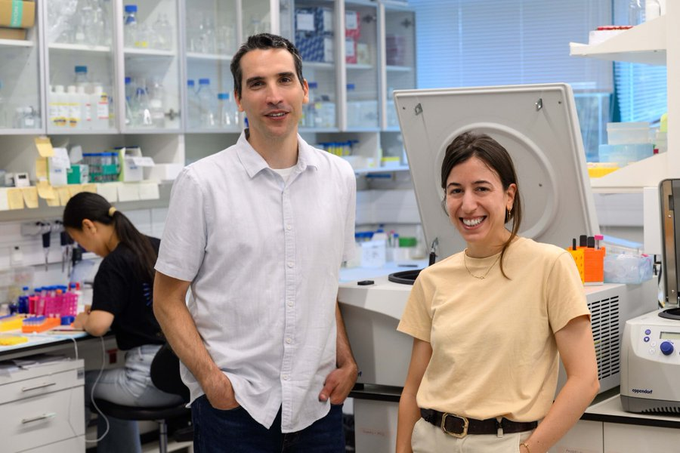
“People have usually thought that if there’s damage, it doesn’t really matter what surrounds it, and that the nearest neighbor might have a small effect,” said Dr. Ariel Afek of the Weizmann Institute, who led the research. He added that in fact what surrounds the DNA determines its fate.
“The local physical environment around DNA damage can strongly affect how it is repaired,” Afek told The Times of Israel. “If it bends in one direction or twists in another, it could make the efficiency of the repair a hundred times easier or harder.”
The research suggests that the very shape of the DNA determines whether damage is repaired or not, or where mutations might become permanent.
The discovery “will have a long and lasting impact on the field,” said Prof. Bennett Van Houten of the University of Pittsburgh, who was not involved in the study. “By revealing that surrounding genetic code alters the physical structure of DNA to directly affect how well these enzymes recognize and fix damage, the findings help explain why specific sequences are especially prone to high mutation rates in tumor cells.”
Afek said that he and his team wanted to go back to the beginning to study the initial stages of the process of cell damage and repair.
“Some researchers look at the mutation in cancer patients,” Afek said. “But we wanted to go back and look at the process that actually initiated the mutation at an atomic level a long time ago to really understand the mechanism and the molecular causes.”
“Why do damaging agents like UV light from the sun, or oxidation from the air, hit specific places in the genome more than others, and why do repair enzymes fail to fix the damage in certain spots?” he asked, by way of explanation. “Mutations stand at the essence of many genetic diseases, and we are trying to understand the building blocks that make mutations happen or not.”
The new findings might help researchers create customizable treatments to introduce repair enzymes that will work to repair differently shaped DNA to cure diseases such as cancer and other conditions like neurodegenerative disorders, but the research is still in its early stages.
“The research helped solve a part of the puzzle, but there is so much that is still unknown. This is just the tip of the iceberg,” Afek said. “There’s still room to understand many other factors that shift mutations and repair in our bodies.”