
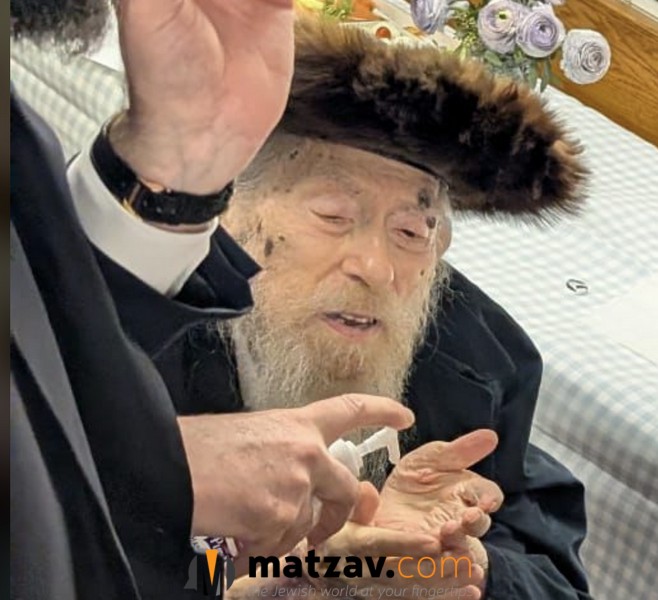

It is with great sadness that Matzav.comreports the passing of Rav Yehoshua Safrin zt”l, the Komarna Rebbe of Manhattan, a scion of the illustrious Komarna dynasty and the son of the Komarna Rebbe, Rav Chaim Yaakov Safrin zt”l. He was 91.
The Rebbe was niftar over Shabbos, leaving behind a family and a legacy deeply rooted in the extraordinary Torah and chassidic heritage of Komarna.
Rav Chaim Yaakov Safrin served as the Komarna Rebbe in New York and later in Yerushalayim and was considered one of the outstanding mekubalim and talmidei chachomim of his generation. Rav Chaim Yaakov was renowned for his mastery of both nigleh and nistar. The Satmar Rebbe, Rav Yoel Teitelbaum zt”l, is reported to have described him as unique in his generation in the realm of remez.
Rav Chaim Yaakov, born in 1891, was a descendant of the great Komarna dynasty and became one of its principal surviving leaders in the aftermath of the Holocaust, when much of the dynasty and its leadership had been destroyed. Survivors of Komarna looked to him to continue the mesorah of the famed chassidus.
The Safrin family had reached America before the Holocaust. Rav Chaim Yaakov recognized the danger developing in Europe and urged others to escape as well. He and his family arrived in the United States in 1938, and his chassidim established Bnei Yaakov Anshei Komarno for him on Manhattan’s Lower East Side.
It was within that distinguished family that Rav Yehoshua grew up, surrounded by the distinctive Komarna tradition of intense Torah learning, avodah and the study of Toras hanistar.
The Komarna dynasty traces its roots to Rav Alexander Sender Safrin and, most famously, to his son Rav Yitzchok Eizik Yehuda Yechiel Safrin of Komarna, known as the Heichal Habracha, one of the leading chassidic and kabbalistic figures of the 19th century. The dynasty became particularly renowned for its emphasis on the teachings of Kabbalah and the Zohar alongside nigleh and chassidic avodah.
Rav Yehoshua was one of several sons of Rav Chaim Yaakov who continued the family’s Torah and chassidic legacy. His brothers included Rav Shalom Safrin of Yerushalayim; Rav Nesanel Safrin; Rav Menachem Monish Safrin, who served as the Komarna Rebbe in Bnei Brak; Rav Alter Yitzchok Elimelech Safrin in the United States; and Rav Yissachar Dov Safrin of Bnei Brak.
Rav Yehoshua was the son-in-law of Reb Moshe Menachem Razler zt”l.
He was also one of the last surviving talmidim of Rav Reuven Grozovsky zt”l at Bais Medrash Elyon, carrying with him a connection to that extraordinary generation of American Torah life and to one of its eminent gedolim.
Rav Yehoshua was the publisher of works left in manuscript by Rav Chaim Yaakov. Among them was Pri Chaim, containing derushim and chiddushim arranged according to the Alef Bais and based on the four levels of Pardes. Another volume of Pri Chaim contains his father’s writings on Tehillim.
Rav Yehoshua was also involved in bringing his father’s Poras Yosef to print, a collection of 267 teachings organized around Yosef Hatzaddik and the parshiyos of Vayeitzei, Vayishlach, Vayeishev, Mikeitz, Vayigash and Vayechi. The work was preserved in Rav Chaim Yaakov’s own manuscript before being prepared for publication by his son.
These efforts formed part of a larger preservation of Rav Chaim Yaakov’s Torah legacy, which includes works such as Bais Avos, Shabbos Shalom Umevorach, Pri Chaim and Poras Yosef.
Rav Chaim Yaakov eventually left New York for Eretz Yisroel in 1962 and settled in Yerushalayim, where he established his bais medrash in the Geulah neighborhood near Kikar Shabbos. The bais medrash remains active today. He was later buried on Har Hazeisim.
Rav Yehoshua, meanwhile, remained associated with the Komarna presence in New York, carrying the title of Komarna Rebbe in Manhattan and representing another living link to the family’s prewar chassidic heritage.
Despite carrying the Komarna legacy of his illustrious family, he also developed particularly strong ties with Ger and was a major benefactor of Gerrer institutions.
Over the course of decades, Rav Yehoshua became one of those particularly close to the Gerrer Rebbe. His relationship with the Gerrer court was reflected at numerous family simchos, where he was regularly accorded honor and was frequently called upon to recite brachos beneath the chuppah at Gerrer weddings.
Rav Yehoshua also devoted considerable resources to preserving the Komarna legacy established by his father in Eretz Yisroel.
Among his significant undertakings was the renovation and restoration of the well-known Komarna bais medrash on Rechov Malchei Yisrael in the Geulah neighborhood of Yerushalayim. The bais medrash, originally established by his father, became popularly known as “Komarna-Mifal HaPayis.”
The building remains a prominent reminder of the Komarna presence in Yerushalayim and of the legacy of Rav Chaim Yaakov, who perpetuated the dynasty after its European world was devastated during the Holocaust.
Rav Shea was a throwback to the Yidden of old, a Yid whose warmth and good cheer seemed to belong to an earlier generation. He always had a good word to say, and his warm manner and ready smile had a way of putting a smile on the face of everyone he encountered.
His passing closes another chapter in an American Komarna story stretching back nearly nine decades, to the arrival of his father and family in New York on the eve of the destruction of European Jewry.
The levayah will take place Sunday, August 30, at 11 a.m. at Shomrei Hadas Chapels, 3803 14th Avenue in Brooklyn. Following the New York levayah, the aron is expected to be flown to Eretz Yisroel for kevurah.
The family will be sitting shivah in Manhattan.
Yehi zichro baruch.

{Matzav.com}