
 Vos Iz Neias
Historic Diamond Necklace Worn by Egyptian Queen Stolen in Brazen Vienna Museum Heist
VIENNA (VINnews) — Two men walked into Vienna’s Museum of Applied Arts (MAK) as ordinary visitors on Thursday and left minutes later with a historic platinum and diamond necklace worth several million dollars, after smashing its glass display case with a hammer.
The theft took place at around 2 p.m. on August 27 during opening hours at the museum on Stubenring in central Vienna. According to Austrian police, the two suspects had purchased admission tickets and did not wear masks, leaving them clearly visible on the museum’s security cameras. After breaking the display case and taking the necklace, they fled on foot in the direction of Stadtpark. No one was injured.
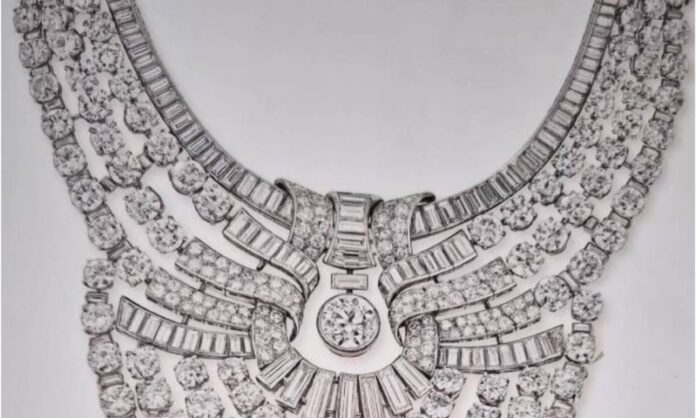
The stolen piece is an extraordinary Van Cleef & Arpels platinum necklace set with 673 diamonds weighing more than 200 carats. The jewelry house describes the creation as a triumph of “white jewelry.” Austrian media have estimated its value at several million dollars, while reports have linked the piece to a $4.3 million Sotheby’s sale in New York in 2015.
The necklace has a remarkable royal provenance. It was created for Egypt’s former royal family and was worn by Queen Nazli of Egypt in 1939 at the wedding of her daughter, Princess Fawzia, to Iran’s Crown Prince Mohammad Reza Pahlavi, who would later become the Shah of Iran.
The jewelry was part of an elaborate collection associated with Egypt’s royal court before eventually resurfacing on the international art market. Queen Nazli, the wife of King Fuad I and mother of King Farouk, later left Egypt and eventually settled in the United States. Financial difficulties reportedly contributed to the dispersal and sale of her jewelry collection.
The necklace’s history makes it significantly more than an exceptionally valuable piece of jewelry: it is also a surviving artifact of the Egyptian and Iranian royal worlds of the pre-World War II era.
The necklace was one of the highlights of “Glanzstücke: Van Cleef & Arpels High Jewelry × Masterpieces from the MAK Collection,” a major exhibition that opened on June 10 and had been scheduled to run through September 27.
The exhibition brought together approximately 500 objects, including more than 300 creations from the Van Cleef & Arpels collection and more than 200 works from the MAK collection. The museum says the exhibition was intended to explore the relationship between the French jewelry house’s craftsmanship and major works from the museum’s own collection.
Following the theft, the affected exhibition area was temporarily closed while investigators examined the scene. The rest of the museum subsequently resumed normal operations, although the security breach has raised questions about how the thieves were able to reach such a valuable piece during public opening hours.
Vienna police have launched an extensive investigation and released photographs of the two suspects. Authorities describe both men as approximately 170–175 centimeters tall, slim, with dark hair and dark beards. At the time of the theft, they were wearing black outer clothing and dark sneakers with white soles.
Investigators have been examining surveillance footage and other forensic evidence. Police also deployed tracking dogs immediately after the robbery. Austrian authorities have said the search is being conducted both nationally and internationally.
In a further development, police said one of the suspects is believed to have been carrying what appeared to be a real firearm. The pair nevertheless fled on foot toward Stadtpark, and the initial search failed to locate them.
The stolen necklace has also been entered into INTERPOL’s Stolen Works of Art database, alerting authorities and the international art and antiques market to the theft.
The Vienna robbery comes amid a striking series of high-profile museum and cultural-property thefts across Europe.
In Paris, thieves broke into the Louvre in broad daylight last year and escaped in less than eight minutes with jewelry estimated at approximately $102 million. Several suspects have since been arrested, although most of the stolen jewelry has not been recovered.
In Spain, thieves recently raided the Treasure of Villena, one of the country’s most important Bronze Age gold collections, taking numerous gold objects. In Italy, four works by Renaissance master Antonello da Messina were reported stolen from a museum in Sicily, while police have also recovered paintings by Renoir, Cézanne and Matisse worth more than $10 million that had been stolen from a museum near Parma.
The Vienna theft is therefore being viewed not simply as another jewelry robbery, but as part of a broader and increasingly concerning pattern of sophisticated attacks on European museums and cultural institutions.
For investigators, the fact that the Vienna thieves entered legally, paid for admission, operated in the middle of the day and apparently left their faces visible on surveillance footage could prove crucial in identifying them — and potentially recovering one of the most historically significant pieces of jewelry currently missing from a European museum.