
 Vos Iz Neias
OP-ED: While US Strikes Iran’s Larak Island, Israel Is Left Carrying Long-Term Risk
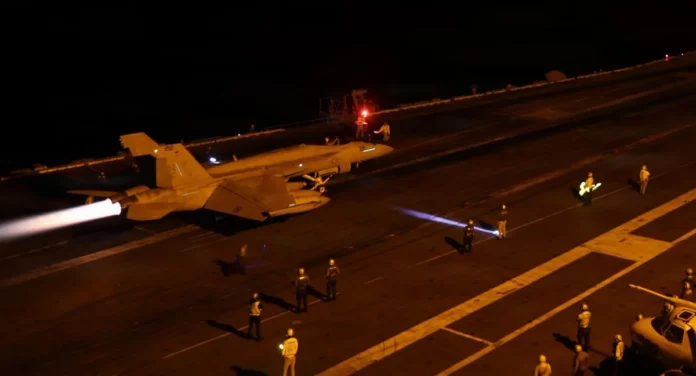
JERUSALEM (VINnews/Amine Ayoub) — American military forces carried out targeted strikes against two Iranian launchers on Larak Island, a key Islamic Revolutionary Guard Corps position near the Strait of Hormuz that threatened vital international shipping lanes.
In Washington, the tactical victory was framed as a decisive intervention to safeguard strategic maritime commerce, while senior American commanders simultaneously issued urgent warnings against allowing the engagement to spiral into an open-ended regional war. In response, the Revolutionary Guard vowed immediate and severe retaliation against its adversaries.
Yet while Washington calculates its military deployment from across an ocean, the strategic equation for Israel remains starkly unchanged. The United States delivers the kinetic strike, but Israel remains the nation permanently left holding the strategic bag.
This dynamic is neither accidental nor temporary. It is the permanent structural reality of Israel’s geopolitical position. The United States operates as an expeditionary global superpower with the unique luxury of distance, timing and strategic flexibility. It can deploy aircraft carrier strike groups, launch precision strikes from remote platforms and retreat behind continental defense shields whenever political appetites in Washington shift.
Israel possesses no such geographic luxury. It lives in the immediate blast radius of every operational choice made inside the Pentagon. When American munitions neutralize Iranian launchers off the coast of Bandar Abbas, Tehran does not attempt a risky amphibious strike against distant American naval forces. Instead, the Islamic Republic turns to its established playbook of asymmetric coercion, calibrating its violent retaliation against the one target it can reach with immediate lethal precision: the sovereign State of Israel.
This is where the reality of holding the bag becomes an urgent national security warning rather than a convenient metaphor. Every time American forces strike an Iranian military asset, Washington achieves a short-term tactical objective while offloading the long-term risk management directly onto Jerusalem.
The immediate consequence of American military action in the Persian Gulf is not an instant increase in Israeli security, but an immediate spike in Israel’s national threat level.
Israeli air defense systems are forced into high-intensity readiness. Its intelligence services are tasked with tracking imminent proxy counterattacks, and its civilian population prepares for the inevitable fallout of an escalation cycle planned and executed by an ally operating thousands of miles away.
Washington reaps the global prestige of protecting international trade routes, while Israel absorbs the long-term strategic vulnerability. The strategic calculation is further complicated by the internal political dynamics currently unfolding inside Tehran.
Heavy reporting confirms a growing, intense debate within Iranian government circles over the staggering economic price of this ongoing warfare. Years of punitive economic sanctions, soaring inflation and the immense financial drain of maintaining regional terror proxies have generated visible internal friction.
Iranian officials and economic planners are openly questioning whether sustaining an open-ended confrontation with the West is economically sustainable when domestic infrastructure is deteriorating and public discontent is rising.
When details of these budgetary debates surface, it is tempting for Western analysts and Israeli observers to view these economic pressures as tangible evidence that the radical regime in Tehran is nearing strategic exhaustion. Yet confusing economic distress with strategic capitulation would be a catastrophic miscalculation for Israeli security.
The Islamic Revolutionary Guard Corps does not measure strategic success through foreign exchange rates, inflation metrics or consumer satisfaction. The ideological core of the Iranian regime remains single-mindedly committed to regional hegemony and the systematic encirclement of Israel.
Throughout its history, the Islamic Republic has repeatedly demonstrated a cold, ruthless capability to force its civilian population to absorb severe economic hardship while continuing to fund its forward military networks.
A single destroyed launcher on Larak Island or a vocal debate in Tehran over economic priorities will not compel the regime to abandon its foundational doctrine. The Revolutionary Guard will simply adapt its operational methods, shift resources and pursue lower-cost asymmetric warfare against Israeli targets.
This harsh reality highlights the grave danger of outsourcing Israel’s long-term strategic deterrence to volatile American political cycles. Foreign policy in Washington is inherently subject to shifting domestic political tides, congressional elections, presidential campaigns and changing global strategic priorities.
An American administration that authorizes precision strikes against Iranian naval targets today can easily choose diplomatic de-escalation tomorrow if global energy prices spike or domestic opposition to foreign military entanglements grows.
If Israel allows its national security posture to become overly dependent on episodic American military actions, it effectively surrenders strategic initiative to foreign political decision-makers whose long-term vital interests do not, and can never, completely align with Israel’s national survival imperatives.
Furthermore, periodic American military interventions risk trapping Israel in an endless cycle of tactical suppression rather than genuine strategic deterrence. Destroying two launchers on a remote island degrades immediate operational capacity, but it leaves the core leadership, industrial missile manufacturing infrastructure and ideological drive of the Iranian regime entirely intact.
Each tactical intervention provides a brief window of breathing room, but functions as a temporary security palliative rather than a permanent strategic cure. While Washington celebrates a localized operational success in international waters, Iran quietly works to replace destroyed hardware, refine its targeting tactics and prepare for subsequent strikes.
In this perpetual cycle of action and reaction, the short-term tactical achievements belong to Washington, while the long-term accumulating strategic exposure is borne exclusively by Jerusalem.

Amine Ayoub
To escape this structural trap, Israel must reassess its overarching national security posture. Maintaining deep strategic coordination, intelligence sharing and defense integration with the United States remains an indispensable asset for the Jewish state.
However, mistaking American military support for a permanent substitute for sovereign Israeli deterrence is a profound strategic error.
The core foundation of Israel’s national defense doctrine has always rested upon a single fundamental, non-negotiable principle: Israel must always maintain the independent operational capacity and political will to defend itself, by itself, against any combination of threats in the region. Whenever deterrence becomes reliant on external military actions, the core pillar of national independence is weakened.
The Israeli public, carefully digesting news of military strikes in the Persian Gulf, must demand uncompromising strategic honesty from its political and military leadership.
Foreign military victories in the Strait of Hormuz must never serve as a psychological substitute for active, decisive Israeli defense planning.
Israel’s national defense establishment must preserve complete strategic flexibility, ensuring that operational red lines, intelligence collection priorities and force readiness are determined strictly by Israeli security needs rather than American political constraints.
Every military decision and long-term strategic assessment must be subjected to a rigorous standard: Does this posture permanently safeguard the sovereign State of Israel, or does it merely manage an increasingly dangerous and unstable security environment?
The recent strikes on Larak Island serve as a clear reminder of the volatility of the regional conflict. Washington has proven once again that it possesses the military capability to hit Iranian targets when global maritime commerce is threatened, but American forces will not be the ones paying the ongoing strategic price when the regional bill comes due. That heavy burden falls, as it always has, directly upon the citizens and defense forces of Israel.
Recognizing this reality is not an expression of political cynicism or isolationism. It is the fundamental requirement of true strategic maturity. As the regional confrontation intensifies, Israel must remain clear-eyed, fully prepared and uncompromisingly self-reliant. In an unforgiving Middle East, absolute self-reliance remains the only true guarantee of national survival.