
 Vos Iz Neias
Israel to Close British Consulate in Jerusalem, Halt British Gaza Role in Retaliation for UK Sanctions
JERUSALEM — Israel announced Tuesday that it will close the British Consulate General in Jerusalem and take a series of diplomatic and security-related measures against Britain, sharply escalating a dispute with London over Israeli communities in the West Bank.
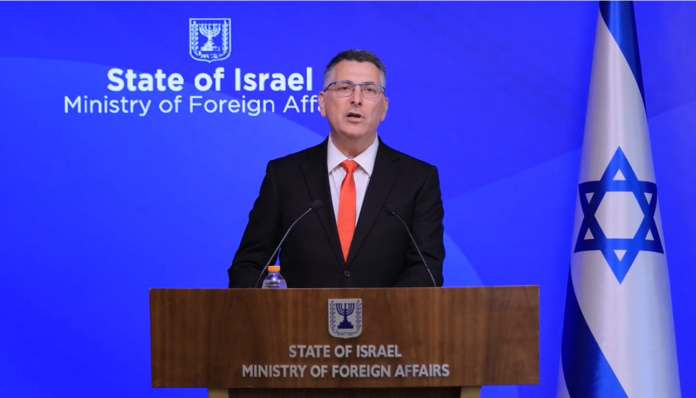
Foreign Minister Gideon Sa’ar said the measures were coordinated with Prime Minister Benjamin Netanyahu and were being taken in response to a new package of British restrictions targeting Israeli settlements and businesses connected to them.
The Israeli response also includes removing British representatives from the U.S.-backed international center coordinating efforts related to Gaza, ending Britain’s role in training Palestinian Authority security forces and barring 12 British lawmakers and other nationals from entering Israel, according to Sa’ar.
The announcement came only hours after British Foreign Secretary Ed Miliband told Parliament that Britain would prohibit trade in goods produced in Israeli settlements in the West Bank and impose additional restrictions on businesses and individuals involved in settlement expansion.
Britain, France and Canada announced the trade measures as part of a broader effort involving a group of Western governments that said Israeli settlement expansion was threatening the possibility of a future two-state agreement.
The confrontation represents another significant deterioration in relations between two countries that have maintained close diplomatic, economic and security ties for decades.
Sa’ar accused Britain’s Labour government of pursuing what he described as a systematic anti-Israel policy and said Israel could impose additional measures against other countries that take similar action.
“The message to every government that harms us is clear,” Sa’ar said, warning that countries taking measures against Israel could face Israeli retaliation.
Consulate closure
The British Consulate General in Jerusalem has a distinctive role in Britain’s diplomatic network.
Unlike the British Embassy, which handles Britain’s diplomatic relationship with Israel, the Jerusalem consulate represents Britain in Jerusalem, the West Bank and Gaza and works on political, commercial, security and economic matters involving the Palestinians. It also provides consular assistance to British citizens in Jerusalem, the West Bank and Gaza.
Britain has maintained a separate position on Jerusalem for decades. Its government says it recognizes Israel’s de facto authority over West Jerusalem but does not recognize Israeli sovereignty over Jerusalem as a whole, saying the city’s final status should be determined through negotiations. Britain regards East Jerusalem as occupied territory.
Sa’ar rejected that position and emphasized Israel’s longstanding assertion that Jerusalem is its sovereign capital.
He said foreign governments operating in Jerusalem must do so with Israel’s consent.
The closure would therefore have significance beyond the immediate dispute over settlement trade. It would directly affect one of Britain’s principal diplomatic channels for dealing with Palestinian affairs from Jerusalem.
The Israeli announcement did not immediately make clear how the closure would affect individual consular services or the timing for winding down the mission.
Britain targets settlement trade
Miliband’s announcement in the House of Commons was broader than a simple ban on settlement-produced goods.
He said Britain would prohibit trade in goods from Israeli settlements and take measures against companies and individuals involved in activities that contribute to settlement expansion.
The British government said the measures were aimed at settlements rather than Israel as a whole.
Miliband also stressed that Britain would continue trading with Israel within its internationally recognized borders and rejected the broader boycott campaign known as Boycott, Divestment and Sanctions, or BDS.
In his parliamentary statement, Miliband said Britain supports Israel’s security and continued economic prosperity while arguing that settlement expansion threatens the possibility of establishing a Palestinian state alongside Israel.
The new British legislation is expected to take between six and nine months to come into force, although some of the other sanctions announced by London are being implemented more quickly. Britain also announced additional sanctions against individuals it accused of supporting or encouraging violence against Palestinians.
Britain said it would also refuse licenses for arms and other exports that materially contribute to Israel’s occupation of Palestinian territories. Miliband said Britain had already suspended more than 30 arms licenses relating to weapons used by the Israeli military in Gaza and would maintain those restrictions.
A wider international move
Britain’s decision was not taken alone.
Canada and France announced similar plans Tuesday, while a group of 12 governments said they intended either to introduce national restrictions on settlement trade or support European measures.
The governments included Britain, France, Canada, Denmark, Finland, Iceland, Ireland, Norway, Poland, Portugal, Spain and Sweden.
In a joint statement, the countries said settlement expansion and settler violence were undermining the possibility of a two-state solution. They specifically cited Israeli plans for development in the E1 area east of Jerusalem.
The governments said they were opposed to actions they regarded as equivalent to annexation of Palestinian territory or forced displacement of Palestinians.
At the same time, the joint statement reiterated recognition of Israel’s security needs and condemned the Oct. 7, 2023, Hamas attack.
The statement also reaffirmed support for Israel and a future Palestinian state existing alongside it.
Israel rejects Britain’s E1 claims
The E1 development plan has become one of the central points of the dispute.
British officials argue that construction in the area could divide the northern and southern parts of the West Bank and make a contiguous Palestinian state more difficult to establish.
Sa’ar disputed that characterization.
He said Britain was presenting existing planning and tender activity as though it represented a new Israeli decision. According to Sa’ar, the decisions concerning E1 were made more than a year ago and the tender process had already been underway for months.
He also pointed to Israeli plans for transportation routes intended to maintain access between Palestinian population centers.
Among the projects he cited were Road 80, connecting areas around Bethlehem and Ramallah, and what Israel calls the “Fabric of Life” road connecting the areas around a-Za’im and al-Eizariya.
Sa’ar said the projects contradict British claims that Israeli construction would necessarily sever Palestinian territorial continuity.
The dispute reflects a fundamental disagreement between Israel and many Western governments over the legal and political status of Israeli communities in the West Bank.
Britain and most Western governments regard the settlements as illegal under international law. Israel disputes that characterization and describes the West Bank as territory whose final status should be resolved through negotiations.
Israel moves against British officials
Beyond the consulate, Sa’ar announced restrictions on a group of British elected officials and other nationals.
The individuals Israel says will be barred from entering the country are:
- Jeremy Corbyn, member of Parliament
- Zarah Sultana, member of Parliament
- Fahad Ansari, director of Riverway to the Sea
- Naz Shah, member of Parliament
- Diane Abbott, member of Parliament
- Hannah Spencer, member of Parliament
- Carla Denyer, member of Parliament
- Sian Berry, member of Parliament
- Ellie Chowns, member of Parliament
- John McDonnell, member of Parliament
- Richard Burgon, member of Parliament
- Adrian Ramsay, member of Parliament
Sa’ar said the restrictions apply to individuals Israel considers involved in antisemitic or anti-Israel activity or who deny Israel’s existence.
The move adds a personal dimension to the growing diplomatic dispute and could further complicate contacts between British lawmakers and Israeli officials.
Britain removed from Gaza coordination effort
Israel also said Britain would no longer participate in the U.S.-led international coordination effort connected to Gaza.
The International Gaza Support Center in Kiryat Gat was established as part of the international framework for implementing and monitoring postwar arrangements involving the Gaza Strip.
Representatives from multiple countries have worked at the center, which coordinates issues involving the ceasefire framework, humanitarian assistance and stabilization efforts.
Israel had already taken similar action against representatives from other European countries.
In August, Sa’ar ordered Dutch representatives removed from the center after the Netherlands adopted measures restricting imports from Israeli settlements. Israel had also previously taken action against Spanish representatives.
The British removal therefore follows an emerging Israeli policy of restricting participation by governments that impose sanctions or trade measures against Israeli settlements.
Israel’s decision to exclude Britain could have consequences for the international effort to coordinate postwar Gaza policy, although the center includes representatives from numerous other countries.
British training mission also terminated
Israel will also terminate the British Support Team in Ramallah, which has assisted in the development of Palestinian Authority security institutions.
The British government has previously described its assistance as professional support intended to help develop Palestinian security institutions that are capable, accountable and respectful of human rights.
Britain has declined to publicly disclose the size of the team for security and diplomatic reasons.
Ending that cooperation marks another significant step because British assistance to Palestinian security institutions has been part of London’s broader effort to strengthen Palestinian governance.
Israel has increasingly objected to what it considers unilateral European pressure while Western governments have argued that strengthening Palestinian institutions is necessary for any eventual political settlement.
Sa’ar accuses Britain of double standards
Sa’ar also accused Britain of applying a one-sided standard to Israel while failing to take comparable action against the Palestinian Authority.
He cited Palestinian Authority payments to Palestinians convicted of terrorism and to families of Palestinians killed or imprisoned in attacks as an example of what he said was an issue receiving insufficient attention from Britain and other European governments.
Israel has long argued that Palestinian financial assistance programs encourage terrorism. The Palestinian Authority has disputed Israel’s characterization of its welfare and prisoner-related programs.
Sa’ar said pressure on Israel alone would not produce a political settlement.
He argued that sanctions and diplomatic pressure would instead make negotiations more difficult by convincing Israel that international governments were attempting to impose a solution rather than facilitating direct negotiations.
Britain says measures are not aimed at Israel as a whole
Miliband sought to draw a distinction between Israel and the settlements.
In his parliamentary statement, he said Britain would continue supporting trade with Israel proper and explicitly rejected the broader BDS movement.
“The sanctions regime will target illegal settlements and settlement expansion, not Israel,” Miliband said, according to the British government’s published transcript.
The distinction is important because Britain and Israel maintain substantial commercial ties.
British government trade figures show total trade in goods and services between Britain and Israel reached about 6 billion pounds in 2025. British exports to Israel were approximately 3.5 billion pounds, while imports from Israel were about 2.5 billion pounds.
British officials have also said they continue to view Israel as an important commercial and technological partner.
That means the new restrictions are intended primarily as a political measure focused on settlements rather than a comprehensive economic embargo on Israel.
Britain recognized a Palestinian state in 2025
The latest measures build on a broader change in British policy toward the Israeli-Palestinian conflict.
Britain formally recognized a Palestinian state in September 2025, saying the move was intended to protect the possibility of a two-state solution and create a path toward a lasting peace.
The British government said at the time that Hamas should have no role in the future of a Palestinian state and called for the immediate and unconditional release of hostages held by the group.
The recognition placed Britain alongside a growing number of governments that have moved toward formal recognition of Palestinian statehood while continuing to recognize Israel.
Israel strongly opposed the decision, arguing that unilateral recognition rewarded the Palestinians without first requiring Hamas to disarm or establishing a negotiated agreement with Israel.
Israel says Britain is interfering in its election
Sa’ar’s criticism also focused on the timing of Britain’s actions.
Israel is approaching a national election scheduled for later in October, and Sa’ar accused the British government of interfering in Israel’s political process.
He argued that Britain’s decision to impose sanctions while Israel is heading toward an election amounted to an attempt to influence Israeli domestic politics.
British officials have rejected that characterization and have presented their measures as a response to settlement expansion, settler violence and concerns about the future of a two-state agreement.
The timing nevertheless adds another layer to an already contentious relationship.
Netanyahu government faces growing pressure
The confrontation comes as Netanyahu’s government faces increasing diplomatic pressure over its policies toward the West Bank and Gaza.
Western governments have increasingly separated their support for Israel’s security from their assessment of Israeli government policies in the territories captured in the 1967 Mideast war.
The British government says it remains committed to Israel’s security and has condemned Hamas’ Oct. 7 attack, while simultaneously arguing that settlement expansion and violence by Israeli settlers are undermining the prospects for a negotiated settlement.
Israel, meanwhile, says foreign governments are applying disproportionate pressure to Israel while failing to adequately confront Hamas and other Palestinian militant groups.
That disagreement has become particularly pronounced since the Gaza war began.
Sa’ar warns other countries
The Israeli foreign minister said Britain had initiated the latest confrontation but warned that Israel would respond to other governments that adopt similar measures.
That warning could be significant because Britain is not the only European government considering restrictions on settlement-related trade.
The joint statement issued Tuesday indicates that several European governments are either preparing national restrictions or considering additional measures.
Israel has already demonstrated through its actions against Dutch and Spanish representatives that it is prepared to use access to multinational Gaza coordination structures as a diplomatic lever.
The British case goes further by targeting a longstanding consular presence in Jerusalem and a security cooperation program with the Palestinian Authority.
A diplomatic relationship under increasing strain
Britain and Israel have historically maintained close security, intelligence, commercial and diplomatic relations, despite major disagreements over the Israeli-Palestinian conflict.
The economic relationship remains substantial, with billions of pounds in annual trade and extensive British commercial activity involving Israeli technology, health care, pharmaceuticals, scientific research and other sectors.
But political relations have deteriorated significantly as the British government has adopted a more critical position toward Israeli settlement policy.
The British government says its actions are designed to preserve the possibility of two states living alongside one another.
Israel argues that the measures reward Palestinian intransigence, undermine Israeli sovereignty and make a negotiated agreement more difficult.
Tuesday’s announcement brings those competing positions into direct diplomatic confrontation.
The immediate consequences will include the closure of Britain’s consular mission in Jerusalem, the loss of British participation in the Gaza coordination framework, an end to Britain’s training role with Palestinian security forces and restrictions on entry for the named British nationals.
The broader question is whether the dispute will remain focused on settlement policy or expand into a wider breakdown in bilateral cooperation.
Sa’ar’s warning suggests Israel is prepared to escalate further if additional countries follow Britain’s lead.
For Britain, meanwhile, the measures represent another step in a policy that seeks to pressure Israel over settlement expansion while maintaining that its dispute is with Israeli government policies rather than with Israel’s existence or the Israeli people.
For now, the diplomatic relationship between two longstanding partners is facing one of its sharpest confrontations in years.