

New York (VINNEWS/Rabbi Yair Hoffman) With only hours left before Israel’s party lists had to be handed in to the Central Elections Committee, the Ashkenazi chareidi party known as United Torah Judaism (UTJ) faced the most serious internal crisis in its history. Two of its factions announced that they were breaking away from Agudas Yisroel and forming a brand-new party, one that would still run on the same UTJ ticket, but as an independent partner rather than as a junior member of Agudah.
What Happened
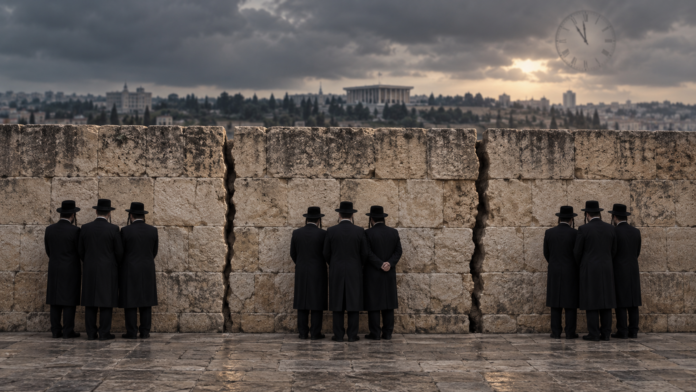
MK Meir Porush, who heads the Shlomei Emunim faction, and Elyakim Stark, who represents the Belzer chassidim, announced that they would run on the UTJ list under a brand new party called “Chomas Toras Yisroel,” which means “The Wall of the Torah of Israel.”
To understand why this is such major drama, we first need to understand how UTJ worked previously. For nearly forty years, UTJ has been a partnership of two parties. The first is Agudas Yisroel, which represents the chassidic world, including Gur, Belz, Vizhnitz, and the Shlomei Emunim grouping led by Porush. The second is Degel HaTorah, which represents the Litvish, or yeshiva, world. Inside Agudah, Gur, the largest chassidic court in Israel, has long been the dominant force. It is sometimes called the “Central Faction.”
The new plan would turn UTJ from a two-party partnership into a three-party arrangement: Degel HaTorah, Agudas Yisroel (which would now be mostly Gur and its allies), and Chomas Toras Yisroel (Shlomei Emunim and Belz).
Why Porush and Belz Want Out
The breakaway factions have complained for years that they are treated unfairly inside Agudah. Their central claim is that Gur controls the money. Every party in the Knesset receives monthly funding based on the number of seats it holds. According to Shlomei Emunim and Belz, Gur has delayed passing along their share of those funds, which total hundreds of thousands of shekels, to their branches and institutions around the country.
By registering as a separate party, Chomas Toras Yisroel would receive its Knesset funding directly, with no middleman.
But the fight is about more than money. It is also about power and respect. If Porush heads his own party, then any future coalition talks with Prime Minister Binyamin Netanyahu, or with anyone else, would have to include a separate seat at the table for him. Right now, Agudah negotiates as one unit, and Gur’s representatives usually do the talking.
A Plan Nearly a Year in the Making
This was not a rash decision made at the last minute. Reports indicate the move had been prepared for close to a year. A “shelf party,” meaning a legally registered party that already exists on paper but is not active, was quietly purchased, and its identity was kept secret until the final days. It was then renamed Chomas Toras Yisroel.
Perhaps most striking of all, Degel HaTorah knew about the plan in advance and helped keep it quiet. That means the Litvish partner in UTJ sided, at least quietly, with Porush and Belz against Gur.
Gur Says No
When the plan was presented, Gur’s representatives refused to approve it. The meeting fell apart and people walked out of the hall. This left the entire UTJ list in limbo with the clock ticking toward the filing deadline.
Background: Tensions Were Already High
This crisis did not come out of nowhere. Even before this blow-up, the negotiations between Agudah and Degel were tense. Reports two weeks earlier indicated that Degel HaTorah was expected to demand five of the first eight spots on the joint slate, as well as that MK Uri Maklev be given priority for the first position over MK Meir Porush. In other words, the question of who leads and who follows was already a sore point.
Analysis: What Could Happen Next
There are several possible outcomes, and each one has its own consequences.
Scenario One: A last-minute compromise. Chareidi politics has a long history of dramatic fights that end in a handshake minutes before a deadline. Gur might agree to let Chomas Toras Yisroel exist as a third partner in exchange for guarantees about slots on the list and on the funding formula. UTJ would then run as one list with three parties inside it. This is the most likely outcome, because everyone involved knows the cost of failure.
Scenario Two: UTJ runs, but without a formal three-way agreement. The list could be submitted under the old two-party structure, with Porush and Belz staying inside Agudah for now but with the dispute unresolved. The fight would then continue after the election, and Chomas Toras Yisroel would remain a loaded gun on the table.
Scenario Three: A real split. If no agreement is reached, one side could file separately. This would be a disaster for the chareidi community. Israel’s electoral threshold is 3.25 percent of the vote, roughly four seats. Agudah on its own has hovered around that line for years. A separate Porush-Belz list would almost certainly fall below the threshold, and Agudah without Belz and Shlomei Emunim might as well. Hundreds of thousands of chareidi votes could be wasted, and the community could lose several Knesset seats at exactly the moment when the draft law, yeshiva funding, and the future of the entire chareidi relationship with the state are on the table.
The Deeper Repercussions
Even if a compromise is reached, this episode changes things in ways that will last.
First, the era of Gur running Agudah as its own private domain is over, or at least under serious challenge. Once Belz and Shlomei Emunim have shown they are willing to walk, they cannot be taken for granted again.
Second, Degel HaTorah’s quiet support for the breakaway is a warning to Gur. It suggests that the Litvish world would rather deal with several smaller chassidic partners than with one powerful Gur-led bloc. This shifts the balance of power inside UTJ toward Degel.
Third, coalition negotiations will become more complicated for whoever forms the next government. Instead of two chareidi Ashkenazi negotiating teams, there could be three, each with its own demands. Netanyahu, or any other prime minister, would have to satisfy more players. That could mean more leverage for the chareidim as a whole, or it could mean more infighting that a prime minister can exploit by playing one side against another.
Fourth, there is the damage to the community’s image and morale. The chareidi public is being asked to unite and turn out in record numbers to defend the Torah world. A public brawl over budgets and seats, played out in the secular press, makes that message much harder to deliver.
Winners and Losers
Winners:
Meir Porush is the biggest winner if the plan goes through. He would move from being one voice inside Agudah to being the head of his own party with direct funding and a direct line to the prime minister. It would be the crowning achievement of a career that began in the shadow of his father, the legendary MK Menachem Porush.
Belz also wins. As the second-largest chassidus in the Agudah camp, Belz has long felt it deserved more than it got. A separate party gives Belz its own budget stream and its own voice, without having to ask Gur for anything.
Degel HaTorah wins quietly. A weaker Gur means a stronger Degel inside UTJ. Degel also earns goodwill from Porush and Belz, which it can spend later.
Losers:
Gur is the clear loser. It goes from controlling the whole of Agudah’s Knesset funding and negotiating position to controlling only its own share. Its refusal to approve the plan, and the walkout that followed, made it look like the party that was willing to risk the entire list rather than share power.
Agudas Yisroel as an institution is also a loser. A party that was founded in 1912 as the umbrella for all of chassidic Jewry is now being described as, essentially, the Gur party. That is a real blow to its historic identity.
The chareidi voter is the potential biggest loser of all. If the fight ends in a split and seats are lost, it is the yeshiva student, the kollel family, and the chareidi school system that will pay the price when budgets are cut and laws are passed without a strong chareidi voice in the room.
Prime Minister Netanyahu is somewhere in the middle. More partners means more headaches, but it also means more opportunities to divide and manage. Time will tell whether he sees this as a problem or an opening.
Conclusion
The name “Chomas Toras Yisroel,” the Wall of the Torah of Israel, was clearly chosen to send a message of strength and protection. The irony is that the wall being built right now is a wall between chareidi Jews. Whether it becomes a permanent structure or is quietly taken down before the deadline will say a great deal about where chareidi politics is heading in the years ahead.
The author can be reached at [email protected]