
 Vos Iz Neias
Hamas Rebuilding Military Presence In Gaza Despite Ceasefire, Israeli Officials Say
JERUSALEM (VINnews) — While Hamas committed under the Gaza ceasefire agreement to disarm, Israeli security officials say the group is instead taking active steps to restore and consolidate its military presence in parts of the Strip.
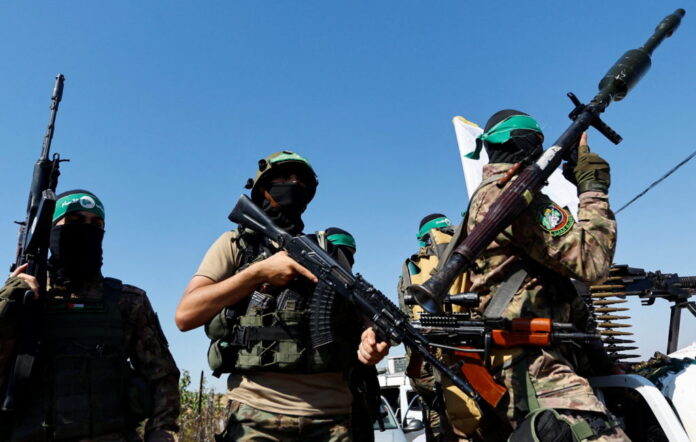
According to information obtained by Israel’s N12 news and confirmed for the first time officially by the IDF, Hamas terrorists have recently returned to weapons storage facilities in areas still under the group’s control, retrieving weapons and using them to carry out security operations and reinforce Hamas’s control over the territory.
Israeli security officials told N12 that Hamas members have been accessing weapons depots containing large quantities of military equipment, including Kalashnikov rifles, other small arms, military gear and rockets. The weapons are reportedly being used by Hamas while they conduct patrols and guard positions in areas controlled by the organization.
The developments appear to directly contradict the disarmament requirement contained in the ceasefire framework. The first phase of the U.S.-backed ceasefire, which took effect on October 10, 2025, called for Hamas to return the remaining hostages and fully disarm. The IDF says that while the hostages have since been returned, Hamas has not fully disarmed and continues to pose a threat to Israeli forces deployed along the so-called Yellow Line.
Israel has responded with a series of targeted strikes intended to prevent Hamas from restoring its military infrastructure.
On Tuesday, Southern Command forces, acting on precise intelligence supplied by the Shin Bet, carried out a major operation in which three Hamas weapons depots containing dozens of weapons were destroyed. The IDF also destroyed a rocket-launching site that had previously been used to fire rockets toward Israel during the war.
The operation followed a broader increase in Israeli military activity in the Gaza Strip. According to the N12 report, Southern Command carried out 16 targeted strikes against Hamas’s command structure during the past week, killing 14 Hamas terrorists, including five company commanders and four platoon commanders.
The IDF has repeatedly reported similar operations against weapons-storage sites since the ceasefire. In August, for example, the military said it and the Shin Bet dismantled five Hamas weapons facilities containing Kalashnikov rifles, explosive devices, anti-tank weapons, ammunition and other military equipment. The military said the weapons were intended for attacks against Israeli troops operating near the Yellow Line and against Israeli civilians.
Israeli officials say the most significant development is not simply Hamas’s continued possession of weapons, but what they describe as a growing willingness by the organization to use them in direct confrontations with Israeli troops.
According to the N12 report, the change became apparent approximately two weeks ago, initially with the launching of kites from Gaza. In recent days, the incidents have escalated to direct fire toward Israeli troops positioned along the Yellow Line and the use of an explosive device against an Israeli military engineering vehicle.
On Sunday, an explosive device attributed by the IDF to Hamas struck an engineering vehicle operating on the Israeli side of the Yellow Line in northern Gaza. No soldiers were wounded. The IDF described the incident as a “blatant violation” of the ceasefire and subsequently carried out strikes against Hamas infrastructure used to advance attacks.
The IDF has also recently issued warnings concerning kites crossing from Gaza. While the military acknowledges that the kites recently detected were not weaponized, it says Hamas previously used kites and balloons as weapons, including to ignite fires in Israeli communities and agricultural areas.
The latest incidents highlight the growing gap between the formal ceasefire framework and conditions on the ground. The agreement was intended to lead toward Hamas’s disarmament and an eventual Israeli withdrawal, but the two sides remain sharply divided over the sequence and enforcement of those steps.
Reuters reported last month that President Donald Trump’s subsequent Gaza roadmap also hinges on Hamas disarmament in exchange for an Israeli withdrawal. Israel has insisted that Hamas must disarm before a full withdrawal, while Hamas has sought a phased process linked to the broader political arrangements for Gaza.
Meanwhile, Israeli forces have continued conducting strikes against what they describe as immediate Hamas threats even after the ceasefire. Reuters reported this week that an Israeli strike in Gaza City killed a Hamas terrorist along with civilians, while other Israeli attacks were also reported in the Strip. Israel maintains that its operations are aimed at militants and threats to its forces, while Hamas and Palestinian authorities have repeatedly accused Israel of violating the ceasefire.
The situation has also produced a growing number of confrontations around the Yellow Line, the demarcation separating areas where Israeli forces remain deployed from the rest of Gaza. The IDF says its troops remain deployed there under the terms of the ceasefire and will continue to act against immediate threats.
For Israel, the emergence of armed Hamas personnel returning to weapons depots represents a particularly sensitive development: rather than moving toward the disarmament envisioned by the ceasefire, Israeli officials believe Hamas is attempting to reconstruct the basic military infrastructure needed to maintain control of territory and, potentially, resume armed operations.
The developments raise further questions over whether the ceasefire can evolve into a durable political arrangement, or whether the gradual restoration of Hamas’s military capabilities will lead to renewed and more serious confrontation.