

 Jewish Breaking News
Israeli-American Founder and Former Iron Dome Chief Engineer Raise $250 Million to Mass-Produce Low-Cost Cruise Missiles for the U.S. and Its Allies
A secretive defense startup with deep Israeli roots has emerged with more than $250 million in funding and an ambitious plan: build long-range cruise missiles by the thousands, at a fraction of the cost of established Western weapons. Covenant’s latest financing round reportedly valued the company at more than $1 billion.
Behind the Washington-headquartered company are Israeli-American entrepreneur Michael Kaufman and co-founder Ofir Dayan, a former system chief engineer for Rafael’s Iron Dome, the Financial Times reported. Their venture brings experience from one of Israel’s most consequential defense programs into a different mission: expanding the West’s long-range strike capacity.
Kaufman previously worked in Peter Thiel’s investment network and moved to Israel to develop Covenant’s activities, according to CTech. The company operates a roughly 32,000-square-foot research, development and manufacturing facility in northern Israel, alongside larger factories in Texas and Germany. It is recruiting across all three countries. Israel is part of the company’s industrial foundation, not merely a connection in its founder’s biography.
Israeli venture capital firm Aleph was also involved early. In a public post, Aleph co-founder Michael Eisenberg said he met Kaufman while Covenant was still an idea, months before October 7, and participated in the seed round alongside Peter Thiel and Lux Capital’s Josh Wolfe. Subsequent funding brought in Andreessen Horowitz, Lightspeed and 8VC. That places Israeli engineering, entrepreneurship and investment inside a venture now pursuing major Western military customers.
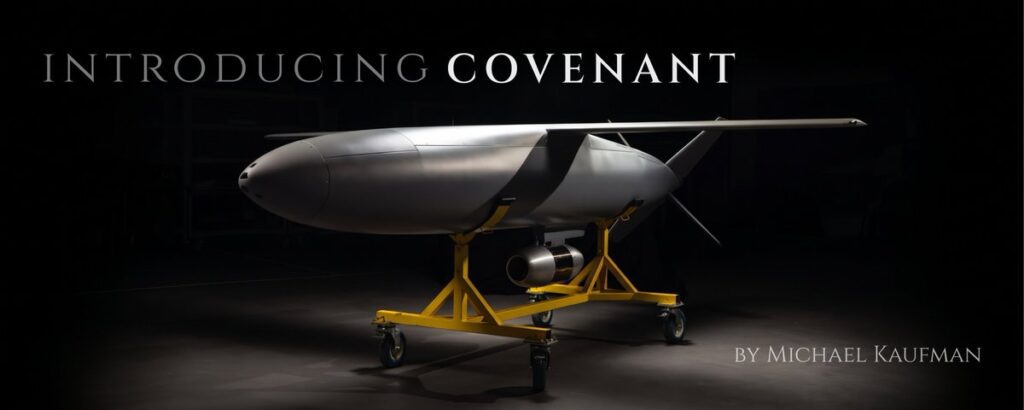
Covenant’s flagship weapon, Anthem, is designed for long-range precision strikes with a heavy payload. Its commercial proposition is that Western militaries need more than sophisticated weapons: they need affordable inventories that can survive the demands of a prolonged conflict. The launch comes as wars in Iran and Ukraine have intensified concerns about depleted precision-missile stockpiles and slow replacement rates.
The company says it has designed Anthem around readily available commercial components, long-term supply agreements and production across allied countries. It is also developing the supporting equipment and software needed to transport, launch and operate the system, rather than selling a missile that requires customers to assemble the rest themselves.
“If our stockpiles run thin, so does our deterrence,” Kaufman said.
The project has moved beyond drawings. Covenant says Anthem has completed more than 200 test flights. A publicly documented demonstration near Tan-Tan, Morocco, involved U.S. military personnel, Morocco’s Royal Armed Forces and Covenant engineers. That was a development test, not a combat deployment, but it offered an early view of the Israeli-linked company working within an international military partnership.


Covenant says it has booked approximately $150 million in orders covering research, qualification and production work. Its disclosed U.S. programs include accelerated testing with the Army and a Navy project to develop a maritime version of Anthem. The naval work is valued at roughly $70 million and includes a cost-sharing component. These figures describe contracted work, not an equivalent value of missiles already delivered.
The newly opened Dallas facility is scheduled to begin serial production in the first quarter of 2027, eventually ramping toward 5,000 weapons annually. The northern Israel facility supports engineering and manufacturing, while the German operation adds another production base serving allied demand.
The next hurdle is turning successful tests and signed contracts into reliable, high-volume deliveries. For Israel, the significance is already tangible: an Israeli-American founder, an Iron Dome engineering veteran and an Israeli industrial footprint are helping shape a new supplier for the United States and its allies. Whether Covenant fulfills its promise will now depend on what its factories deliver.