
 Vos Iz Neias
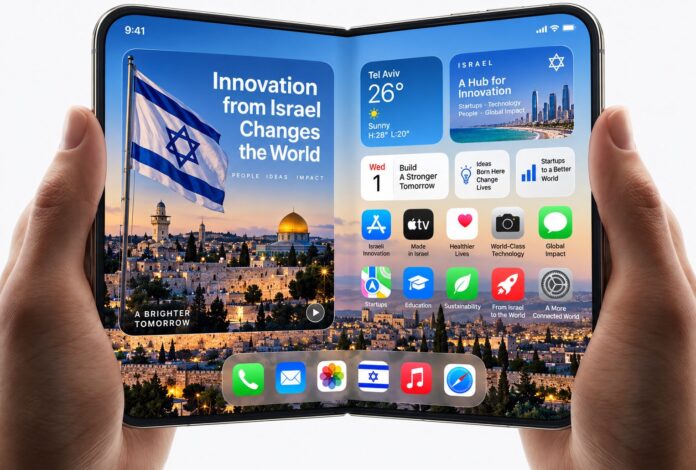
Israeli Innovation Helped Shape Apple’s iPhone, Including New Foldable Duo
CUPERTINO, Calif. (VINnews) — Apple on Wednesday unveiled the iPhone Duo, its first foldable smartphone, a launch that also renewed attention on a less visible part of the company’s story: years of Israeli engineering that helped build the cameras, chips, sensors and storage inside the iPhone.
The Duo, introduced at Apple’s “Surprise and Shine” event, opens to a 7.6-inch inner display and has a 5.4-inch outer screen. It is powered by the A20 Pro chip, starts at $1,999 for 256GB of storage and is scheduled for pre-order on Oct. 16, with shipments beginning Oct. 23.
The device will not carry a “Made in Israel” label. But Apple’s Israeli footprint is well established. The company operates research and development centers in Herzliya, Haifa and Jerusalem and employs about 2,000 to 2,500 people in the country, according to Israeli business and technology reports. Apple executives have described those teams as central to work on custom silicon, cameras, depth sensing and storage.
Avi Kaner, a New York businessman and frequent commentator on Israel and technology, wrote Wednesday that Israeli companies and engineers have left a mark on iPhone features across several generations, even if most buyers never see that connection.
Apple’s presence in Israel grew through a series of acquisitions and a long-term buildup of local labs.
In late 2011 and early 2012, Apple bought Anobit, an Israeli flash-memory company. Hardware chief Johny Srouji, a Haifa-born Technion graduate who now oversees Apple’s hardware organization, has said the company’s storage controllers are developed in Israel. Apple later hired around that team and expanded chip work in Haifa.
In 2013, Apple acquired PrimeSense, a Tel Aviv firm known for 3D sensing technology used in Microsoft’s Kinect. That purchase is widely linked to Apple’s later work on depth sensing and Face ID. In 2015, Apple bought LinX Computational Imaging, which specialized in compact multi-camera systems and computational photography. In 2017, it added RealFace, a facial-recognition startup. Later deals included Camerai and, in 2026, the Israeli startup Q.AI.
Those purchases were not one-off talent grabs. Apple turned them into standing R&D operations focused on semiconductors, imaging, sensing and memory — some of the hardest problems in a modern smartphone.
Rony Friedman, who long led Apple’s Israel R&D organization, said earlier this year that local teams contributed to chips, cameras and depth systems used in features such as Face ID and cinematic video, as well as work on the Apple Watch, Mac processors and Vision Pro. “It’s hard to find an Apple product that doesn’t have some kind of touch from Apple employees in Israel,” he said.
Srouji has struck a similar note. After visiting Apple’s Israeli labs last year, he said the local team is “essential to developing products used by experts, entrepreneurs, creators and students around the world.”
Apple has also been expanding its physical presence. Reports describe a large new Herzliya campus expected to come online in 2027, plus additional space in Jerusalem near the Hebrew University. Industry accounts have called the Israeli operation one of Apple’s most important development centers outside Cupertino.
The new iPhone Duo puts that history in a fresh frame. Foldable phones depend on custom silicon, durable sensing, camera systems that work across two displays, and storage that can handle high-resolution video. Those are the same areas Israeli engineers have been working on for Apple for more than a decade.
Kaner argued that the story is larger than any single acquisition. Apple, he said, absorbed Israeli startups and then built a lasting research presence around chips, cameras, sensing and storage — technologies that helped define the iPhone even when the finished product is assembled elsewhere.
Apple typically declines to discuss individual acquisitions or assign public credit for specific features to particular labs. The company has not issued a statement tying the Duo itself to its Israeli centers. The public record, however, shows a consistent pattern: Israeli firms supplied key capabilities, Israeli engineers stayed on, and Apple kept expanding the operation.
For iPhone users, the result is mostly invisible. Face ID, computational photography, on-device storage and custom chips are marketed as Apple inventions. Behind those systems is a pipeline that runs through Herzliya, Haifa and Jerusalem as well as California.
The Duo will begin reaching customers next month. Whether or not buyers notice the Israeli role, the engineering record suggests that role is already inside the phone.