
 Vos Iz Neias
Iran Now Holds the Key to Eilat: Houthis Seize Yemen’s Entire Red Sea Coast
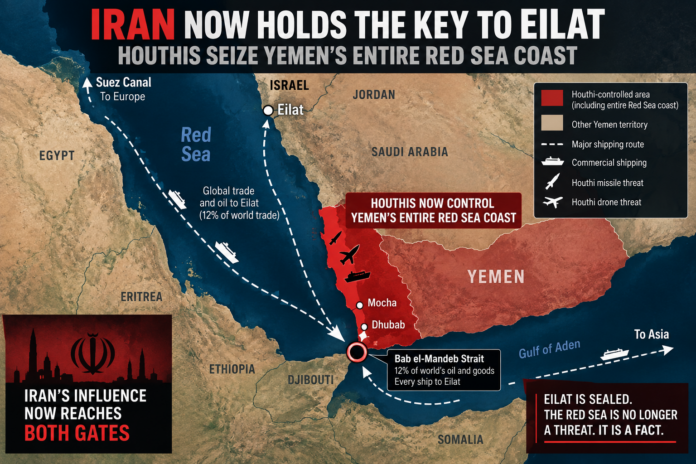
New York (VINNEWS/Shira Miller) In forty-eight hours, the map of the Red Sea has been redrawn. Yemen’s Iranian-backed Houthi rebels captured the port city of Mocha on Thursday, and by Friday they had swept the entire Yemeni coastline, planting themselves on the shore directly opposite the Bab el-Mandeb Strait. Roughly 12 percent of the world’s oil and goods pass through that strait. So does every ship bound for Eilat. The southern gate of the Red Sea is now in the hands of a movement whose banner reads “Death to Israel, a Curse on the Jews.”
The fall of Mocha was confirmed to the Associated Press by Ahmed Baash, a commander of the National Resistance Forces loyal to Yemen’s government, and by Hazam al-Assad of the Houthis’ political bureau. What followed, according to Al Jazeera, was a collapse rather than a battle. Mocha airport and its general command headquarters fell. So did the Al-Amari camp, the naval bases, the Abu Musa and Ashari camps, and the Khalid ibn al-Walid base, the largest military installation in the region. Government forces abandoned Dhubab, south of Mocha and facing the strait’s narrowest point, moments before the city itself went under.
Hans Grundberg, the United Nations envoy to Yemen, did not soften the message to the Security Council. The nation, he said, faces the “harsh reality” of a return to war, and the consequences of this new and more dangerous phase will not remain within Yemen’s borders.
The Blockade Is No Longer a Threat. It Is a Fact.
The Houthis have been saying it for three years. They blockaded Eilat during the Gaza war and fired on ships whose ties to Israel were often vague or nonexistent. In June, as Iranian missiles rained on Israel, Houthi spokesman Yahya Saree proclaimed “a complete and total ban on maritime navigation on the Israeli enemy in the Red Sea” and declared every Israeli movement a military target.
Until this week, geography restrained the threat. The Houthis ruled from the mountains of the north, hundreds of kilometers from the strait. Now they own the beaches, the naval bases, and the launch sites. Anti-ship missiles, attack drones and explosive-laden boats fired from Dhubab reach the shipping lane in minutes. The proclaimed ban has become an enforceable siege. Eilat, gutted during the 2023–2025 campaign, will not reopen while this coastline remains in Houthi hands.
Iran Squeezes Both Gates
This is the fact that should alarm Jerusalem most. Since the United States and Israel struck Iran in February, Tehran has kept the Strait of Hormuz virtually closed. The world’s answer was Bab el-Mandeb: Saudi Aramco poured crude through its East-West pipeline to Red Sea terminals, and Gulf importers rerouted their lifelines through the strait. Iran’s proxies now sit astride both doors at once.
On Friday, satellite imagery cited by Reuters showed smoke near that very East-West pipeline. Riyadh has said nothing. If the Houthis are striking the pipeline that was built to escape Hormuz, then there is no escape route left. A Media Line analyst has already warned that the food and necessities of Kuwait, the UAE, Bahrain, Qatar and Saudi Arabia arrive by sea, and that airlifting goods is driving prices skyward. The Gulf states that quietly stand with Israel against Tehran will feel the pain first. Israel, fighting a multi-front war on borrowed money, will feel it next.
The Front Israel Cannot Reach
Of all Iran’s proxies, the Houthis are the hardest to kill. They waited a month after Feb. 28 before joining the war, then opened fire on southern Israel and vowed to bar the United States and Israel from using the Red Sea against Iran. “Our fingers are on the trigger,” Saree said. The trigger has now been pulled.
Yemen lies 2,000 kilometers from Israel. Every strike demands long-range aircraft and mid-air refueling. American and Israeli bombardments in 2024 and 2025 punished the Houthis and did not break them. Analysts have warned that a cornered Iran would use Bab el-Mandeb to relieve pressure on itself, and that is precisely what is unfolding. The coastal seizure hands Tehran maximum leverage on the one front where Israeli power is weakest, on the very day Israel announced the destruction of Hezbollah’s underground Ali Al-Taher fortress near Nabatieh and declared its southern Lebanon security zone complete. Israel’s army is committed in the north. Its enemies have opened the south.
Saudi Arabia Fires the First Shots Back
Riyadh has not waited for diplomacy. The Houthi-affiliated Al-Masirah channel reported two Saudi air strikes on Mocha airport, and Al Jazeera’s correspondent in Sanaa reported repeated Saudi strikes on Houthi positions across the city on Thursday and Friday, with a Yemeni government counteroffensive expected. Saudi Ambassador Abdulaziz Alwasil told the Security Council that the kingdom will defend its territorial integrity under the U.N. Charter and international law.
A full Saudi–Houthi war would drag Riyadh into open combat with Iran’s axis, an outcome that serves Israel’s interest and simultaneously threatens to turn the entire Red Sea into a battlefield. Egypt is already bleeding. The International Monetary Fund reported in July that Houthi attacks stripped $6 billion from Suez Canal revenues in 2024 alone, and the canal is one of Cairo’s last reliable sources of hard currency. A renewed collapse of Red Sea traffic weakens Egypt at the exact moment Israel needs it strong.
The Bottom Line
Two days ago the Houthis threatened the Red Sea. Today they hold its southern gate. Eilat is sealed, Israel’s costs are climbing, the Gulf’s lifelines are exposed, and the Islamic Republic has a chokehold that no Israeli air campaign has yet managed to loosen. Whether Saudi jets and Yemeni ground forces can reverse the advance in the coming days will decide a question far larger than Yemen: whether Bab el-Mandeb remains an international waterway, or becomes an Iranian one.