
 Vos Iz Neias
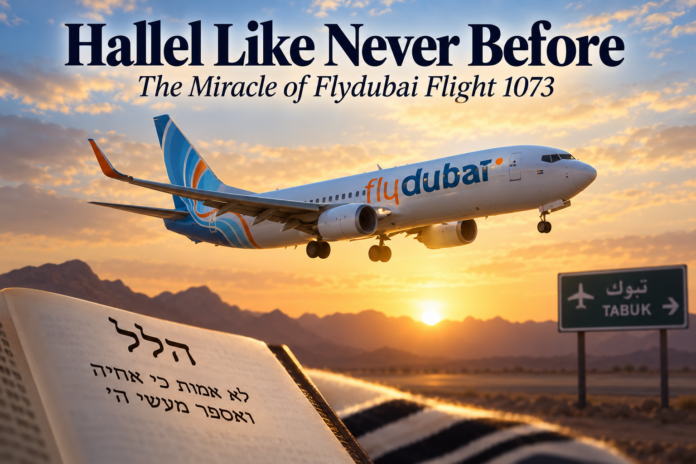
Say Hallel Like Never Before: The Miracle of Flydubai Flight 1073
New York (VINNEWS/Rabbi Yair Hoffman) This morning, during Chol HaMoed Sukkos, 174 passengers took off from Dubai for Ben Gurion Airport. Twenty-seven of them were children. They were our brothers and sisters, cousins and friends of Klal Yisrael. They were going home for Yom Tov or for a trip to Eretz Yisroel.
And for, r”l. a few terrifying minutes over the desert, their lives hung by a thread.
The Hallel recited over the remaining days of this Yom Tov cannot be recited in the same way.
What Happened in the Sky
Flydubai Flight FZ1073 left Dubai at about 6:05 a.m. Israel time on a Boeing 737 MAX 8. Roughly two hours and fifteen minutes into the flight, at 8:21 a.m., the aircraft lost more than 14,000 feet in under thirty seconds. According to passenger accounts and Israeli officials, the Omani co-pilot pulled out a knife and stabbed the Emirati captain in the cockpit. He then tried to take control of the plane and send it downward. The blood seen all over the cockpit in the videos that could not have been faked clearly showed the fact that it was clear, bonified terrorism.
And clear bonified evil.
At 8:31 the aircraft sent out the general emergency code, 7700. At 8:38 it switched to 7500, the international code for unlawful interference, meaning a hijacking.
Israeli Air Force fighter jets were scrambled. Prime Minister Netanyahu and Defense Minister Katz held an urgent security consultation.
Inside the cabin, crew members and passengers forced their way into the cockpit and Boruch Hashem – overpowered the attacker. Several of those passengers were Israelis.
Reports say two off-duty pilots were on board and helped bring the plane under control. Passengers described large amounts of blood in the cockpit. The captain was seriously wounded. The plane was stabilized at roughly 15,000 feet, turned toward Saudi Arabia, and landed safely in Tabuk at about 9:45 a.m. Every passenger survived unscathed.
One passenger told Israel’s Channel 14: “This was not a fight — it was a terrorist who tried to crash us.”
The airline shockingly – first described the incident as a “violent altercation between pilots.” Israeli security officials are increasingly treating it as a possible act of terror.
It was clear terrorism.
The Omani co-pilot is in custody, and the investigation is ongoing. Details will certainly be refined in the coming days. Two things are already clear. A man in the cockpit of a plane full of Jews bound for Eretz Yisrael tried to bring it down. And HaKadosh Baruch Hu did not let him.
The Terror From Inside the Cockpit
After September 11, the world’s answer was to reinforce and lock the cockpit door. That solved one problem and created another. A locked door keeps the terrorist in the cabin out. It also keeps the passengers out when the danger is already inside the cockpit.
Aviation history has several bitter examples of that inside danger:
- 1999: EgyptAir Flight 990 went into the Atlantic, killing 217 people. Investigators concluded that the relief first officer deliberately caused the crash.
- 2015: The co-pilot of Germanwings Flight 9525 locked the captain out and flew the plane into the French Alps, killing 150 people.
- 2013: LAM Mozambique Flight 470 crashed after the captain locked out his co-pilot. All 33 people aboard were killed.
- 2022: China Eastern Flight 5735 dove from cruising altitude into a mountainside, and deliberate action has been widely suspected.
In each case, the one person trusted with everyone’s life turned against them. Nothing could be done from the cabin.
This morning should have ended the same way. Tehillim 118, which is part of Hallel, says: “טוב לחסות בה’ מבטח באדם, טוב לחסות בה’ מבטח בנדיבים” — “It is better to take refuge in Hashem than to trust in man; it is better to take refuge in Hashem than to trust in princes.” Every passenger on every flight puts full trust in two strangers behind a door. This morning, one of those strangers was allegedly the enemy. Protection came from Hashem, through the courage of the people He placed on that plane.
Israeli officials said openly that without the intervention in the cockpit, the outcome could have looked like September 11 or Entebbe. Terror against Jews takes many forms: rockets, tunnels, stabbings in the street, bombs on buses, and now possibly a knife in a cockpit at 34,000 feet. The Torah describes Amalek with the words “אשר קרך בדרך” — he attacked on the way, while traveling, when people were most vulnerable. The traveler is always exposed. Security officials in Israel and around the world must now look hard at how a man with such intentions got into a cockpit with a knife, and how pilot screening can be improved. Klal Yisrael also has a different job: to recognize that the Shomer Yisrael neither slumbers nor sleeps, even over the Jordanian desert.
It should also be noted, fairly, that an Emirati pilot was the victim here, not the attacker. Saudi Arabia opened its airport to a plane full of Israelis. Hashem sends His agents of salvation from unexpected places.
The Heroes Were Obligated — and They Fulfilled It
The passengers and crew who broke into the cockpit fulfilled one of the Torah’s great commandments. “לא תעמוד על דם רעך” — “Do not stand idly by the blood of your fellow” (Vayikra 19:16). The Rambam (Hilchos Rotzeach 1:14) rules: “כל היכול להציל ולא הציל עובר על לא תעמוד על דם רעך” — anyone who is able to save and does not save transgresses this commandment. The law of the rodef, the pursuer (Sanhedrin 73a; Rambam, Rotzeach 1:6), requires every bystander to stop someone trying to kill, by whatever force is needed.
The Yerushalmi teaches that one who saves another is considered to have saved an entire world. The people who went into that cockpit saved 174 worlds, among them 27 children, and all the generations those children will someday bring into the world.
Hallel: Instituted for Exactly This
The Gemara in Pesachim (117a) explains why Hallel was instituted:
“נביאים שביניהן תיקנו להן לישראל שיהו אומרין אותו על כל פרק ופרק ועל כל צרה וצרה שלא תבא עליהן, ולכשנגאלין אומרים אותו על גאולתן”
“The prophets among them instituted that Israel should recite it at every festival, and for every trouble that should not come upon them. When they are redeemed, they recite it over their redemption.”
This morning, both parts of that teaching came together. It is a festival: Sukkos, when full Hallel is recited every day (Arachin 10a). And it is a day of redemption from a trouble that very nearly came upon Klal Yisrael.
The Gemara in Megillah (14a) gives the reasoning behind all shirah: “ומה מעבדות לחירות אמרינן שירה, ממיתה לחיים לא כל שכן” — “If, for going from slavery to freedom, song is sung, then for going from death to life, all the more so!” 174 people went from death to life this morning, in a matter of minutes.
Let’s all read the words of Hallel with this morning’s news in mind:
- “אפפוני חבלי מות ומצרי שאול מצאוני, צרה ויגון אמצא” — “The cords of death encircled me, the confines of the grave found me; I found trouble and sorrow” (Tehillim 116:3).
- “כי חלצת נפשי ממות, את עיני מן דמעה, את רגלי מדחי” — “For You delivered my soul from death, my eyes from tears, my feet from stumbling” (116:8). The word dechi, a stumbling or a fall, describes a plane dropping 14,000 feet in less than a minute.
- “מן המצר קראתי י-ה, ענני במרחב י-ה” — “From the narrow straits I called out to Hashem; He answered me with expansiveness” (118:5). There is no narrower strait than an airplane cabin in free fall.
- “סבוני כדבורים… בשם ה’ כי אמילם” — “They surrounded me like bees… in the Name of Hashem I cut them down” (118:12).
- “יסר יסרני י-ה, ולמות לא נתנני” — “Hashem has chastened me severely, but He did not give me over to death” (118:18).
- “לא אמות כי אחיה, ואספר מעשי י-ה” — “I shall not die, for I shall live, and I shall tell of the deeds of Hashem” (118:17).
- “כוס ישועות אשא, ובשם ה’ אקרא” — “I will raise the cup of salvations and call out in the Name of Hashem” (116:13).