
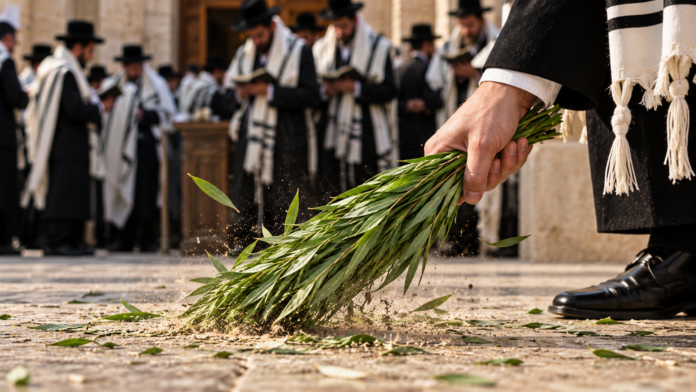

New York (VINNEWS/Rabbi Yair Hoffman) What is up with everyone beating those Hoshanos tomorrow- on Hoshana Rabbah? The answer takes us on a trip through Jewish history and our emunah in our Mesorah. It commemorates the idea of Halacha l’Moshe miSinai.
When the Beis HaMikdash stood, the aravah (willow) was taken all seven days of Sukkos. The mitzvah is not written in the Torah; it is a halachah l’Moshe miSinai (Sukkah 44a). Large willow branches were stood up beside the mizbeach, and the people circled it once each day and seven times on the seventh day (Sukkah 45a). The Rambam (Hilchos Lulav 7:20–22) writes that on the seventh day the aravah even pushed aside Shabbos, to publicize that it is a true mitzvah. That is why the day is also called “Yom Aravah.”
After the Churban, the aravah has no Torah basis outside the Mikdash (Sukkah 44a). The Nevi’im therefore established a custom to take it only on the seventh day, as a zecher laMikdash. Because it is a custom and not a formal takanah, no berachah is recited.
Waving or Beating?
The Gemara (44b) says of Rabbi Elazar bar Tzadok, “chavit v’la barich,” “he struck and did not make a berachah.” Rashi, the Tur and the Ran understand “chavit” as waving. Rav Tzemach Gaon explains that the aravah is beaten on the ground: its leaf is shaped like lips, and beating it in the dust brings atonement, as the pasuk says, “Let him put his mouth in the dust; perhaps there is hope” (Eichah 3:29). The Rambam (7:22) writes that one strikes it on the ground or on a utensil two or three times. The Rosh and Tur write twice.
The Arizal taught that the aravah is never taken together with the lulav, so that the gevuros (forces of judgment) are not stirred up during the time of chassadim (Sha’ar HaKavanos, Sukkos, Derush 8). This became the universal practice, as ruled by the Rama, the Mishnah Berurah (664:15), the Chida (Birkei Yosef 664:2) and the Ben Ish Chai.
Ashkenazic and Sephardic Customs
Both communities agree on the basics. The aravah is taken by itself, with no berachah. Whatever disqualifies the aravah of the lulav disqualifies this one (Rama 664:4). The branches should be tied together (Mishnah Berurah 664:17; Birkei Yosef 664:4). The used aravos may not be stepped on (Shulchan Aruch 664:8), and they are later burned for a mitzvah. The details differ:
| Topic | Ashkenazic custom | Sephardic custom |
| Waving | Wave the aravah first, then beat it (Rama, out of concern for Rashi’s view). | Only beat it; no waving (Arizal). |
| Number of branches | One leaf is enough by law (Shulchan Aruch 664:4); the Rama adds that it is unbecoming; the Mishnah Berurah (664:17) recommends three. Many Ashkenazim also take five, following the Arizal. | Five, for the five gevuros (Arizal, Sha’ar HaKavanos). |
| When | Beaten in shul, at the end of the Hoshanos. | Older custom: after all of Mussaf, on the way out of shul. Beis El custom: right after the hakafos that follow Shacharis. |
| Where | On the ground or on a utensil (Rambam; Shulchan Aruch 664:4); the Magen Avraham (664:7) says specifically on the ground. | Only on natural ground, not on a paved floor (Ben Ish Chai; Kaf HaChaim 664:50); some allow a plastered wall or spread dirt. |
| Words and kavanos | No special texts are required by the Rama or the Mishnah Berurah. | L’Shem Yichud, the “minhag Nevi’im” text, the words “chavit v’la barich,” and kabbalistic kavanos for each of five strikes. |
| Nishmas | Not said (the Rama rules Nishmas is not said on Hoshana Rabbah). | Nishmas is said after Mussaf, with the Aron open, without Hashem’s Name. |
| Women | Women also beat the aravah. | Women are exempt and should not do it (Ben Ish Chai). |
| Burning | Hoshanos burned in the matzah oven; lulav burned at biur chametz (Rama 664:9). | Ben Ish Chai: the reverse; the aravah burns the chametz, and the lulav heats the matzah oven. |
How Many Branches
The Gemara records a dispute between Rav Nachman, who requires three twigs, and Rav Sheshes, who allows one leaf on one twig. Rav Hai Gaon rules like Rav Sheshes but advises following Rav Nachman, since a single leaf is unbecoming. The Maharash of Tirna took seven, for the seven Hoshanos, and the Arizal taught five. Each branch should be at least three tefachim long. One may use an aravah that someone else already used, as long as it is still fit (Shevet HaLevi 2:58).
When to Beat
The Geonim and Rishonim (Rosh, Tur, Roke’ach and others) placed the aravah at Mussaf and the lulav at Shacharis. The Beis Yosef explains that this keeps the two mitzvos apart and publicizes the aravah. Most Sephardic communities beat it on natural ground after Mussaf as they left shul, a practice recorded in Eretz Yisrael, Syria, Turkey, Egypt and Baghdad. The kabbalists of Beis El in Yerushalayim beat it right after the hakafos that follow Shacharis, before the Torah reading. Those who go outside at that point must not leave the Sefer Torah alone in the shul; some members of the congregation should stay with it.
How to Beat (Sephardic Order)
Hold the bundle in the right hand and say the L’Shem Yichud, which comes from the Chemdas Yamim and was edited by the Chida (Kaf Achas 17). Strike the ground five times, raising the hand before each strike, and say “chavit v’la barich.” According to the Chemdas Yamim and the Ben Ish Chai, each strike corresponds to one of the five final letters, Mem-Nun-Tzadi-Pei-Chaf, which hint at the five gevuros.
In both communities, the branches should remain kosher until the last strike (Ben Ish Chai). The Chayei Adam (152:13) writes that beating until all the leaves fall off is “a custom of children, out of joy.”
Where to Beat
The Zohar and Rabbi Chaim Vital say the aravah is struck on the ground, bringing the judgments down to Malchus, called “karka olam.” The Ben Ish Chai and the Kaf HaChaim therefore exclude floors paved with stone or wood. Rabbi Eliyahu Mani (Michtav Me’Eliyahu 63) reports that at Beis El and in Chevron they struck a plastered wall that stood on the ground. The Nesivei Am (664) allows spreading dirt on the shul floor.
Nishmas (Sephardic Custom)
After Mussaf, the Aron is opened and the congregation says Nishmas joyfully, without Hashem’s Name. The source is Minhagei Beis El and the Nahar Mitzrayim, who warns against saying the Name out of habit. The common text ends at “umei’olam ve’ad olam Atah Kel.” Afterward the congregation accepts, bli neder, to say it again next year (Siddur Kavanos HaRashash). Some suggest this is a segulah for long life.
Segulos
The Menoras HaMaor writes that the aravah of Hoshana Rabbah protects those traveling on dangerous roads. The Chemdas Yamim calls it a protection for the home. The Kaf HaChaim (664:59) cites the Mahari Fichdel that placing the aravos under the bed protects against fear and bad dreams. It is therefore good to keep a few aravos at home rather than burning them all.
There is also a custom for a pregnant woman to bite off the pitam of the esrog on Hoshana Rabbah, without eating it, since the esrog is muktzeh until nightfall. She then says a tefillah for an easy birth and gives tzedakah. Her husband should give her the esrog and read the tefillah for her to repeat word by word.
The author can be reached at [email protected]