
 Vos Iz Neias
Why Did Passengers Act When Flydubai Flight Came Under Attack? The Psychology of Emergency Behavior
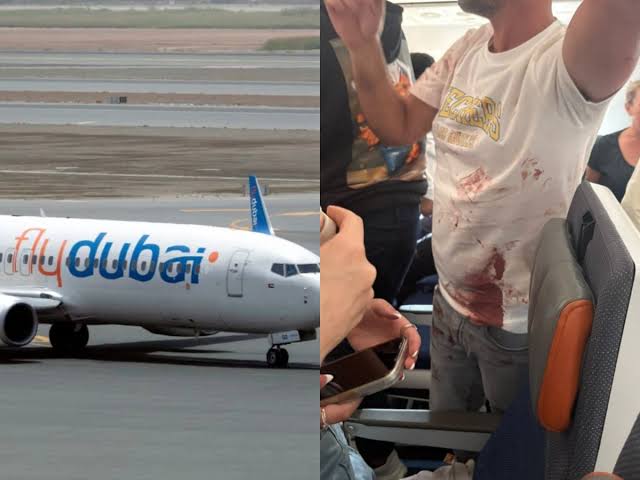
JERUSALEM (VINnews) — When a Flydubai flight from Dubai to Tel Aviv descended thousands of feet in a matter of seconds on Wednesday, passengers faced a situation in which there was little time to understand what was happening.
According to passenger accounts, the crisis began when the co-pilot allegedly attacked the captain in the cockpit. The aircraft entered a steep descent before the injured captain managed to open the cockpit door. Passengers and other pilots then intervened, restraining the attacker, while additional pilots took control of the aircraft and eventually landed it safely in Tabuk, Saudi Arabia.
One Israeli passenger, identified in Israeli media as Yaniv Hayoun, described entering the cockpit and helping overpower the attacker. Another passenger, Zvika Manes, said passengers who were called forward did not hesitate to intervene. The incident has since prompted questions about what causes people to act during an extreme emergency rather than waiting for instructions.
Israeli behavioral psychologist Dr. Liraz Margalit argues that the answer may lie partly in the powerful influence of ordinary routines.
A famous example comes from the 1979 fire at a Woolworths department store in Manchester, Britain, in which 10 people died. Accounts of the disaster have been used in research into how people respond when an apparently ordinary environment suddenly becomes dangerous. The fire produced highly toxic smoke from burning polyurethane foam, and 11 people ultimately died.
The broader lesson from disaster psychology is that people do not necessarily respond to danger by immediately running away. Instead, they may initially continue behaving according to the social script associated with the place they are in.
In a restaurant, people eat. In a store, they shop. On an airplane, they expect the crew to manage the situation.
That tendency is related to what psychologists call normalcy bias: the tendency to interpret alarming information through the framework of ordinary events and underestimate the possibility or seriousness of a disaster. Research into fire evacuation has found that ambiguous warning signs can contribute to delays in leaving a building.
A systematic review of 83 studies on disaster evacuation likewise found that risk perception is an important factor in determining whether people evacuate, while having an evacuation plan and previous evacuation experience can also influence behavior.
The phenomenon does not mean that people simply become passive during emergencies. Once the danger becomes unmistakable, behavior can change rapidly. The Flydubai passengers were confronted with several unusually strong signals: screaming, a violent struggle in the cockpit and an aircraft undergoing a dramatic descent. Reports indicate that some passengers moved toward the cockpit and physically intervened.
The incident also highlights another important factor in emergency behavior: social cues. People frequently look to those around them to determine whether a situation really requires action. If everyone else remains calm, an individual may hesitate. Conversely, seeing another person move toward danger can make intervention seem both necessary and socially acceptable.
The Israeli response has generated particular attention because the passengers who intervened did not simply wait for an official evacuation order. President Isaac Herzog has since recommended that four Israelis who helped save the flight receive the Presidential Medal of Civilian Valor, praising their courage and quick action.
Margalit’s argument goes further, suggesting that characteristics often associated with Israeli culture, such as informality toward authority, initiative and a willingness to intervene, which can be loosely defined as Chutzpah, may encourage people to act rather than wait for instructions. Such cultural explanations, however, are difficult to establish scientifically, and emergency behavior varies greatly between individuals and situations.
What the research does establish is that the instinct to remain within a familiar routine during a crisis is widespread. Psychologists have studied normalcy bias in disasters for decades, including research by Israeli psychologists Haim Omer and Nahman Alon, who described normalcy bias as a tendency to underestimate the probability or extent of disruption during a disaster.
The Flydubai incident therefore offers a striking real-world example of two very different emergency responses: the instinct to wait for authority and the decision to take immediate action. In an aircraft moving thousands of feet downward in seconds, there may be no time to wait for certainty. Sometimes, the most important decision is recognizing that the normal rules no longer apply.