5 Towns Central
Orthodox Jewish Community Rises in Florida – & Social Media Erupts in Antisemitic Outrage
A growing Orthodox Jewish community in Florida has become the target of a social media firestorm, with online critics accusing Jewish families of refusing to assimilate, questioning their right to establish a religious neighborhood, and spreading unsubstantiated claims that the community will exploit public assistance programs.
The controversy surrounds Lakefront Estates, a major residential development near Lake Okeechobee in Glades County, where more than 80 Orthodox Jewish families from New York have already moved in and opened schools. Dozens of additional families are expected to arrive in the coming weeks.
The project, representing an investment reportedly exceeding $100 million, is designed to provide families with homes, educational institutions, religious facilities and essential services in a community built around their way of life.
Yet footage of the development circulating online has triggered an extraordinary backlash. Rather than focusing on the construction of homes and the opening of schools, many commenters have questioned why Jewish families would want to live together, while others have resorted to familiar antisemitic stereotypes about Jewish money, public benefits and supposed unwillingness to become part of American society.
One social media commenter alleged, without providing evidence, that the families would impose enormous costs on Florida taxpayers through welfare, food assistance, Medicaid and other public benefits, while supposedly working off the books.
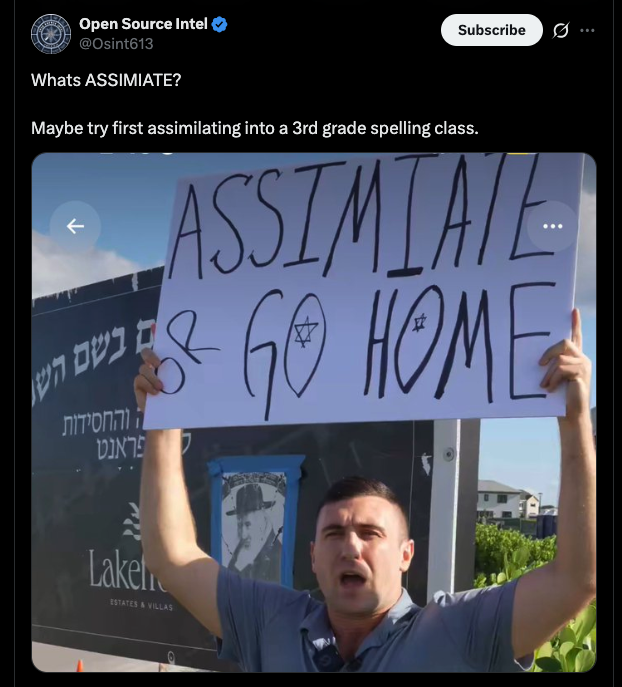
Another prominent online figure, Jake Lang, posted that he had been “CHASED AWAY” by guards at what he described as a “HASSIDIC JEWISH ONLY Community,” adding the demand: “Assimilate or GO HOME!!!”
The rhetoric raises an obvious question: Why is a Jewish community choosing to build homes, schools and institutions for its families being treated as a threat?
Building a community, not withdrawing from America
The vision for Lakefront Estates extends far beyond a residential development. Plans call for as many as 1,000 single-family homes and 300 rental units, alongside Shuls, mikvahs, boys’ and girls’ schools, a yeshiva, a kollel, kosher shopping and medical services.
The goal is to create an environment where Orthodox Jewish families can practice their religion, educate their children according to their traditions and establish the communal support systems that are central to their way of life.
Hatzalah South Florida has also begun organizing a local branch, meeting with prospective emergency responders who will serve the growing community.
For Orthodox families, these are not extravagant or sinister ambitions. They are the practical foundations of everyday life: places to daven, schools for children, access to kosher food, religious facilities and neighbors who share the rhythms and responsibilities of observant Jewish life.
Families are also seeking more affordable housing and additional space than may be available in established Orthodox communities in the New York area.
The broader development is intended to accommodate substantial future growth, although its long-term plans will take time to complete.
Since when is choosing your neighbors a crime?
Much of the online outrage appears to rest on the suggestion that a religious community choosing to live among people who share its traditions is inherently suspicious.
But Americans routinely establish neighborhoods and communities around shared interests, cultural backgrounds, religious beliefs and lifestyles. Churches build housing developments, religious schools draw families to particular areas, and communities across the country organize their lives around institutions that reflect their values.
Orthodox Jews are no different.
Living near other Jewish families makes it easier to observe Shabbos, walk to shul, send children to religious schools and maintain a kosher household. It also allows families to rely on neighbors for childcare, meals during difficult times, assistance for the elderly and support during emergencies.
These networks are especially important in a community whose religious practices shape nearly every aspect of daily life.
Wanting those resources nearby does not mean rejecting America. It means exercising the freedom to practice one’s religion and build a life around it.
The demand that Jewish families must “assimilate or go home” is particularly revealing. These are American residents choosing to build homes and institutions in an American state. They are not required to abandon their traditions to prove that they belong.
The welfare accusations: allegations are not evidence
Perhaps the most troubling part of the backlash is the willingness of some commenters to portray the incoming families as prospective welfare cheats before establishing any evidence of wrongdoing.
One widely circulated comment claimed that the community would cost Florida millions through public benefits allegedly collected by large families while their members worked off the books.
No evidence was offered to substantiate those sweeping allegations about the families moving into Lakefront Estates.
There is a legitimate public interest in how taxpayer-funded programs operate. Eligibility rules should be followed, fraud should be investigated when credible evidence exists, and public spending can be scrutinized regardless of who receives the benefits.
But those principles apply to individuals based on their actual circumstances and conduct, not to an entire religious community based on stereotypes.
Having a large family does not establish fraud. Receiving a benefit for which someone is legally eligible is not evidence of wrongdoing. And a family’s Orthodox Jewish identity tells us nothing about whether its members comply with tax laws or public assistance requirements.
Religious freedom applies to Jews, too
Some critics have questioned why a Jewish community should be able to establish a neighborhood centered on its religious needs, sometimes comparing the development to Muslim communities seeking similar arrangements.
The answer should be straightforward: Americans of every faith have the right to worship, establish religious institutions and build communities, subject to applicable laws.
Muslim Americans have those rights. Christians have those rights. Jews have those rights.
There is no contradiction in supporting religious freedom for everyone while recognizing that different faiths have different practices and communal needs.
An Orthodox Jewish development built around synagogues, Jewish schools and kosher services is not, by itself, evidence of hostility toward outsiders. Nor does it establish that residents intend to impose their religious laws on their neighbors.
There is an important distinction between voluntarily organizing one’s own community around religious principles and seeking to compel people outside that community to follow them.
Lakefront Estates’ stated purpose is to provide a place for Orthodox Jewish families to live and practice their faith. Claims about broader political or religious ambitions require evidence, not assumptions based on the community’s identity.
What really seems to bother some of the internet’s loudest critics?
The intensity of the response is striking. A community is building houses, opening schools and organizing emergency services, yet some of the loudest reactions are demands that its residents leave the country or accusations that they are exploiting the public.
For some commenters, the hostility is openly antisemitic. For others, the development may challenge their assumptions about what an American neighborhood should look like or who is entitled to create one.
It is also worth recognizing what a functioning community can offer: close relationships, shared traditions, multigenerational support and a sense of responsibility for one’s neighbors.
Orthodox Jewish communities often organize extensive networks of charitable assistance, volunteer emergency response, hospitality and mutual aid. These institutions are not unique to Jews, but they are an important part of how many observant Jewish neighborhoods function.
There is no need to romanticize any community or suggest that every resident is perfect. No neighborhood is. The point is that the existence of a close-knit religious community should not automatically be treated as evidence of wrongdoing.
People who have little interest in religious life are free to choose a different environment. People who value a tightly connected community should have the same freedom.
A new community should not have to apologize for being Jewish
Lakefront Estates is still in its early stages. Families are arriving, schools are opening, and the work of building the institutions needed to support a growing population is beginning.
The development can be evaluated on its merits, its compliance with local laws, its economic impact and its relationship with the surrounding area. Those are fair questions for residents and public officials to examine.
But a different standard is being applied in much of the online commentary: Jewish families are being asked to justify why they want to live among other Jews in the first place.
That is not a reasonable demand.
America’s promise of religious liberty means people do not have to erase their identities to earn a place in society. Jewish families can be proudly Orthodox and proudly American at the same time.
They can build synagogues, educate their children in Jewish schools, establish kosher businesses and create a neighborhood shaped by their traditions without being accused of plotting against the country.
A community of families investing in homes, schools and local services should be judged by what it actually does, not by the prejudices others project onto it.
If the sight of Jewish families building a future together provokes such hostility, this may reveal why these families want their own community.
🇺🇸✡️ WATCH: Historic Milestone in Florida as Over 80 Orthodox Jewish Families Move Into New $100 Million-Plus Community and Schools Open
More than 80 families from New York have moved into Lakefront Estates, where schools have now opened. Dozens more families are expected in the coming weeks, following reported investment of hundreds of millions of dollars in the project.
Located in Glades County near Lake Okeechobee, Lakefront is a purpose-built residential community. The broader development plan calls for up to 1,000 single-family homes and 300 rental units.
The vision goes beyond housing: plans include synagogues, mikvahs, boys’ and girls’ schools, a yeshiva, a kollel, kosher shopping and medical services. Developers are targeting families seeking more space and an alternative to soaring housing costs in established Orthodox neighborhoods.
Hatzalah South Florida has also begun organizing a local branch, meeting with prospective responders who will serve Lakefront. With families arriving and classrooms opening, the focus now shifts from construction to building the services a growing community needs.
— Jewish Breaking News (@JBreakingNews) October 12, 2026
I was just CHASED AWAY by guards at new HASSIDIC JEWISH ONLY Community in Okeechobee Florida for exposing the new $100,000,00+ Compound!!!! ✡️
Assimilate or GO HOME!!! https://t.co/L5DVf4bNOc
— Jake Lang – January 6 Political Prisoner 🇺🇸 (@JakeLang) October 13, 2026
A Photo of young Jake Lang kissing the Kotel (below), how quickly we forget.