
 Matzav
FEARING ELECTION DAY CHAOS: Police Block IDF Plan for Mass Arrests of Chareidi Draft Evaders, Warning of Widespread Protests
The IDF has postponed a major operation to arrest chareidi draft evaders after Israel Police warned that carrying out the arrests next week could trigger widespread demonstrations lasting through Election Day and potentially disrupt voting across the country.
The operation had been scheduled for Sunday through Tuesday of next week, but senior police officials refused to assign the Tel Aviv District police force to provide security for the arrests, effectively preventing the military from proceeding with its plans.
According to a report Wednesday evening by Daniel Grovais on Kan News, police commanders raised serious concerns that an organized campaign to arrest chareidi draft evaders so close to the elections could ignite a wave of protests that would be difficult to contain.
The police assessment was that the arrests could provide demonstrators with a new rallying point, escalating tensions within the chareidi community at a particularly sensitive time.
Officials reportedly described the proposed operation as a potential “reason to celebrate” for protest organizers, who could use the arrests to mobilize large demonstrations in the days leading up to the elections.
During an internal discussion involving senior police commanders, participants expressed concern that the unrest might continue well beyond the initial arrests and spill over into Election Day itself.
The possibility of large-scale protests disrupting voting arrangements was reportedly a central factor in the police decision. Officials feared that simultaneous demonstrations in multiple locations could stretch police resources and interfere with the orderly conduct of the elections.
With the Tel Aviv District police force unavailable to secure the planned operation, the IDF decided to delay the arrests rather than proceed without the necessary coordination and protection.
The military confirmed that the operation had been postponed because of objections raised by Israel Police.
“In light of considerations by Israel Police, the arrest operation planned for next week has been postponed. Operations in civilian areas require coordination and cooperation with Israel Police,” the IDF Spokesperson’s Unit said in a statement.
Israel Police had not issued an official response to the report as of Wednesday evening.
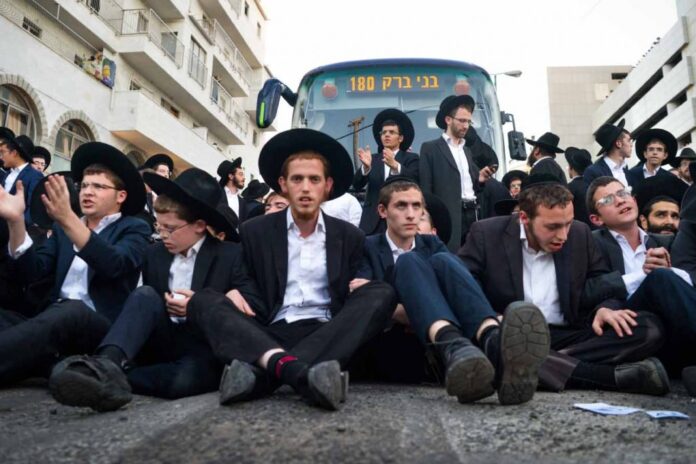
The decision comes amid continuing confrontations over the military draft of chareidi yeshiva students, with enforcement operations and arrests repeatedly sparking demonstrations in chareidi neighborhoods and at major intersections.
The latest postponement also comes as the government faces mounting legal scrutiny over its efforts to enforce military conscription requirements.
The postponement follows a series of unsuccessful attempts to arrest chareidi draft evaders, including a confrontation in Modiin earlier this month that demonstrated how quickly such operations can draw large crowds.
On October 6, military police attempted to arrest a yeshiva bochur in Modiin, but hundreds of demonstrators descended on the location after alerts were circulated through an emergency notification network operated by anti-draft activists.
According to an initial military investigation, approximately 700 protesters reached the building within just ten minutes. Demonstrators surrounded the premises and confronted security personnel, ultimately preventing the arrest from being completed.
The military subsequently acknowledged that the operation had been called off because of the disturbances. Police and military officials later disputed responsibility for the failure, with police maintaining that military personnel had not removed the suspect from the location quickly enough.
Additional attempted arrests in Bat Yam and Dimona also encountered organized opposition, with anti-draft activists mobilizing demonstrators after receiving alerts about military police activity.
Meanwhile, a separate report Wednesday evening by Channel 13 revealed figures suggesting that enforcement against chareidi draft evaders has been extremely limited in recent months.
According to police data cited in that report, 143 chareidi draft evaders were detained during encounters with police since July but were subsequently released at the scene because military police failed to arrive in time to take custody of them.
During the same period, Channel 13 reported, military police arrested only 15 chareidi draft evaders, compared with 14 non-chareidi draft evaders.
The report also cited an estimate that approximately 50,000 chareidi men in Israel are currently classified as draft evaders.
The IDF disputed the accuracy of the figures presented by Channel 13, insisting that its enforcement operations have continued.
“The figure presented is unfounded and does not correspond to the information in the IDF’s possession. Contrary to the claims, proactive enforcement activity by military police soldiers continues and is carried out routinely through various methods,” the military said.
The controversy comes as the state faces a deadline to update the Supreme Court on the measures being taken to enforce draft requirements among chareidi men.
According to Channel 13, the government is expected to submit its response Thursday, explaining what steps have been implemented to locate and arrest individuals classified as draft evaders.
The latest developments follow an earlier discussion at the Justice Ministry in which military representatives acknowledged that proactive arrests had largely been suspended during the recent Yom Tov period, partly because enforcement resources had been concentrated at border crossings.
Following that discussion, officials instructed the military police to resume proactive enforcement as soon as possible, in coordination with Israel Police. Military prosecutors were also directed to advance changes concerning prosecution thresholds and disciplinary procedures for draft evasion.
The planned operation for next week was expected to form part of that renewed enforcement effort. However, the police decision to withhold security assistance has now delayed the initiative, leaving the military’s next steps uncertain as the Supreme Court awaits the state’s update.
{Matzav.com}