
 Vos Iz Neias
Michigan Senate Candidate Warns Jewish Democrats Are ‘Terrified’ Of Rival’s Anti-Israel Rhetoric
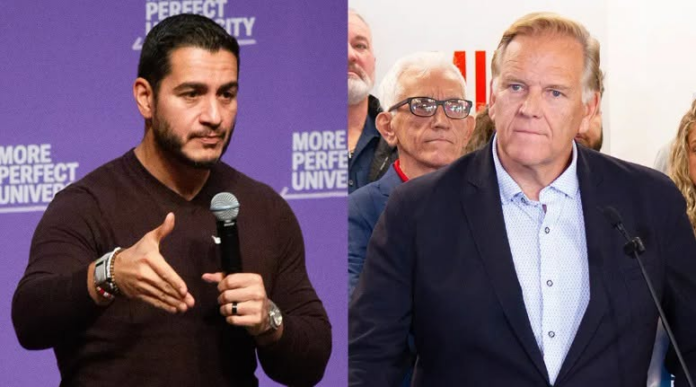
DETROIT (VINnews) — Republican Senate candidate Mike Rogers accused Democratic rival Abdul El-Sayed of frightening Jewish voters with his rhetoric on Israel and antisemitism during their final televised debate Wednesday, as the increasingly contentious Michigan race entered its closing weeks.
Speaking at the October 21 debate hosted by Detroit television station WXYZ, Rogers, a former congressman, claimed that traditionally Democratic Jewish voters were turning toward his campaign because of concerns about El-Sayed’s positions. “We’re doing exceptionally well with Jewish Democrats who are literally afraid,” Rogers said. “I’ve talked to ones with tears in their eyes about the future of their kids and grandkids, because [of] the anger and division that he is laying out on the street.”
Rogers repeated the accusation in his closing remarks, arguing that El-Sayed’s rhetoric had contributed to an atmosphere in which Jewish students feared openly displaying their religious identity. “Jewish Democrats who are afraid for their children when their daughters can’t wear their Star of David walking across Michigan’s campus, these are real,” he declared. “My opponent’s rhetoric, his vitriol, is having consequences.”
El-Sayed, a former Wayne County health director and outspoken critic of Israel, did not directly address those accusations during the debate. However, his positions on Israel, Iran and the influence of pro-Israel political organizations remained points of contention.
The debate followed a New York Times report that the American Israel Public Affairs Committee (AIPAC) planned to direct as much as $9 million toward a super PAC supporting Rogers.
El-Sayed seized on the report while criticizing Rogers’ support for US military action against Iran. “But that’s what you get when you have an AIPAC-backed politician,” he said.
AIPAC had previously spent heavily against El-Sayed during the Democratic primary, supporting his opponent, Representative Haley Stevens. On Wednesday, the organization announced changes to its political activities, ending direct candidate endorsements and contributions through its PAC while continuing independent spending through its affiliated super PAC.
Asked whether Iran represented a significant threat to the United States, El-Sayed acknowledged that “there’s no doubt that Iran has posed a threat,” but argued that the 2015 nuclear agreement negotiated under President Barack Obama had contained the danger before President Donald Trump withdrew from it in 2018. He accused Rogers of “having cheered this war all along.”
Rogers countered by accusing his opponent of refusing to condemn Iran’s Islamic Revolutionary Guard Corps (IRGC), which the United States designates as a terrorist organization.
“My opponent can’t even condemn the IRGC, which is the terrorist enforcement arm of Iran, and doesn’t believe Iran is any more dangerous than Israel,” Rogers said, referring to previous remarks by El-Sayed.
Another confrontation centered on Republican allegations concerning El-Sayed’s family connections to the Muslim Brotherhood. Rogers raised questions about the candidate’s family background and his past political statements, while El-Sayed categorically denied membership in the Islamist organization. He described the Muslim Brotherhood as “an organization I’ve never been a part of,” dismissing Rogers’ allegations as personal attacks. “It’s really quite beneath you,” El-Sayed told his opponent.
A New York Times investigation published Wednesday examined El-Sayed’s family history, reporting that his mother had worked as a nurse in Missouri for a Muslim aid organization subsequently designated by the US government as a supporter of terrorist groups.
According to people interviewed by the newspaper, she held a low-level position and was not accused of wrongdoing. El-Sayed has said he had limited contact with his mother while growing up.
The investigation also uncovered a 2012 open letter signed by El-Sayed urging Egypt’s then-president Mohamed Morsi, who was affiliated with the Muslim Brotherhood, to remove supporters of the former Egyptian dictatorship from the media and police. Rogers cited the letter as evidence of troubling political sympathies, accusing El-Sayed of urging Morsi to “defund the police.”
The controversy has exposed divisions among Michigan’s Jewish Democrats, many of whom oppose the Trump administration but remain concerned about El-Sayed’s positions on Israel and antisemitism.
Prominent Jewish Democrats, including Senator Elissa Slotkin, have endorsed El-Sayed and campaigned alongside him. However, a coalition of Michigan rabbis and Jewish political figures known as Nonnegotiable has continued pressing the Democratic candidate to express stronger support for Jewish communities and Israel.
In a statement issued ahead of the debate, the group acknowledged the importance of the Senate race in opposing the Trump administration but warned El-Sayed that his positions were alienating potential supporters. “We know what this Senate seat means for our country, and we want a check on the dangerous excesses of the Trump-Vance administration,” the statement said. “Yet you are making it painfully difficult for our community to vote for you.”
With Election Day approaching, the competing appeals to Jewish voters highlight how disagreements over Israel, antisemitism and American foreign policy have become significant issues in one of the country’s closely watched Senate contests.