
 Vos Iz Neias
Youth Unrest Spreads Across Europe As Anger Grows Over Living Costs, Housing And Immigration
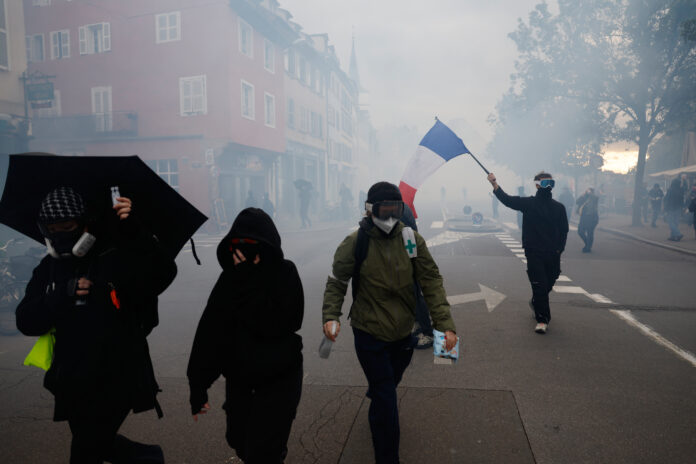
NEW YORK (VINnews) — A wave of protests and social unrest is spreading across Europe, with young people increasingly taking to the streets over rising living costs, unaffordable housing, education cuts and concerns about their future. While the demonstrations differ from country to country, several have been accompanied by looting, vandalism and violent clashes with police.
The latest developments have brought the unrest into sharper focus in Germany, Italy, Belgium, Spain, Portugal, the Netherlands and Switzerland. Although the protests are not part of a single coordinated movement, governments are increasingly concerned that local demonstrations could develop into a wider European campaign.
In Germany, tens of thousands of people took part in demonstrations on Saturday, October 31, organized under the banner “Gen Z regelt!”, meaning roughly “Gen Z takes charge.” Rallies were held in 34 cities, including Berlin, Frankfurt and Munich. Organizers called for greater investment in education and public services, opposed compulsory military service and demanded a fairer distribution of the financial burden on younger generations.
Most demonstrations remained peaceful, but serious violence broke out in Frankfurt. Groups of hooded rioters smashed shop windows and looted stores, while police reported that Molotov cocktails had been thrown at emergency personnel. Several businesses were damaged, and barricades were set on fire in Hamburg. Some luxury retailers in Berlin had boarded up their windows in advance, fearing that their premises could become targets.
The German authorities have warned that extremist groups may attempt to exploit the demonstrations. The campaign has also faced questions about its leadership and political affiliations, with some student organizations distancing themselves from it. A separate student-led protest day is planned for November 20.
In Italy, demonstrations have taken place in several major cities, including Milan, Rome, Turin, Bologna and Florence. Thousands of young people joined protests against Prime Minister Giorgia Meloni’s government, with demands ranging from lower living costs and improved public services to opposition to military spending and Italy’s involvement in international conflicts.
The most serious violence occurred in Milan, where rioters looted shops, damaged property and clashed with police. Following the unrest, the government announced that an additional 500 soldiers would be deployed to reinforce security in the city.
Meloni condemned the violence, insisting that the right to demonstrate did not justify setting cities ablaze or attacking police officers. Her government has also raised concerns about the involvement of foreign nationals in the disturbances, although the protests have brought together groups with different political and social agendas.
Belgium has also experienced repeated confrontations. In Brussels and Liège, police used tear gas and water cannons to disperse demonstrators, with more than 100 people arrested. The unrest has developed against a backdrop of student protests over university registration fees and wider dissatisfaction with public services. Belgian Interior Minister Bernard Quintin described the violence as organized and repeated, warning that it was no longer simply a matter of peaceful protest.
In Spain, the housing crisis has become one of the main sources of public anger. The case of 87-year-old Maricarmen Abascal, who was removed from the Madrid apartment where she had lived since 1956, became a rallying point for housing activists. She was carried out on a stretcher during the eviction and died two weeks later. The incident helped fuel demonstrations over rents, evictions and the lack of affordable accommodation.
The political fallout has been significant: after parliament rejected the government’s proposed housing measures, Prime Minister Pedro Sánchez called an early election for November 29. University students and staff have also announced strikes over what they describe as inadequate funding for public education.
Portugal has seen large demonstrations over housing affordability, low wages and the rising cost of living. In Lisbon, protesters marched with tents to highlight the difficulty of finding affordable accommodation, while protest encampments appeared under the slogan, “Can’t afford the rent? Bring a tent.” Police subsequently cleared an encampment in Porto during the night. Housing costs have become a particularly pressing issue in Portugal, where house prices have more than doubled since 2017 and rents for new leases have risen sharply.
The Netherlands has also seen preparations for possible disorder. Some shopkeepers boarded up their storefronts ahead of demonstrations, while groups of football supporters gathered in The Hague, reportedly saying they wanted to defend the city. The situation reflects growing concern that violence accompanying protests in neighboring countries could spread across borders.
Even Switzerland, traditionally associated with orderly and peaceful demonstrations, has experienced serious disturbances. Hundreds of young people took to the streets of Zurich and Basel under the slogan “We’ve had enough, even in Switzerland.” In Zurich, demonstrators erected barricades, set a car on fire and attacked police with fireworks, bottles and stones. Officers responded with water cannons, tear gas and rubber bullets.
Beyond the immediate economic grievances, immigration and integration have become increasingly prominent in the political debate surrounding the unrest. Several European leaders have pointed to difficulties integrating immigrant communities, while others have blamed far-left groups and political extremists for encouraging violence.
Hungarian Prime Minister Péter Magyar linked the unrest in France to immigration, arguing that the destruction demonstrated the risks of what he considers overly permissive immigration policies. Polish Prime Minister Donald Tusk likewise defended his country’s restrictive approach, saying Poland would not repeat the mistakes of other European states.
In Germany, officials have expressed concern that extremist groups could use the demonstrations to advance their own agendas. The involvement of different political organizations, however, makes it difficult to characterize the protests as a single ideological movement.
The Palestinian issue has also appeared at some demonstrations. Palestinian flags, keffiyehs and slogans supporting Gaza have been visible at marches in several cities. In Milan, Palestinian symbols appeared during demonstrations against war and rising living costs, while pro-Palestinian activists in Lyon reportedly burned Israeli and American flags. Jewish organizations in Germany have warned of increased security risks surrounding some demonstrations.
Despite the different causes behind the demonstrations, many young Europeans share a sense that their prospects are worse than those of previous generations. High housing costs, uncertain employment opportunities, pressure on public services and concerns about the future have helped create an atmosphere of widespread frustration.
There are also signs that protest organizers are attempting to build links across national borders. Representatives of 27 youth and student organizations from 11 countries met in Paris on October 17 and 18 to coordinate an international day of action scheduled for November 20, under the slogan “Fight for our future, not their wars.” Germany’s “Gen Z regelt!” campaign and Switzerland’s Socialist Youth movement are among the groups expected to participate.
The organizers say they intend to hold peaceful demonstrations. European governments, however, are increasingly concerned that the growing number of protests could create opportunities for extremist groups and violent fringe elements to turn public anger into widespread disorder.
The challenges driving the demonstrations are unlikely to disappear quickly. With housing, employment, education and immigration continuing to dominate political debate, the coming weeks could prove an important test of whether European governments can respond to the concerns of younger generations before the unrest escalates further.