

 Vos Iz Neias
Kristallnacht Survivor Warns Police Leaders In Berlin: “It Starts With Laws That Seem Harmless”
JERUSALEM (VINnews) — Nearly 150 senior police officers from the United States and Europe, many of them German officers in uniform, gathered at Berlin’s New Synagogue on Thursday to hear a powerful warning from 94-year-old Holocaust survivor George Shefi: Police must protect the rule of law and the citizens they serve, and must never again become instruments of persecution.
Shefi, who was smuggled out of Berlin on a Kindertransport train in July 1939, shortly before his eighth birthday, spoke about his childhood under Nazi rule and his growing concern about the future, according to a Yisrael Hayom report.
“Sometimes it starts with laws that seem insignificant, unimportant, but reality can deteriorate very quickly into a situation in which Jews are once again at risk,” he told the gathering. He stressed that police officers must understand history to ensure that law enforcement is never again used to persecute Jews.
The event was organized by Jochen Kopelke, head of Germany’s Police Union (GdP) and president of the European Police Union (EU.Pol), together with the International March of the Living. At its conclusion, Shefi presented Kopelke with a copy of his autobiography. Kopelke shook his hand and told him: “You should know that there are good police officers, too.”
The synagogue itself carries a powerful historical message. It survived Kristallnacht in November 1938 thanks to Wilhelm Krützfeld, a German police officer who prevented the building from being burned down and drove away the mob attempting to set it alight. Shefi described his actions as “the bravest thing imaginable.” The audience later rose to give the survivor a prolonged standing ovation.
Shefi recalled that he was almost seven when the Nazis unleashed Kristallnacht, the two-day pogrom of November 9–10, 1938. Approximately 1,400 synagogues and Jewish institutions in Germany and Austria were damaged or destroyed, and nearly 100 people were murdered.
“I remember that on the morning after Kristallnacht, my mother forbade me from leaving the house,” he said. “I stayed home for three days and only afterward was allowed outside, accompanied by an adult. The Jewish school and synagogue, which were in the same building, had been burned down.”
When he eventually went outside, he saw a Jewish-owned shop that had been completely destroyed. Its contents had been thrown into the street. Another Jewish-owned business, belonging to a man married to a Christian woman, had suffered less damage, but antisemitic graffiti had been painted on the pavement outside.
Shefi remains concerned that history could repeat itself. He pointed to a proposal in the eastern German town of Heidenau to remove Stolpersteine, the small memorial plaques embedded in sidewalks outside the former homes of Holocaust victims. “This is an attempt to erase history, and that is how it begins,” he warned.
He keeps a booklet documenting German anti-Jewish laws enacted between 1933 and 1942, when Berlin was declared “free of Jews.” Initially, the restrictions appeared relatively minor, he explained, but gradually became more severe. Jews were forbidden from owning pets, buying tobacco or entering libraries. “There were non-Jewish Germans who opposed this process, but there were not enough of them, and they did not do enough to stop the deterioration,” he said.
Born in Berlin on November 29, 1931, Shefi was an only child. His mother, aunt and grandfather were central figures in his life. His grandfather, a veteran of the German army, initially refused to accept the discriminatory restrictions imposed on Jews, believing his service to Germany entitled him to equal rights. Eventually, however, he was sent to forced labor and died after being unable to withstand the harsh conditions.
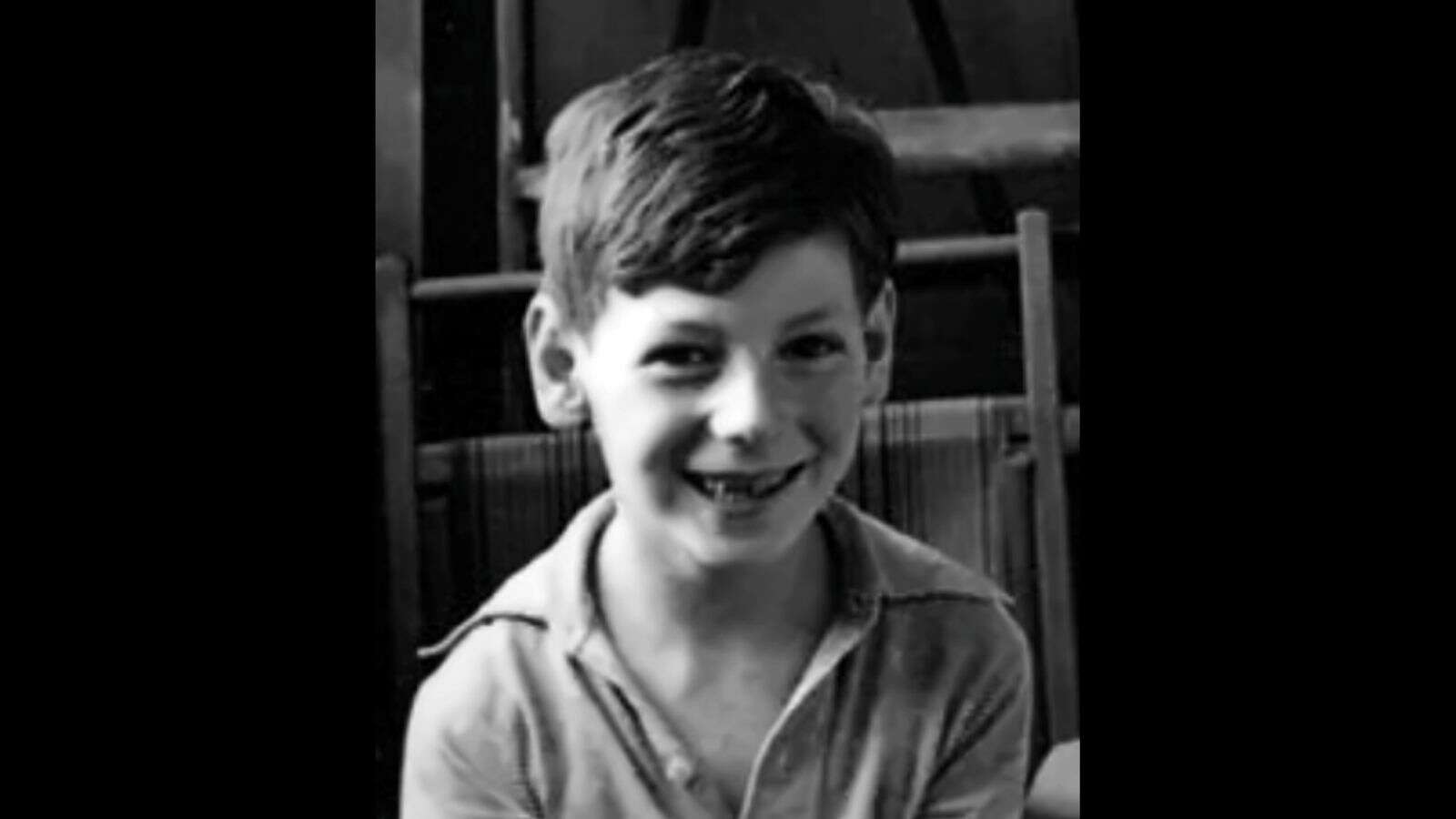
George Shefi
In July 1939, Shefi was sent to Britain through the Kindertransport rescue program, which brought Jewish children out of Nazi-controlled Europe. He left approximately five weeks before the outbreak of World War II. “I collected all the toys I loved into a pile twice as tall as I was,” he recalled. “In the end, I could take only one suitcase, so I didn’t take a single toy.”
His final memory of his mother is of her running alongside the departing train, searching for him with her eyes. “She didn’t see that I could see her. That was the last time I saw her.”
In January 1943, his mother was deported to Auschwitz, where she and her sister were murdered shortly after arriving.
“Her courage, her ability to see what was coming, and her great love gave her the strength to save my life,” he said.
Shefi eventually moved to the United States at age 13, later immigrated to Israel, served in the Navy and volunteered with the police. He married Yael, and they raised three daughters. Today, their family includes six grandchildren and five great-grandchildren.
Over the years, Shefi has spoken to approximately 12,000 German high school students, emphasizing that younger generations should not feel personally guilty for the Holocaust but must take responsibility for preventing future atrocities. “The young Germans of recent decades are not guilty of what happened, but they are responsible for what will happen,” he said. “To know how to behave, you have to know what happened.”
His concern about contemporary antisemitism was also reinforced during a visit the day before the conference to the Berlin home where he was born. Graffiti expressing anti-Israel and pro-Palestinian messages had been painted on its walls, near the Stolpersteine commemorating his mother and aunt.

Anti-Israel Graffiti in Berlin
“I was shocked. This is an outrage, and I expect the police and the municipality to remove these inscriptions,” he said. “They are painful because they are right next to the memorials to my mother and aunt. These messages must be removed from the building where I grew up and from public spaces.”
Revital Yachin Krakowski, CEO of March of the Living Israel, who accompanied him, said the rise in antisemitism had motivated the initiative to bring senior law enforcement officials together in Berlin. “At a time when Jews, synagogues and Jewish institutions are being attacked every day, we chose to bring senior law enforcement officials from around the world together inside a synagogue to learn, remember, fight antisemitism and commit to protecting Jewish life,” she said.
As he approaches his 95th birthday, Shefi’s advice is simple: “Keep smiling and stay optimistic. That is what gave me the strength throughout my life’s journey, even in the most difficult moments.”
“My greatest victory over the Nazis is not receiving a medal, writing a book or building a professional career as an engineer and seafarer. My victory is my family. I was an only child, I survived, and together with my wife I built a family of 23 people. They tried to destroy us, but we are here, with a country and an army.”
He ended with a message directed specifically at the police officers listening to him: “There are very few people left who can tell what happened. I am here to say, as one police officer to other police officers: Know what happened, remember what I told you, and make sure it never happens again.”