
 Matzav
COURTROOM REVOLT: Israeli Judges Accuse Supreme Court of Going Soft on Dangerous Criminals as “Streets Are Bleeding”
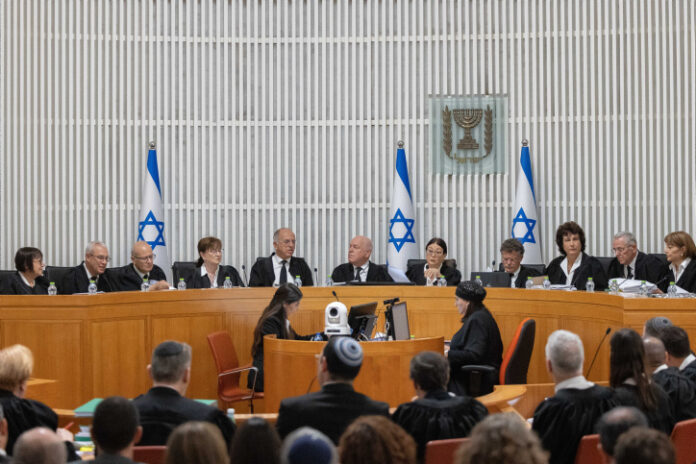
An extraordinary dispute has erupted within Israel’s judiciary after District Court judges sharply criticized Supreme Court justices for what they described as excessive leniency toward dangerous criminals, unnecessary interference in lower-court rulings, and policies that make it increasingly difficult to combat serious crime.
The unusually candid exchanges took place during a series of professional meetings between judges from different levels of the court system, according to a report Sunday evening by journalist Avishai Grinzaig of i24NEWS.
The discussions exposed significant disagreements over the detention of criminal suspects, sentencing practices, the influence of probation officers, and the Supreme Court’s willingness to overturn decisions made by District Court judges.
In one particularly contentious meeting, judges from the Tel Aviv District Court confronted Supreme Court Justices Alex Stein, Khaled Kabub, and Ruth Ronnen over what they regarded as an overly accommodating approach to defendants facing serious criminal charges.
The District Court judges complained that Supreme Court rulings effectively require them to request probation service assessments even in cases where they believe the seriousness of the alleged offenses makes such evaluations unnecessary.
“You are forcing us to send defendants for probation service reports unnecessarily in serious cases. There are cases where there is no need to request a report,” the judges argued.
Justice Stein reportedly agreed with the criticism, expressing concern that judicial decisions were failing to adequately reflect the dangers posed by certain defendants.
“That’s absolutely right. The streets are bleeding, and the defendant needs to be in custody,” Stein said.
His fellow Supreme Court justices, however, rejected the suggestion that Stein’s position represented the only legitimate judicial approach.
“That is one opinion. But there is another opinion,” Ronnen and Kabub responded.
Stein continued by arguing that judges were not making sufficient use of the legal presumption of dangerousness when determining whether defendants should remain in custody.
Kabub again disagreed, responding, “As I said, there is another opinion.”
The disagreement reflected a broader frustration among District Court judges who believe that Supreme Court intervention has made it more difficult to detain suspects accused of serious offenses.
Another meeting focused on the role of probation service reports, which provide courts with assessments of defendants and recommendations concerning detention, rehabilitation, and sentencing.
District Court judges complained that they were being placed in an impossible position. They said Supreme Court justices criticize them when they decline to obtain probation assessments, but also challenge their rulings when they request the reports and subsequently decide not to follow the recommendations.
“You criticize us for not requesting probation reports. And when we do request them, you attack us for not listening to the report. In practice, you have turned social workers into judges,” the District Court judges reportedly said.
The criticism extended to the Southern District Court, where judges told Supreme Court Justices Daphne Barak-Erez and David Mintz that the country’s highest court was failing to adequately consider the particular challenges facing residents of southern Israel.
District Court Judge Alon Gabizon argued that crime in the south has developed characteristics that require a more forceful judicial response, particularly agricultural theft and dangerous driving offenses that have severely disrupted residents’ lives.
“You need to recognize that crime in the south is unique. There is agricultural crime, and there are traffic offenses in the south that have turned residents’ lives into hell. Don’t interfere,” Gabizon told the visiting justices.
Barak-Erez responded that regional crime patterns could legitimately be considered when evaluating cases, but cautioned against establishing different sentencing standards for different population groups.
Judge Nasser Abu Taha, who serves on the Southern District Court, joined the criticism, drawing on his personal familiarity with crime within Arab communities.
“I grew up in Arab society. I know the nature of the crime. If we impose harsher sentences, we know why. Don’t interfere,” Abu Taha said.
The exchanges revealed tensions over the degree of discretion District Court judges should exercise when confronting crime in their jurisdictions, particularly when they believe local circumstances warrant tougher penalties than those ordinarily imposed.
The complaints were not confined to criminal proceedings.
During another meeting, judges from the Central District Court confronted Supreme Court Justices Ofer Grosskopf and Yechiel Kasher over the Supreme Court’s handling of legal costs awarded in civil cases.
District Court judges argued that existing regulations require courts to award realistic legal expenses, but that Supreme Court rulings frequently reduce those awards or impose amounts they consider disproportionately low.
“The regulations require realistic costs. We adhere to that. And then the Supreme Court intervenes in the costs we awarded, or on appeal to the Supreme Court they award ridiculous costs,” the judges complained.
They also argued that inadequate awards of legal expenses encourage unnecessary litigation and contribute to the already substantial workload facing the courts.
“You can’t constantly complain about the burden on the system and then award costs that bear no relation to the amount the other side actually spent and how much the losing party will have to pay,” they said.
The Israeli Judicial Authority responded to the report by defending the professional meetings, saying they are intended to encourage open discussion among judges serving at different levels of the court system.
“The court system attaches great importance to maintaining a professional, open, and productive dialogue between judges of the various judicial levels. To this end, professional meetings are held between judges, allowing for the exchange of views, sharing of knowledge and experience, and discussion of broad issues relating to the work of the judicial system,” the authority said.
The statement emphasized that judges do not discuss cases that are currently pending before the courts during these gatherings. Instead, the meetings are devoted to general legal principles and professional matters.
The Judicial Authority also challenged the manner in which the remarks were reported, arguing that individual statements had been presented without the broader discussions in which they were made.
“The quotations are fragmented and lack context, and they do not reflect the full picture of the dialogue at meetings that lasted many hours. Since these are internal discussions, we will not comment beyond what has been stated,” the authority said.