
 Vos Iz Neias
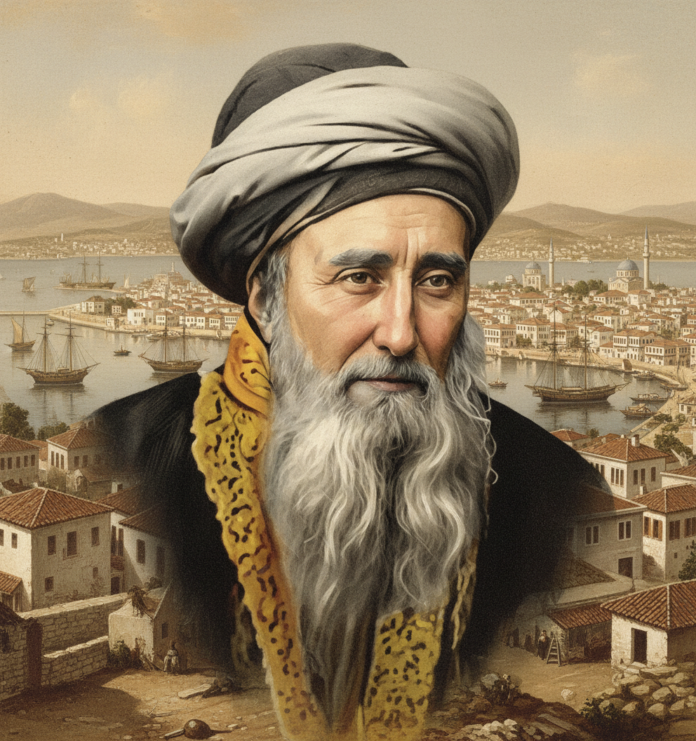
Rabbi Chaim Palagi zt”l on his yahrtzeit – Today 17 Shevat 5628 (1788–1868)
By Rabbi Yair Hoffman
The funeral was an event of extraordinary magnitude. It was conducted as an official state ceremony, attended by Turkish military officers, government officials, and representatives of foreign nations whose consulates lined the waterfront. Ottoman authorities provided an entire battalion of troops to escort the cortege—an honor extended to only two or three chief rabbis in the entire history of the empire.
Members of his community walked alongside the bier carrying his seforim and lit candles – all in front of the military generals and government officials.
Who was this extraordinary man, and where did he come from?
But first, a quick explanation of a Psak that Rav Palagi gave that the Poskim have not understood. Rav Palagi ruled that a sukkah may not be erected by a gentile. This has shocked Poskim because the Gemorah tells us that a Sukkas GaNBach is permitted, and this is the final ruling of the Shulchan Aruch! The answer, this author believes, is simple. The Chacham bashi lived in Izmir where many of the residents had gentiles build Sukkos, and the gentiles were so acquainted with the Jewish community that they perceived it as a religious obligation. They were not building it for the purposes of shade – they were building it as a religious tool! The Sukkas Ganbach was when they built it for shade!
And now back to Rav Palagi the man.
In the annals of Torah scholarship, there are certain luminaries whose breadth of knowledge, depth of compassion, and sheer volume of literary output defy the imagination. Rabbi Chaim Palagi, the legendary Chacham Bashi of Izmir, stands as an extraordinary figure of the nineteenth century—a man who authored approximately eighty seforim, served as the supreme halachic authority of one of the Ottoman Empire’s most important Jewish communities, and championed the cause of the poor and downtrodden with a fierce and unrelenting passion.
Known by the acronyms HaChabif (or Moharchaf), he was described in his own time as a living Gaon—a 19th-century heir to the legacy of the great Babylonian academies.
His halachic responsa reached communities across the entire Jewish world—from Morocco and Egypt to France and Switzerland, from Poland and Russia to Iraq and Syria. His seforim have been reprinted for generations and remain a central reference in Sephardic and Ashkenazic scholarship alike. And yet, beyond the towering intellectual achievement, what emerges most powerfully from every account of his life is the extraordinary middos—the remarkable character traits—that animated everything he did. Here was a man who never sold a single one of his books, distributing each one freely at a seudas mitzvah. Here was a leader who, on his very deathbed, asked that the community not trouble itself to pray for his recovery, but rather hire poor men from the city to pray—thereby providing them with parnassah in his final hours.
The Jewel of the Aegean: Izmir and Its Jewish Community
To understand the world of Rabbi Chaim Palagi and where he came from, one must first understand the city that produced him. Izmir—known to the Western world as Smyrna—sits on the eastern shore of the Aegean Sea, nestled at the head of a deep natural gulf along the coast of western Anatolia. For centuries, its magnificent harbor made it one of the great commercial crossroads of the Mediterranean, linking the vast interior of Asia Minor to the trade routes that connected Europe, North Africa, and the Levant.
By the time of Rav Palagi’s birth in the late eighteenth century, Izmir had grown into the Ottoman Empire’s most important port city after Constantinople itself, a teeming metropolis where Turkish, Greek, Armenian, and Jewish merchants traded alongside one another in the bustling bazaars of the Kemeraltı district.
The Jewish presence in this Aegean port stretched back to antiquity—inscriptions from the second and third centuries attest to a Jewish community in Roman-era Smyrna. But it was the great waves of Sephardic immigration following the Spanish expulsion of 1492 and the Portuguese expulsion of 1497 that truly transformed the city’s Jewish landscape.
Thousands of exiled Jews, carrying with them the traditions of medieval Iberian Jewry, settled across the Ottoman Empire, and Izmir gradually became one of their most important centers. By the early seventeenth century, the port’s exploding commercial importance drew successive waves of Jewish settlers from Salonika, Constantinople, the Aegean islands, North Africa, and Italy. Congregations bearing the names of their places of origin—Etz Chaim, Portugal, Gerush—established shuls, schools, and batei din in the heart of the city’s Jewish quarter, known as the Juderia.
By the mid-nineteenth century, the Jewish community of Izmir numbered as many as forty thousand souls, making it the third-largest Jewish community in the Ottoman Empire, after Salonika and Constantinople. Under Ottoman law, Jews held the status of dhimmis—protected non-Muslim subjects who administered their own educational and judicial institutions and collected their own communal taxes in exchange for a special levy known as the jizya.
Izmir’s Jews flourished in commerce, manufacturing, and banking; they served as dragomans (translators) for European consulates and trading houses, and they exported figs, raisins, carpets, and licorice root to markets across the continent. It was the largest, wealthiest, and most intellectually vibrant Sephardic community in Asia Minor—and it was the community that Rav Chaim Palagi was born to lead.
Early Life and Illustrious Lineage
Rabbi Chaim Palagi was born on 19 Shevat 5547 (1788) to Rav Yaakov Palagi, himself a noted talmid chacham and mekubal, and his wife, Kali Kadin. The family name—Palagi (also rendered Palachi, Palaggi, or Falagi)—was part of the illustrious Pallache family, whose roots in the Sephardic rabbinical world ran deep. Their home stood in the densely packed Jewish quarter that hugged the slopes above Izmir’s busy waterfront, where Ottoman mosques, Greek churches, and lehavdil – Sephardic synagogues shared a single skyline.
His maternal grandfather was the towering Rav Yosef Raphael ben Chaim Chazan, author of the monumental Chikrei Lev, who served as the Rishon L’Tzion—the chief rabbi of the Sephardic community in Eretz Yisroel—in his later years. The young Chaim served his grandfather from his earliest youth, and it was this formative relationship that shaped both his character and his scholarship. Rav Yosef Raphael’s vast erudition and communal stature left an indelible impression on his grandson, influencing his halachic methodology, his communal orientation, and the prodigious literary output that would eventually number in the dozens of volumes.
Of his own childhood dedication, Rav Chaim later wrote: “I call heaven and earth as my witnesses that from the day of my earliest awareness until I reached the age of twenty, I was diligent in my studies day and night without any interruption whatsoever.” This was not empty rhetoric. T
he young prodigy began writing at the age of sixteen, and by the time he was seventeen he had already completed his first sefer, Pe’ulas Tzaddik L’Chaim, a commentary on Pirkei Avos—an astonishing achievement for a teenager growing up in the narrow alleyways of the Izmir Juderia.
Teachers and Semicha
Rav Chaim studied under several distinguished masters. Among his primary teachers were his grandfather Rav Yosef Raphael Chazan, Rav Yitzchak Mayo, Rav Pinchas Raphael Yehoshua di Sigura (known as the Pardes), and Rav Yitzchak Gatignio (Gategno), author of Beis Yitzchak. In 5567 (1807), at the age of nineteen, he married Estrola (Asterula), the daughter of Yitzchak Rabi. Six years later, in 5573 (1813), he received the exalted ordination of “HaChacham HaShalem” from his grandfather Rav Raphael Yosef and from Rav Chaim Yitzchak Algazi—a recognition that, even at twenty-five, he was already counted among the city’s most formidable Torah scholars.
Rise to Communal Leadership
In a remarkable display of respect, Rav Chaim refused to accept any public rabbinical position during his father’s lifetime. It was only in 5588 (1828), after Rav Yaakov’s passing, that he agreed to serve as a dayan in the Beis Din and as Rosh Yeshiva of the Beis Yaakov Rabi yeshiva in Izmir—the very institution where he had studied in his youth.
He also sat and learned in the Beis Hillel yeshiva, where he composed many of his seforim, and he taught in the Eitz HaChaim yeshiva, where his grandfather had also taught.
In 5597 (1837), Rav Chaim was appointed Av Beis Din of the Great Rabbinical Court of Izmir—a body of remarkable stature that comprised forty-five rabbanim. This role positioned him as the foremost halachic authority in a community that served as a hub for Jewish life across the entire Aegean region and beyond, with ties to Jewish communities in Salonika to the northwest, Rhodes and the Dodecanese islands to the south, Constantinople to the northeast, and the ancient Jewish settlements of the Anatolian interior.
Tragically, in 5598 (1838), his beloved wife Estrola passed away, leaving him bereft after three decades of marriage.
The Tanzimat Reforms and the Chacham Bashi
The decades of Rav Chaim’s ascendancy coincided with one of the most turbulent and transformative periods in Ottoman history. Beginning with the Edict of Gülhane in 1839, the Ottoman government embarked on a sweeping program of modernization known as the Tanzimat (“Reorganization”). Driven by reformist statesmen and promulgated under Sultan Abdülmecid I, the Tanzimat sought to reverse the empire’s decline by overhauling its legal, military, and administrative systems along European lines. For the empire’s non-Muslim minorities—Jews, Greeks, and Armenians—these reforms had far-reaching consequences. The traditional dhimmi status, which had afforded protected autonomy but also legal inferiority, began to shift. The landmark Hatt-ı Hümayun of 1856 declared all Ottoman citizens equal before the law regardless of creed, opening new avenues for Jews to participate in government and civic life while simultaneously prompting the Ottoman state to assert greater control over the internal affairs of minority communities.
It was within this rapidly changing political landscape that Rav Chaim reached the pinnacle of communal leadership. In 5615 (1855), he was elevated to the office of Chacham Bashi (Chief Rabbi) of Izmir—the highest rabbinical position in the city. A year later, his appointment was personally confirmed by Sultan Abdülmecid I through an official royal decree known as a “Nishan,” which granted him sweeping judicial and communal authority.
Under the Tanzimat framework, the Chacham Bashi was not merely a spiritual leader; he held government-sanctioned power to adjudicate civil disputes, enforce his rulings, and oversee the administration of the entire Jewish community. Rav Chaim now bore responsibility not only for the religious life of Izmir’s Jews but for their civic governance as well—all while navigating the crosscurrents of Ottoman reform, European commercial pressure, and the internal tensions of a community undergoing rapid social change.
Champion of the Poor and Downtrodden
Perhaps no aspect of Rav Chaim Palagi’s legacy resonates more powerfully than his tireless advocacy for the poor and vulnerable members of his community. He was a communal leader who marshaled his halachic authority in service of the oppressed.
The economic stratification of Izmir’s Jewish community had grown increasingly severe during the eighteenth and nineteenth centuries. While a class of prosperous merchants and Franco (European-protected) traders amassed fortunes through the port’s booming export trade in figs, raisins, carpets, and wool, a far larger population of artisans, peddlers, and laborers struggled to survive in the cramped quarters of the Juderia. The gap between rich and poor was a source of mounting communal tension, and Rav Chaim placed himself on the side of the disadvantaged.
He repeatedly and publicly rebuked the wealthy notables of the community for their treatment of the poor. In particular, he excoriated the practice by which the affluent evaded paying their fair share of communal taxes and instead dramatically increased the gabela—the tax on kosher meat—effectively shifting the entire burden onto the shoulders of those who could least afford it.
“This is not what Hashem desires,” he thundered. “Instead of tzedakah, there is outcry! There is no greater robbery and oppression than this!”
He enacted a takkanah requiring that a portion of the revenue from the meat tax be set aside for the poor and for those who toiled in Torah study. This bold redistribution brought him into bitter conflict with some of the community’s most powerful figures—but Rav Chaim did not waver.
He established charitable institutions and social welfare organizations throughout the city, and he labored personally to build a Jewish hospital in Izmir—an institution that would eventually serve patients of all faiths in the Karataş district. To fund this effort, he enlisted the financial support of international philanthropists including Baron Rothschild in Paris and Sir Moses Montefiore in London, with whom he maintained warm personal relationships.
He marshaled those same connections to help rescue the Jews of Damascus during the infamous Blood Libel of 1840, when members of the ancient Jewish community of Syria’s capital were falsely accused of ritual murder—a crisis that reverberated through Jewish communities from the Levant to Western Europe and galvanized international Jewish solidarity.
Middos
Despite the crushing demands of his schedule—as Av Beis Din, Chacham Bashi, Rosh Yeshiva, and prolific author—he made time for every person who came to him, regardless of their stature. He himself described the challenge: “From age forty, when I was appointed to be a rabbinical judge and teacher and to handle matters of concern to the public, until this day, there is not a minute when I am not surrounded by litigants or by public affairs. These matters come both from this city and its environs, and also various decrees of the government keep me busy with matters affecting the public.” And yet, he continued: “When a man or woman comes before me and speaks for a long time in order to pour out their sorrow… I don’t push them away, as I don’t want to embarrass them or make them feel that I don’t care about their pain.”
That poignant reference to “various decrees of the government” speaks to the unique pressures faced by the Chacham Bashi of a major Ottoman city during the Tanzimat era. As the empire’s reform agenda expanded, the Ottoman authorities increasingly involved communal religious leaders in civil administration, taxation disputes, and matters of public order. Rav Chaim was not merely a rav and a posek; he was, in effect, a government-recognized magistrate responsible for mediating between his community and the Ottoman state.
His son, Rav Avraham, painted a vivid portrait of his father’s character at home: “His behavior with his family and the excellence of his character traits in dealing with them was unique in the world. He never became upset about any household issue; to the contrary, he always made peace overtures. He never became upset at the children’s noise. He used to call them to him each morning to recite the morning brachos, and they prayed out loud. Very patiently, every day, he performed the mitzvah of ‘V’shinantam l’vanecha.’ He would instruct his children in yiras Shamayim… and never to make fun of any person. Once, a member of his household offended another person, and he did not rest until that person had been appeased. A number of times, he even gave money to a person who had been offended.”
Rav Chaim was also renowned for his extraordinary hachnasas orchim. He ruled that a host is permitted to deviate from the truth—to exaggerate or adjust details—in order to spare a guest from discomfort or embarrassment.
Pioneer of Jewish Education
Rav Chaim invested enormous energy and authority in improving the state of Jewish education in Izmir, with special attention to the children of the poor. His educational reforms unfolded against the backdrop of a larger struggle over the future of Jewish schooling in the Ottoman Empire. During the second half of the nineteenth century, the Alliance Israélite Universelle, based in Paris, was establishing French-language schools across the Sephardic diaspora, promoting a modernized, European-oriented curriculum that some traditional leaders viewed with alarm. Rav Chaim’s approach was different: he sought not to import a foreign model but to strengthen the existing communal framework from within, ensuring that every Jewish child—rich or poor—received a solid grounding in Torah, tefillah, and Hebrew literacy.
He instituted what might be described as a form of compulsory education: no father was permitted to remove his son from the Talmud Torah until the child had mastered, at minimum, the order of tefillah and the ability to read. Furthermore, he decreed that no artisan was permitted to employ a boy as an apprentice until inspectors—whom Rav Chaim personally appointed—certified that the child had completed his studies. Before his passing, he established a special oversight committee to supervise the city’s educational institutions.
He founded and supported multiple yeshivos where select avreichim studied without any tuition or fees, and he personally bore the financial burden of supporting the scholars and their families. In addition, he responded to hundreds of halachic inquiries that streamed into Izmir from across the globe—from Egypt, Libya, Morocco, Jerusalem, Tunisia, Holland, Germany, France, the Ottoman Empire, Russia, Iraq, Syria, Poland, and Switzerland. That such a diverse array of communities—spanning three continents, multiple languages, and vastly different cultural contexts—turned to a single rav and Posaik in an Aegean port city speaks volumes about the authority Rav Chaim commanded in the wider Torah world.
Concern for Public Health
Izmir in the nineteenth century was periodically ravaged by the diseases that afflicted all densely populated Mediterranean port cities—cholera, plague, and typhus swept through the crowded quarters at irregular intervals, and the great fire of 1841 that destroyed the Jewish neighborhood was only the most dramatic in a series of urban catastrophes. Against this backdrop, Rav Chaim Palagi displayed a striking awareness of public health concerns.
He publicly opposed the smoking of cigarettes—not only on Shabbos, where the prohibition was clear, but even during the week, on the grounds that smoking was harmful to health. This was a remarkable position for the mid-nineteenth century, when the medical dangers of tobacco were not yet widely recognized.
He also enacted various communal regulations designed to promote the welfare and health of Izmir’s residents, understanding that a rabbi’s responsibility extended not merely to spiritual matters but to the physical wellbeing of his flock.
The Obligation to Respond
One of Rav Chaim’s particularly illuminating teachings concerns the obligation to respond promptly to correspondence. In his Ginzei Chaim, he writes powerfully that failing to respond to a letter in a timely fashion is not merely a breach of common courtesy but an actual Torah violation. He explained that derech eretz—basic decency—requires an immediate response, and that forcing someone to wait anxiously for a reply can cause genuine anguish and even long-term health concerns. Not responding, he wrote, is cruel and a sign of arrogance, and Hashem will repay such behavior measure for measure.
His son Rav Avraham testified that his father always answered letters from even the simplest people. In this, Rav Chaim exemplified the principle that true gadlus encompasses not only intellectual brilliance but meticulous attention to interpersonal obligations.
A Staggering Literary Legacy
The sheer scope of Rav Chaim Palagi’s literary output is almost beyond comprehension. He authored approximately eighty seforim spanning the entire breadth of Torah scholarship: seven works on Tanach, nine on the Talmud, fifteen volumes of midrashim and derashos, numerous works of mussar, and twenty-four compositions on halacha, Kabbalah, and she’eilos u’teshuvos. He began writing at the age of sixteen and did not stop until the day before he died.
Among his most celebrated works are the Kaf HaChaim—a comprehensive treatment of halacha and mussar organized according to the daily schedule, Shabbos, and Rosh Chodesh; Lev Chaim—responsa on Orach Chaim published when he was just thirty-two years old; Tochachas Chaim—ethical exhortations on the Torah portions; Mo’ed L’Chol Chai—halachic rulings and moral instruction for the festivals; Nishmas Kol Chai—an important collection of responsa; and Artzos HaChaim—a passionate work extolling the virtues of Eretz Yisroel, the land he yearned to reach but never would.
Nearly all of his seforim bear the word “Chaim” (life) in their titles—a beautiful reflection of the vitality and life-giving quality he sought to infuse into every area of Torah learning.
Upon the completion of each sefer, Rav Chaim would hold a festive seudas mitzvah and distribute copies of the new work to all who attended, free of charge. He never sold a single copy of any of his books. Some people speculated that his astonishing productivity in writing must be supernatural—perhaps the result of employing Divine Names. But his son Rav Avraham firmly rejected this notion, testifying: “My father’s fear and awe of Heaven, and his wisdom, were much greater and stronger than any Divine Name used to write with!”
The Great Fire of 1841
On 11 Av 5601 (1841), a devastating fire swept through Izmir, destroying much of the Jewish quarter and engulfing Rav Chaim’s home. Such conflagrations were a recurring terror in the densely built neighborhoods of Ottoman cities—Izmir’s wooden houses, pressed tightly together along narrow lanes, were catastrophically vulnerable to fire, and the Jewish quarter had been ravaged before. But the losses sustained in the 1841 fire were uniquely devastating for the world of Torah scholarship: fifty-four of Rav Chaim’s manuscript works were consumed—years of painstaking scholarship reduced to ashes in a single night.
Rav Chaim’s own agonized words convey the magnitude of the loss: “That night, the vast majority of my Torah writings which I had nurtured and raised were consumed… all together they became food for the fire. Woe for that which has departed, woe for a loss that can never return… In those days my mind was not with me from the enormity of my sorrow, and sleep fled from my eyes, and I wept day and night—how could such a great evil have befallen us?”
But then, in a passage that reveals the depth of his emunah, he continued: “The kindness of Hashem I shall recall, the praises of Hashem for all that He has bestowed upon us. For with His help, blessed be His Name, I returned to the texts to restore from memory what had been burned—and from then until now, a third and a quarter…” Over the ensuing years, he painstakingly reconstructed much of what had been lost, ultimately publishing dozens of works. A small number remained in manuscript form. In recent years, many of his compositions have been reprinted by the Shuvei Nafshi Institute in Yerushalayim.
His Reach Across the Jewish World
Rav Chaim Palagi’s influence extended far beyond the Aegean coast. His halachic rulings and responsa were sought by communities across the Sephardic world and Europe—from the ancient Jewish communities of Baghdad and Aleppo to the kehillos of Amsterdam and Paris. In a telling illustration of his stature, when the great Rav Yosef Chaim of Baghdad—the Ben Ish Chai—was only fourteen years old, a halachic query arrived at his father’s home from none other than Rav Chaim Palagi, the Chief Rabbi of Izmir. The correspondence between these two titanic figures of Sephardic Jewry—one in the great Mesopotamian center on the Tigris River, the other in the bustling Aegean port on the Turkish coast—speaks volumes about the vast network of Torah communication that crisscrossed the Ottoman Empire and the centrality of Rav Chaim’s role within it.
Turkish Jews to this day venerate his memory with extraordinary reverence. In Izmir’s synagogues, when his name is mentioned or his rulings cited, the entire congregation rises and bows in respect. His grave in the Gürçeşme cemetery of Izmir remains a place of pilgrimage for Jews from around the world.
Challenges and Steadfastness
Rav Chaim’s decades of communal leadership were not without turbulence. His determination to redirect meat-tax revenues toward education and charitable causes brought him into conflict with powerful communal figures who profited from the existing system. In the mid-1860s, as his health began to decline, certain secular leaders within the Izmir community attempted to exploit the situation and maneuver for his removal from office.
The episode must be understood against the backdrop of the larger political struggle that was reshaping Jewish communal governance across the Ottoman Empire. The Tanzimat-era Organic Statute—promulgated as part of the Ottoman government’s drive to reorganize minority communities along centralized, bureaucratic lines—envisioned a structure in which secular communal councils would share or even supersede the authority of the traditional rabbinical leadership. In Izmir, as in other Ottoman cities, this created a fault line between those who wished to preserve the Chacham Bashi’s traditional prerogatives and those—often wealthier, more Europeanized community members—who sought to limit rabbinic power in favor of lay governance. Rav Chaim’s fierce independence and his willingness to challenge the wealthy on behalf of the poor made him a particular target.
The dispute escalated dramatically in November 1865, when members of the communal council challenged Rav Chaim’s authority over the gabela. When the concession holders complained to the Ottoman government, an envoy sent from Adrianople to investigate—Rav Shmuel Danon, representing the regional Chacham Bashi—actually recommended Rav Chaim’s removal and proposed himself as a replacement. The matter was referred to Constantinople. But the overwhelming majority of Izmir’s Jews rallied behind their beloved rav. A delegation traveled to the imperial capital to plead his case, and the Ottoman authorities ultimately upheld Rav Chaim’s position, confirming his appointment as Chief Rabbi for life.
At the age of seventy, Rav Chaim resolved to fulfill his lifelong dream of ascending to Eretz Yisroel. But the leaders and members of the Izmir community pleaded with him not to leave, and he acceded to their wishes—subordinating his personal yearning to the needs of his flock.
A Story of Gentle Persuasion
A revealing story captures Rav Chaim’s unique approach to leadership. A rumor had spread that a certain wealthy man had pledged a substantial sum to the Jewish community of Tiberias, far across the sea and overland in the Galilee of Eretz Yisroel. The man denied the pledge and refused to pay. An emissary from Tiberias brought him before the Beis Din in Izmir, where it was demonstrated that he had, in fact, never made such a commitment.
The case was closed—but Rav Chaim was not finished. A few days later, he privately summoned the man and said to him, in essence: “You are correct—you made no such pledge, and no one can compel you to pay. But since there is already a widespread rumor that you did, why not turn this into a merit? Let me explain to you how great a mitzvah it would be to support the community in Eretz Yisroel.” Moved by Rav Chaim’s sincerity and wisdom, the man agreed—and made the donation voluntarily.
Final Days and Legacy
On Simchas Torah of 5628 (1867), during the public Torah reading, Rav Chaim read aloud the pasuk “Vayamas sham Moshe”—“And Moshe died there”—and burst into tears. His congregants understood the ominous significance and wept along with him.
On 16 Shevat 5628 (February 9, 1868), Rav Chaim completed his final sefer, Bircas Mo’adecha L’Chaim—derashos for the festivals and months of the year. The next day, 17 Shevat, he passed away from blood poisoning at the age of eighty-one. Even in his final hours, his concern was for others: he asked that the community not burden itself with prayers for his recovery, but rather engage poor men of the city to pray on his behalf—thereby providing them with employment.
His Distinguished Children
Rav Chaim’s sons carried forward his legacy of Torah scholarship and communal leadership. His eldest son, Rav Avraham, succeeded him as head of the Beis Din in Izmir and authored several important works including Padah Es Avraham and Berech Es Avraham. His second son, Rav Rachamin Nissim Yitzchak (known as the Ran”I), authored Yafeh LaLev, Avos HaRosh, and other works. His third son, Rav Yosef, authored Yosef Es Echav and other seforim. Both Rav Avraham and Rav Rachamin Nissim Yitzchak succeeded their father as Grand Rabbi of Izmir—ensuring that the Palagi family’s stewardship of the community’s spiritual life continued well into the early twentieth century.
Rav Chaim Palagi was buried in the ancient cemetery of Izmir. An intriguing anomaly has been noted: while all other headstones in the cemetery face south, his alone faces east—toward Yerushalayim—for reasons that remain unclear. In the 1920s, amid the upheaval of the Greco-Turkish War and the transformation of Izmir under the new Turkish Republic, his grave was relocated to the Gürçeşme cemetery, where it continues to attract visitors and pilgrims from around the world.
Conclusion
Rabbi Chaim Palagi was a towering colossus of Torah scholarship, communal compassion, and personal piety. In an era before modern communications, his halachic influence spanned continents—from the banks of the Tigris to the banks of the Seine, from the shores of North Africa to the communities of Eastern Europe. In a community beset by poverty, political upheaval, and the dislocations of Ottoman modernization, he served as an unyielding advocate for the weak. In a life marked by personal tragedy—the loss of his wife, the destruction of decades of manuscript work in a devastating fire—he rebuilt, restored, and continued to give.
He wrote approximately eighty seforim and never sold a single one. He served as the supreme halachic authority for one of the Ottoman Empire’s greatest Jewish communities—a bustling Aegean port city of forty thousand Jews—and never turned away a supplicant, no matter how humble. He was offered the opportunity to fulfill his dream of living in Eretz Yisroel and sacrificed it for the needs of his community. And on his deathbed, his final concern was that poor men be given employment through the mitzvah of davening on his behalf.
More than a century and a half after his passing, his seforim continue to be studied, his rulings continue to be cited, and his grave continues to draw those who seek inspiration from one of the most remarkable Torah leaders the Sephardic world has ever produced. The Lion of the Geonim rests in Izmir, but his Torah—and his example—are very much alive.
Much of the material for this article was found in the remarkable Hebrew language biography by Rabbi Dr. Shimon Eckstein (1999) z”l, a Talmid of Yeshiva Torah v’Daas and a Rav in Ottawa, Canada.
The author can be reached at [email protected]