

By Rabbi Yair Hoffman
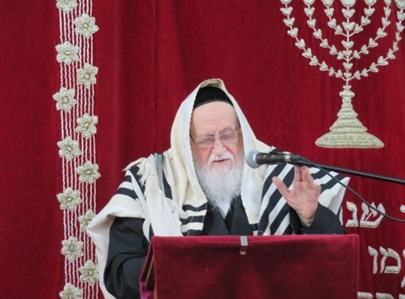
After much of the Torah world having recited Tehillim, Rav Elyakim Schlesinger zt”l passed away this morning at the age of 104. Baruch Dayan HaEmes.
Rav Schlesinger was born in Vienna when the embers of the Austro-Hungarian Empire were still warm, and he was niftar in London having lived through an era that saw the destruction and rebuilding of Torah on the European continent. HaRav Elyakim Schlesinger zt”l was perhaps the last living human bridge connecting the Torah world of prewar Europe with the flourishing world of Torah that we know today. His petirah marks not merely the loss of a great Rosh Yeshiva and posek—it is the closing of an extraordinary chapter in the mesorah of Klal Yisroel.
When we think about what it means to live for over a century, we sometimes focus on longevity itself. But Rav Schlesinger’s 104 years were not simply about length of days. Every decade of his life was marked by a distinct and towering mission—absorbing Torah from the prewar Gedolim, rebuilding Torah in postwar Europe, and fiercely guarding the mesorah for future generations. He was a man who could speak with first-hand knowledge of the Chazon Ish and the Brisker Rov, and yet who in recent years led the charge against the British government’s attempts to impose secular curricula on chareidi schools. The scope of his life defies easy categorization.
A Viennese Cradle of Greatness
Rav Elyakim Schlesinger was born on 22 Cheshvan 5682 (November 23, 1921) in Vienna, Austria, to Rav Dovid Schlesinger and his wife Baila. The Schlesinger home was no ordinary household. His grandfather was none other than Moreinu Yaakov Rosenheim, one of the founders and longtime president of the World Agudath Israel movement—the man who had helped unite Orthodox Jewry across national boundaries into a cohesive force.
Rav Schlesinger thus grew up in a home that was literally a bais vaad lachachamim—a meeting place for the greatest Roshei Yeshiva, Rabbonim, and Admorim who frequented Vienna. The luminaries of European Jewry walked through the Schlesinger-Rosenheim home, and the young boy absorbed it all.
In 1931, with Europe’s political skies darkening, the family relocated to Eretz Yisroel and settled in Tel Aviv. The young Elyakim was just ten years old, yet he had already been steeped in the traditions and bearing of authentic European Yiddishkeit. The family’s move was prescient—just a few years later, the world they had left behind would be consumed in flames.
Learning at the Feet of Giants
In Eretz Yisroel, the foundations of Rav Schlesinger’s lifelong avodas haTorah were set in place. He came under the guidance of Rav Yosef Tzvi Dushinsky zt”l, the great Rav of Yerushalayim and head of the Eidah HaChareidis. Under Rav Dushinsky, the young talmid absorbed the derech of authentic Yerushalmi Torah—a world of uncompromising yiras Shamayim blended with brilliant lomdus. was a prized talmid of the Shevet Sofer (a grandson of the Chasam Sofer) in the Pressburger Yeshiva and later served as Rav of Galanta, Slovakia, and then of Chust, where he founded a major yeshiva that became one of the leading Torah institutions in Hungary. In 1933, following the petirah of Rav Yosef Chaim Sonnenfeld, Rav Dushinsky was invited to succeed him as Ga’avad of the Eidah HaChareidis in Yerushalayim. He immigrated to Eretz Yisroel together with twenty-five talmidim, founded Yeshivas Beis Yosef Tzvi, and established a community of Hungarian Jews in Yerushalayim. He was renowned both as a brilliant posek and as a fierce guardian of authentic Yiddishkeit, waging battles against the Reform and Neologue movements in Hungary and later standing as an uncompromising voice for Torah independence in Eretz Yisroel. His love for his talmidim was legendary, and in the aftermath of the Churban, he devoted himself to rescuing young survivors from spiritual decline. He was niftar on Erev Sukkos 5709 (1948). His Torah writings were later published in the Toras Maharitz series, and the community he founded developed into the Dushinsky Chassidic dynasty, led today by his grandson and namesake.
A beautiful detail that speaks volumes about the Schlesinger family’s character: When young Elyakim arrived to learn under Rav Dushinsky, the Rav told him, “You will see here different minhagim and behavior from what you have seen in your father’s house. However, I want you to conduct yourself the way you have been used to and have been taught by your father.” The family’s adherence to the traditions of Chassidei Ashkenaz—their ancestral mesorah—was so well-known that even Rav Dushinsky himself honored it.
He subsequently learned in Yeshivas Kaminetz and at Yeshivas Lomza in Petach Tikvah—one of the few yeshivos at the time that accepted bachurim from chutz la’aretz. During this period he became known for his crystal-clear havana, his yiras Shamayim, and his unwavering fealty to mesorah.
His uncle, Rav Yechiel Michel Schlesinger, was the Rosh Yeshiva and founder of the famous Yeshivas Kol Torah in Yerushalayim. Torah greatness was, quite literally, in the family’s blood.
Two Towering Relationships: The Chazon Ish and the Brisker Rov
Perhaps the most remarkable dimension of Rav Schlesinger’s early years was his intimate closeness with two of the greatest Gedolei Yisroel of the twentieth century: the Chazon Ish and the Brisker Rov.
While learning in Petach Tikvah, the young Schlesinger would visit Bnei Brak frequently, and it was through these visits that he developed a deep and close relationship with the Chazon Ish, Rav Avraham Yeshaya Karelitz zt”l. This was not a casual acquaintance—it was a bond of genuine closeness. After his marriage, when Rav Schlesinger moved to Yerushalayim and found himself geographically distant from Bnei Brak, he actually complained to the Chazon Ish that he was living too far from him. The Chazon Ish’s response was telling: “Go to the Brisker Rov.”
But the Brisker Rov, Rav Yitzchok Zev Soloveitchik zt”l, was not easily accessible. Rav Schlesinger visited several times and was, as his son later related, “completely ignored.” When he went back to the Chazon Ish to complain, the Chazon Ish told him he had to akshan zich—to be dogged and persistent, and not give up.
The breakthrough came through a Torah insight. Rav Schlesinger’s uncle, Rav Michel Schlesinger, the founder of Kol Torah, was gravely ill. Rav Elyakim had been learning with one of Rav Michel’s sons for his bar mitzvah and had taught the boy a pshetl—a Torah insight. He was then asked to take the boy to the Brisker Rov for a bracha. The Brisker Rov held Rav Michel in high esteem, so they were admitted. The boy delivered the pshetl, and after they left, one of the Brisker Rov’s sons came running out: “My father is calling you.”
Rav Schlesinger later said he was terrified—he had no idea what the Brisker Rov wanted from him. The moment he walked in, the Brisker Rov asked, “Who wrote this pshetl?” Rav Schlesinger admitted it was his own work. The Brisker Rov told him to sit down. From that moment on, a deep and enduring closeness was forged. As his son later observed, “A good vort was always the way to get to the Brisker Rov.”
These were not mere biographical details. These relationships would shape the entire trajectory of Rav Schlesinger’s life and define his approach to Torah, mesorah, and communal leadership for the next seven decades.
Rav Schlesinger married his wife, Dina Yehudis, the daughter of Rav Moshe Blau zt”l—one of the great leaders of Agudath Israel in Eretz Yisroel and a central figure in the Old Yishuv of Yerushalayim. The shidduch united two of the most prominent families in the Orthodox world: the Rosenheim-Schlesinger dynasty and the Blau family, pillars of principled Torah leadership.
Following the petirah of his father-in-law, Rav Schlesinger was appointed Rosh Yeshiva of Yeshivas Pnei Moshe in Yerushalayim, a mosad established in Rav Moshe Blau’s memory. Even at that young age, his sense of achrayus—communal responsibility—extended far beyond his immediate surroundings. Rebbetzin Schlesinger would be his devoted partner for seventy-four years, until her petirah in 2019.
A Call from the Brisker Rov: Returning to Rebuild Europe
The defining moment of Rav Schlesinger’s life came when the Brisker Rov gave him an extraordinary charge: return to Europe and rebuild Torah life on the continent.
One must pause to appreciate the magnitude of this request. Europe in the late 1940s was a continent of ashes. The great yeshivos had been destroyed. The kehillos had been decimated. The infrastructure of a thousand years of Torah life lay in ruins. And here was a young Rosh Yeshiva in Yerushalayim, married into a distinguished family, with a promising future in Eretz Yisroel—being asked to leave it all behind and venture back into the continent of destruction.
But when the Brisker Rov speaks, one listens.
Rav Schlesinger first traveled to Kapellen, Belgium, where he served as Rosh Yeshiva for two years, strengthening a fragile postwar kehilla that was struggling to find its footing. He then moved to London, England, where approximately in 1947 he would establish his life’s great Torah institution: Yeshivas Harama.
Yeshivas Harama: A Pillar of Torah in England
The name “Harama” was not chosen lightly. It reflected Rav Schlesinger’s deep reverence for the dynasty of the Chasam Sofer—specifically his son, the Kesav Sofer, and later the Daas Sofer, who had been among Rav Schlesinger’s own rabbeim. The name thus carried within it the weight of an entire mesorah, an unbroken chain stretching from Pressburg to London.
Over the ensuing decades, Yeshivas Harama became one of the pillars of serious lomdus in England. Rav Schlesinger continued to deliver shiurim to its talmidim for an astonishing span of time—well into his advanced years. The yeshiva produced generations of talmidei chachamim and bnei Torah who would go on to shape communities across England, Eretz Yisroel, and beyond.
His impact went far beyond the walls of the yeshiva. Rav Schlesinger became one of the most influential and respected Gedolei Torah in England’s frum community, widely sought after for hadracha on hashkafic and communal matters alike. He was, in many ways, the spiritual compass of London’s chareidi world.
A Prolific Mechaber: The Beis Av and Beyond
Rav Schlesinger was also a prolific author whose seforim reflect extraordinary breadth and depth. His magnum opus, the multi-volume Beis Av, spans Shas, halacha, machshavah, and drush, and is characterized by his trademark clarity of thought. The sefer has become a respected source cited by talmidei chachamim across the Torah world.
He also authored a Haggadah shel Pesach and additional seforim, all marked by the same quality of incisive analysis and faithfulness to the mesorah of his rabbeim.
Perhaps most precious of all was his sefer Hador Vehatekufah (“The Generation and the Era”), in which he recorded his personal recollections and insights from the great Torah leaders he had known intimately—the Chazon Ish, the Brisker Rov, and others. This sefer stands as an invaluable historical and Torah record, a first-hand window into the Torah leadership of a generation that has now passed entirely from this world.
Protecting Jewish Cemeteries Across Europe
There is a dimension of Rav Schlesinger’s legacy that is not sufficiently known, and it deserves far greater recognition. For decades, he served as President, Chairman, and Head of the Rabbinical Board of the Committee for the Preservation of Jewish Cemeteries in Europe (CPJCE). In this capacity, he became the international address for the protection of Jewish graves across the European continent.
In a memorandum he authored explaining the halachic basis for this sacred work, Rav Schlesinger wrote: “The connection between the soul and the human body after death is an essential aspect of our belief in the eternity of the soul. The soul suffers when a grave is disturbed or even when disrespect is shown to what appear to us to be merely dry bones.”
Rav Schlesinger invested enormous personal energy into safeguarding cemeteries from desecration, working with governments and diplomats across Europe, earning the respect and admiration of governmental leaders from Romania to Lithuania to Poland. He supervised restoration projects, guided halachic decision-making on sensitive questions of kavod hameis, and ensured that the resting places of our ancestors—from small-town shtetl cemeteries to major communal burial grounds—were treated with the dignity demanded by Torah law.
A Champion of Torah Education’s Autonomy
In the final years of his life, Rav Schlesinger emerged as one of the most vocal and courageous defenders of Torah education’s autonomy in the United Kingdom. As the British government’s Department of Education and its regulator, Ofsted, intensified pressure on chareidi mosdos to conform to secular educational mandates—including curriculum requirements that contradicted fundamental principles of emunah—Rav Schlesinger stood firm.
He served as President of the Rabbinical Committee of Traditional Charedi Education and instructed heads of institutions to demonstrate mesiras nefesh in resisting government interference with Torah chinuch. In 2019, at the remarkable age of 97, he personally led a delegation of senior rabbanim to the Houses of Parliament in Westminster to meet with government ministers about the crisis facing chareidi education. In 2022, at the age of 100, he wrote directly to the newly appointed Education Secretary, calling on her to scrap the proposed Schools Bill that he said would fundamentally undermine religious freedom.
His positions were firm and uncompromising. As he wrote in his letter, the United Kingdom had long prided itself on allowing people of all faiths to live in harmony according to their religious principles—but the proposed legislation threatened to overturn that great tradition. A centenarian fighting for the future of Jewish children’s chinuch: if that does not inspire, nothing will.
The Last Bridge to a Vanished World
What made Rav Schlesinger truly irreplaceable was not any single achievement, remarkable as each one was. It was the totality of what he represented: a living, breathing link to a vanished world.
He had sat in the presence of the Chazon Ish. He had earned the respect of the Brisker Rov through a brilliant Torah insight. He had grown up in the home of Yaakov Rosenheim, the architect of Agudath Israel. He had learned under Rav Yosef Tzvi Dushinsky, the Rav of Yerushalayim. He carried within him the mesorah of the Chasam Sofer’s dynasty through the Kesav Sofer and the Daas Sofer.
All of this he transmitted—through his shiurim, his seforim, his personal example, and his communal leadership—to generations of talmidim who never knew that prewar world firsthand. He was, in the deepest sense, a nosein Torah—not merely a teacher of Torah, but a transmitter of an entire world.
The Gemara (Moed Katan 25b) states that the petirah of a tzaddik is compared to the burning of a Sefer Torah. When Rav Schlesinger was niftar, it was not merely one Sefer Torah that was consumed—it was an entire library of living memory, a treasury of first-hand encounters with Gedolei Yisroel whose very names inspire us to greater avodas Hashem.
Lessons for Our Generation
Rav Schlesinger’s life teaches us several enduring lessons.
First, the power of mesiras nefesh for mesorah. When the Brisker Rov asked him to leave Yerushalayim and return to the continent of destruction, he went. He did not calculate personal comfort or career advancement. He went because the mesorah needed him there.
Second, the value of persistence in building relationships with Gedolim. The Chazon Ish told him to akshan zich—to persist in seeking closeness with the Brisker Rov. That persistence bore fruit that lasted a lifetime and shaped an entire community.
Third, the sacred obligation to protect the honor of the dead. In an age when Jewish cemeteries across Europe were being neglected, desecrated, or paved over, Rav Schlesinger made their protection a central mission of his life. This is a dimension of chesed shel emes—true, selfless kindness—that is too often overlooked.
Fourth, the imperative to fight for the autonomy of Torah chinuch, no matter the cost. At an age when most people have long retired from public life, Rav Schlesinger was leading delegations to Parliament and writing letters to government ministers. The chinuch of Jewish children was not something he was willing to compromise on—ever.
And finally, the importance of recording and transmitting the wisdom of the great Torah leaders one has been privileged to know. Rav Schlesinger’s Hador Vehatekufah ensured that the words, the mannerisms, and the Torah of the Chazon Ish and the Brisker Rov would not be lost. Every person who has a relationship with a gadol has an obligation to record what they have seen and heard for the benefit of future generations.
Yehi Zichro Baruch
HaRav Elyakim Schlesinger zt”l was a talmid of prewar Europe, a builder of postwar Torah, a guardian of mesorah, a protector of the dead, and a champion of the living. He lived for 104 years, and every one of those years was filled with avodas Hashem, ahavas Torah, and dedication to Klal Yisroel.
He is survived by his sons, including Rav Yeshaya Schlesinger, grandchildren, and great-grandchildren who carry forward the mesorah he embodied. May the study of his Torah, the reading of his seforim, and the continuation of his life’s work serve as an aliyah for his neshamah.
With his petirah, the bridge across a century has been folded. But the Torah he transmitted, the talmidim he shaped, and the mesorah he guarded so fiercely—these will endure forever.
The author can be reached at [email protected]