
 Vos Iz Neias
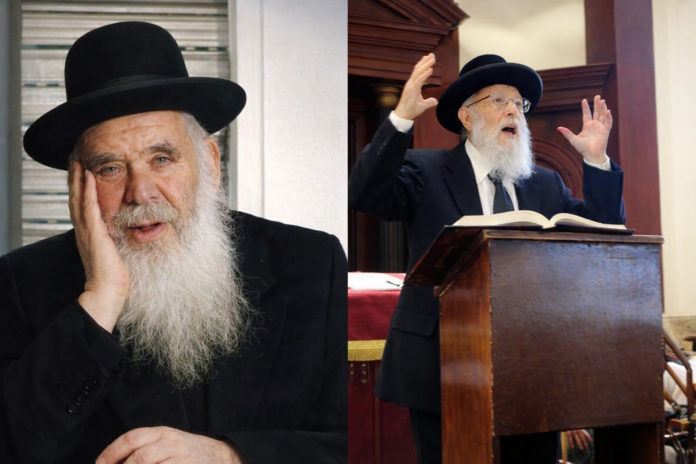
Imagine: Rav Chaim Shmulevitz zt“l – A Rosh Yeshiva in New York An Untold Chapter That Almost Reshaped American Torah Life
By Rabbi Yair Hoffman
The year was 1946, and the war was over. But for Rav Chaim Leib Shmuelevitz zt“l and the remnants of the Mir Yeshiva, the ordeal was far from finished.
The bulk of the Mir Yeshiva students in Europe were now in Shanghai, China – a teeming, sweltering port city that had served as their improbable refuge for more than five years. They had arrived there by way of one of the most extraordinary escape routes in Jewish history: from the town of Mir to Vilna, then through the frozen expanse of Soviet Siberia on the Trans-Siberian Railroad, on to Kobe, Japan, and finally to Shanghai – the only major city in the world that required no visa to enter. In all of Jewish history, no other yeshiva had survived the war intact. The Mir was the sole exception, and the man most responsible for holding it together on foreign soil was Rav Chaim Shmulevitz.
Now China itself was descending into chaos. The fragile truce between Chiang Kai-shek’s Nationalist government and Mao Zedong’s Communist forces had collapsed. On June 26, 1946, full-scale civil war erupted.
My own mother-in-law had barely escaped that war. Encouraged to attend Rebbitzen Kaplan’s Bais Yaakov in Brooklyn by the talmidim in the Mir Yeshiva, she journeyed to the Unted States along with a number of the Mir talmidim.
In the meantime, the Soviets were arming and encouraging the Communist takeover in the north, while hyperinflation was devastating the Chinese economy. One historian noted that in 1946, 100 yuan could buy merely an egg, where just a year earlier it had purchased a fish. The streets of Shanghai, already ravaged by years of Japanese occupation, were now plagued by armed skirmishes, desperate refugees, and a collapsing social order. The other Yeshiva refugees needed to leave, but where could they go?
The British had previously imposed the White Papers, and the difficulties involved in entering Eretz Yisroel were well near impossible. The future pointed to America, and numerous Mir Talmidim had applied for visas to the US.
Rav Chaim Shmuelevitz zt“l (1902-1979) remained in Shanghai and looked after his orphaned Talmidim to ensure that they each had a visa to exit China. This was not the first time he had placed his students’ welfare above his own. Earlier in the war, shortly after arriving in Shanghai, Rav Chaim had received American visas for himself and his family. He refused them, declaring that he would leave only when all the students had received their visas. This breathtaking act of selflessness ultimately meant remaining in Shanghai for five and a half years.
The burden he carried during those years was staggering. With his father-in-law Rav Eliezer Yehuda Finkel zt“l stranded in Eretz Yisroel – having gone there to obtain visas and found himself unable to return – the entire responsibility for running the Yeshiva fell upon Rav Chaim and the Mashgiach, Rav Yechezkel Levenstein zt“l.
But Rav Chaim’s responsibilities extended far beyond the Mir. He took upon himself the financial needs of all the Jewish learning institutions in Shanghai – including contingents from the famed yeshivos of Kamenetz, Kletzk, Lubavitch, and Lublin. Exchanging foreign currency in Shanghai was a criminal offense fraught with danger, and Rav Chaim lived with a perpetual danger of being apprehended by the authorities. Yet he never wavered.
His wife, Rebbetzin Chana Miriam Shmuelevitz – a daughter of Reb Lazer Yudel Finkel zt“l and a granddaughter of the Alter of Slabodka – stood with him through it all, raising their children Ettel, Refoel, and young Gita amid the squalor of wartime Shanghai.
Unfortunately, by 1946, Rav Chaim Shmulevitz could now no longer get a visa for himself and his family.
During the war, Rav Avrohom Kalmanovitz zt“l was essentially responsible for saving the Mir Yeshiva bochurim. This extraordinary Gadol – born in Delyatichi and formerly the Rav of Tiktin – had arrived in America in 1940 with a US passport, and immediately threw all of his vast energies into rescue work. He secured the funds and papers to transport the entire Mir Yeshiva to Kobe and then to Shanghai, and provided for its upkeep for five years.
When the Joint Distribution Committee was prohibited from sending money to Japanese-controlled Shanghai after Pearl Harbor, Rav Kalmanovitz arranged to meet Secretary of the Treasury Henry Morgenthau, Jr. During the meeting, he “fainted” from the overwhelming anguish of his plea. That “collapse” broke the ice; Morgenthau found the means to allow funds out of America through neutral Switzerland.
When FBI agents later confronted him about transferring money to a hostile territory, Rav Kalmanovitz cried out, “These are my children! Yes, I have sent them money and I will continue to send it.” He unbuttoned his shirt and continued. “Shoot me now! Do what you like with me, but I will not stop helping my children.” The agents sheepishly turned around and left without another word.
Rav Kalmanovitz was given permission to establish a branch of the Mir Yeshiva in America. He and Rabbi Yechezkel Kahane (father of Rabbi Meir Kahane) established the American branch of the Mir Yeshiva – first in Far Rockaway, New York, in 1946. He had procured a former Coast Guard base in the Rockaways to host the arriving refugees. It was Rav Kalmanovitz’s yeshiva, even though Rav Chaim Shmulevitz was the son-in-law of Reb Lazer Yudel Finkel zt“l. Rav Nachum Partowitz was then a talmid of the Mir in Far Rockaway.
It was at this desperate juncture that an unlikely chapter in yeshiva history unfolded – one that could have changed the landscape of the Torah world in America forever.
Rav Chaim Shmulevitz entered into discussions with Rav Henach Leibowitz zt“l to become a Ram there, at the Rabbinical Seminary of America/Yeshivas Chofetz Chaim – then located at 135 South Ninth Street, in Williamsburg, New York.
Rav Henoch Leibowitz was himself a remarkable figure. Born in 1916 in Salcininkai, Lithuania, he was the only son of Rav Dovid Leibowitz zt“l, a great-nephew of the Chofetz Chaim himself, who had founded the Yeshiva in 1933 after his great-uncle’s passing.
The Chofetz Chaim had given Rav Dovid a parting message before he left for America: “The Torah was given in a midbar; go to America and the Torah will be given there.” When Rav Dovid suddenly passed away on December 7, 1941 – the same day as Pearl Harbor – his son Rav Henoch, barely in his twenties, assumed the helm of the fledgling yeshiva. He was young, but his vision was enormous.
A contract was written, and Rav Leibowitz made his best effort to obtain a visa for Rav Shmulevitz and his family.
This chapter in yeshiva history was genuine. Rav Leibowitz wrote to the Consul General in Shanghai.
The letter is addressed to Monnett Bain Davis (1893-1953), the American Consul General in Shanghai. Davis was a career diplomat born in Greencastle, Indiana, and a World War I veteran who had served in the American Expeditionary Force before entering the Foreign Service. He had previously served as Consul General in Shanghai from 1935-36, and was now back for a second tour during 1946-47 – tasked with managing American interests in a city spiraling toward chaos.
Davis would eventually become the United States Ambassador to Panama and then the second Ambassador of the United States to the State of Israel, where he would die in his sleep at the US Embassy in Tel Aviv in 1953 and be buried in Arlington National Cemetery. It was written by Rav Henoch Leibowitz zt“l on Erev Shabbos, August 2nd, 1946.
Honorable Sir:
This Seminary entered into a contract with Rabbi Chaim Leib Szmilowicz, who is presently in Shanghai, China. The contract provides that Rabbi Szmilowicz be engaged as a professor of Talmud in our Seminary at a salary of $4,150 per year. [in 2021 dollars this amounts to $57,822 yh]
We wish to advise you that our graduates are in an ever increasing demand in all parts of the United States as well as in Canada, Mexico, and South American countries. We are compelled to increase our facilities. But there is a definite lack of qualified instructors in the United States and we must invite Rabbinical authorities from other countries to take up a post in our Seminary.
We further wish to advise you that Rabbi Szmulowicz is a distinguished Rabbinical authority. Before the war, he served in the capacity of Professor of Talmud in the Yeshiva of Mir, Poland. He is a man of letters and renown in his field.
We will be most grateful to you if you expedite the issuance of a visa to Rabbi Szmilowicz that he, who is accompanied by his wife and children, could arrive at our seminary at the earliest possible moment.
Respectfully yours,
Rabbi A. Henach Leibowitz
Chairman Board of Trustees
One can only imagine what went through the mind of Consul General Davis as he read this letter. Here was a request from a rabbinical seminary in Brooklyn asking him to expedite a visa for a “professor of Talmud” – a discipline utterly foreign to the world of American diplomacy. The careful, formal English of the letter belies the desperate urgency behind it. Rav Leibowitz knew that a man’s life and the future of Torah learning hung in the balance.
It is worth pausing to consider the remarkable act of achrayus and ahavas Yisroel embodied in this letter. Rav Henoch Leibowitz was binding himself contractually to a salary obligation and staking the reputation of his young institution on a man he knew only by his towering reputation. He was twenty-eight years old, leading a yeshiva from a modest walk-up in Williamsburg, and he was reaching across the world to try to save one of the greatest Talmudic minds of the generation.
Eventually, Rav Shmulevitz obtained a visa to France. Yad Vashem archives preserve a photograph of Rebbetzin Chana Miriam Shmuelevitz and their daughter Gita standing on the deck of the Marshal Joffre, sailing from Shanghai to Marseilles in December 1946. From France, Rav Chaim was able to join his illustrious father-in-law in the re-established Mir Yeshiva in Yerushalayim’s Beis Yisroel neighborhood. This was, undoubtedly, with the bracha of Rav Leibowitz zt“l.
One cannot help but wonder: What if Rav Chaim had come to America? What if he had taken that position at 135 South Ninth Street in Williamsburg? The Mashgiach at the time was Rav Chaim Pinchas Scheinberg zt“l, and the temporary Rosh Yeshiva was Rav Mordechai Shulman zt“l, a son-in-law of Rav Yitzchok Isaac Sher zt“l.
Imagine the combination of Rav Chaim Shmulevitz’s legendary shiurim – those sweeping, breathtaking discourses that drew on twenty or thirty Talmudic sources in a single session – paired with Rav Scheinberg’s meticulous approach to halacha and Rav Leibowitz’s Slabodka-inspired emphasis on building the whole person.
It would have been an unprecedented convergence of Litvishe gadlus in one small building in Brooklyn.
Many of the Mir Talmidim who came from Europe continued learning at the Mir branch which had moved from Far Rockaway to Brownsville and eventually to Flatbush. Others learned at a new Yeshiva called Bais HaTalmud, established by some of the Mir’s oldest and most respected students as a continuation of the original yeshiva that went to Shanghai.
But undoubtedly some would have learned under Rav Chaim Shmulevitz had he taken the position in Chofetz Chaim.
Yet Hashgacha Pratis had other plans. Rav Chaim Shmulevitz was destined for Yerushalayim, where he would spend the next thirty-two years teaching, guiding, and inspiring thousands of talmidim, becoming one of the greatest Roshei Yeshiva of the twentieth century. His Sichos Mussar would move generations. His shiurim would reshape the way Talmud was studied across the world. His legendary compassion – the same compassion that had kept him in Shanghai until every last student had a visa, including two boys who had become mentally unbalanced from the trauma of war, whom he personally escorted to the consulate and somehow convinced the officials they were fit to travel – would define what it meant to be a Rosh Yeshiva.
And Rav Henoch Leibowitz?
He would go on to build Yeshivas Chofetz Chaim into one of the most influential Torah institutions in America. In 1955, the Yeshiva relocated from Williamsburg to Forest Hills, Queens, and his talmidim would eventually open more than forty branches across the United States and beyond – from Miami to Los Angeles, from Rochester to Vancouver. Entire Torah communities sprang up around these Chofetz Chaim branches. Rav Mordechai Shulman zt“l, who had intimate knowledge of the original Slabodka Yeshiva, once remarked: “Yeshiva Chofetz Chaim is Slabodka.” It was the highest compliment one could pay.
This letter, written on an Erev Shabbos in the summer of 1946, is a window into a world of mesiras nefesh and mutual responsibility that bound together Torah leaders across oceans and continents. It tells us that even in the darkest hour, when the infrastructure of the Torah world lay in ruins, there were men who refused to give up on one another – who wrote letters and drew up contracts and knocked on the doors of consulates.
May the memory of both Rav Chaim Shmulevitz zt“l and Rav Henoch Leibowitz zt“l be a blessing.
The author can be reached at [email protected].
The author welcomes input from anyone who has more information or documents.