
 Vos Iz Neias
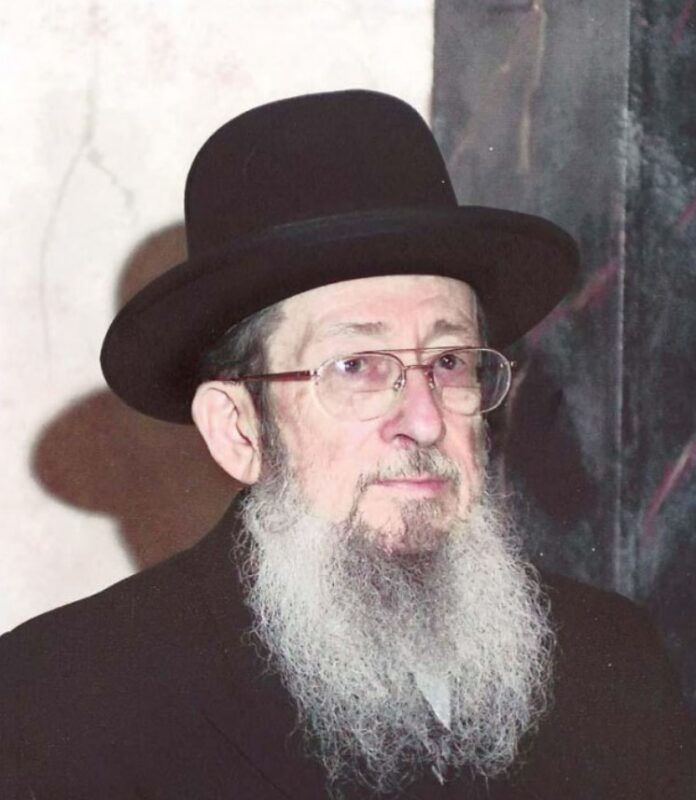
Rav Nachum Zev Dessler zt”l on his yahrtzeit 19 Shvat: a True Mechanech
By Rabbi Yair Hoffman
This Shabbos will be the 25th year since the passing of a model mechanech – someone who personified that remarkable and bold pioneerism that changed the face of merican Chinuch,
In the early 1940s, the idea of a full-day Jewish school in an American city was considered ludicrous. Parents scoffed. Community leaders were skeptical. The prevailing wisdom held that Jewish children belonged in public schools during the day, with perhaps a few hours of religious instruction tacked on in the afternoons or on Sundays.
Against this tide of indifference and outright opposition, one young man—barely in his twenties, a refugee who had traversed Siberia and Japan to reach American shores—dared to dream of something different. He spent his first summer in Cleveland going door to door, lobbying, begging, and pleading with parents to entrust their children to a fledgling day school that had opened in a basement with just twenty-four students.
That young man was Rav Nachum Zev (Velvel) Dessler zt”l.
Over the next seven decades, he would transform that basement classroom into the Hebrew Academy of Cleveland—an institution that has educated over 7,000 students, currently serves more than 1,450 students across multiple campuses, and stands as one of the premier Jewish day schools in North America. More than that, he helped build the very concept of the American Jewish day school, serving as a guiding light for Torah Umesorah and hundreds of schools across the continent. Today, the school bears his name: Beis Chinuch Horav Dessler.
This is the story of how one man’s quiet dignity, unwavering faith, and Kelmer refinement changed the face of Jewish education in America forever.
A Royal Lineage: Kelm, Mussar, and the Dessler Heritage
To understand Rav Nachum Zev Dessler, one must first understand where he came from—not merely geographically, but spiritually. He was born in 1921 in Kelm, Lithuania, a small town that loomed large in the world of Torah. Kelm was home to the legendary Talmud Torah founded by Rav Simcha Zissel Ziv, reverently known as the Alter of Kelm, who was the foremost talmid of Rav Yisrael Salanter zt”l, the father of the Mussar Movement.
Rav Dessler’s yichus was extraordinary on both sides. His father was none other than Rav Eliyahu Eliezer Dessler, the author of the universally acclaimed Michtav M’Eliyahu—one of the most influential mussar works of the twentieth century—who would later serve as the Mashgiach Ruchni of the Ponevezh Yeshiva in Bnei Brak.
On his father’s side, the family traced its lineage back to Rav Yisrael Salanter himself. His mother, Bluma, was a granddaughter of the Alter of Kelm, and Nachum Zev was named after the Alter’s son, Rav Nachum Zev Ziv. He was, quite literally, a scion of the two towering pillars of the Mussar Movement.
The Kelm Talmud Torah was unlike any other institution. It never grew beyond twenty-five to thirty students, yet it produced the mashgiach of nearly every major Lithuanian yeshiva. Its hallmark was sheleimus ha’adam—the pursuit of personal perfection—coupled with an extraordinary emphasis on empathy, caring for others, menuchas hanefesh (calmness of spirit), and refined conduct in every detail of life. Every action and word was to be preceded by forethought and purpose.
A Youth Shaped by Torah and Upheaval
In 1929, when Nachum Zev was eight years old, the Dessler family moved to London, where his father would eventually become a transformative Torah educator. Young Nachum Zev was enrolled in Yeshivah Etz Chaim.
But the pull of Lithuanian Torah learning was strong. Three years later, as a young bachur, he returned to Lithuania and enrolled in the Telshe Yeshiva—one of the great citadels of Torah scholarship—where he would learn for eight formative years under the tutelage of Rav Elya Meir Bloch and Rav Chaim Mordechai Katz.
Telshe was known for its rigorous analytical approach to Talmud study and its emphasis on producing well-rounded talmidei chachamim. For Rav Dessler, the years in Telshe added a powerful dimension to the Kelmer mussar he had absorbed from birth. He emerged as a young man of exceptional refinement, broad Torah knowledge, and deep empathy—precisely the qualities he would need for the historic mission that awaited him.
Then the world fell apart.
As the winds of war swept across Europe, the great yeshivos of Lithuania faced annihilation. In September 1940, the Telshe Roshei Yeshiva—Rav Elya Meir Bloch and Rav Chaim Mordechai Katz—embarked on a desperate journey to save what they could. They traveled across Siberia, through Japan, and across the Pacific to reach America. With them, or following shortly behind, came a small group of Telshe talmidim, among them the young Nachum Zev Dessler.
One remarkable story from this period illustrates the young Dessler’s character. Before the gates of Europe closed, Rav Nochum Velvel—who spoke impeccable English from his years in London—telephoned a foreign consul to help secure a passport for a young woman who needed to escape Lithuania.
Speaking in his well-spoken English, he convinced the consul, who was about to close his office, to stamp one final passport. That young woman was the future Rebbetzin Gifter, wife of Rav Mordechai Gifter, who would become the Rosh Yeshiva of Telshe in Cleveland. It was, as the consul himself noted, the last passport stamped in Lithuania before the gates of Europe closed forever.
Arrival in Cleveland: Building from Nothing
Rav Dessler arrived in Cleveland in 1941, part of the small group of five Telshe students and two Roshei Yeshiva who came to reestablish the Telshe Yeshiva on American soil. He briefly continued his studies at Mesivta Torah Vodaath in New York before settling in Cleveland for good.
In 1943, through the efforts of Rav Elya Meir Bloch and Rav Chaim Mordechai Katz, together with a group from Young Israel of Greater Cleveland, Ohio’s first Jewish day school was organized.
Classes began in September 1943 in the basement of the Cleveland Jewish Center with a grand total of twenty-four elementary school students. It was a beginning that most would have considered inauspicious.
But Rav Dessler saw something different. Where others saw a struggling basement classroom, he saw the future of Torah Jewry in America.
The following year, 1944, the school moved to a house on East Boulevard, and the twenty-three-year-old Rav Dessler was appointed principal. In 1945, he was named Educational Director—a position he would hold for over forty-three years. His journey from that house on East Boulevard to the multi-campus institution that exists today is one of the most remarkable stories in the history of American Jewish education.
Going Door to Door: A Mechanech’s Mesirus Nefesh
The early years were brutally difficult. In 1940s America, the concept of a full-day Jewish school was foreign and unwelcome. Parents wanted their children in public school, where they would become “real Americans.” The idea that children could receive both a rigorous secular and Jewish education under one roof was, to most, unthinkable.
Rav Dessler responded the only way he knew how: with tireless, personal effort. He went door to door, visiting Jewish families across Greater Cleveland, making his case with quiet persistence. He weathered mockery and was told again and again that it would never work. But he persisted, because he carried within him a vision rooted in Kelmer clarity: every Jewish child deserves a Torah education.
One story captures this spirit perfectly. Rav Dessler learned of a Jewish family living in Lorain, Ohio—a considerable distance from Cleveland. He was determined that their children receive a day school education. When logistics proved difficult, he arranged for a driver to meet the children halfway between their home and the school, ensuring they could attend. This was not an isolated incident. It was the norm. Every Jewish child mattered to him.
His son, Rabbi Eli Dessler, captured his father’s philosophy in a single, powerful statement shared at the levayah: Rav Dessler believed every Jewish child was entitled to a Jewish education, “no matter what color his kippah was, or even whether he wore a kippah or not.”
The Chovas HaLevavos teaches, “A little bit of purity is a great deal.” Rav Dessler could discern that spark of purity in every child and every family. He nurtured it and gave it room to grow.
An Approach to Chinuch Like No Other
Rav Dessler’s approach to parents who were not yet observant was extraordinary and far ahead of its time. One incident, remembered decades later, illustrates this beautifully. A couple came to register their children. Though respectful of Orthodoxy and committed to a Torah education for their children, they were concerned about the mixed messages they might be sending.
Rav Dessler’s response was characteristic of the man: “Give me your children and you will see what happens. I only ask two things of you: First, if you drive to shul on Shabbos, never make the children get into the car—let them walk. Second, when they come home from school, learn from them and with them, and do not contradict or argue with them.”
That family eventually became fully Shomer Shabbos. Today, their children and grandchildren are committed, participating members of Torah-observant communities. This story was repeated, in various forms, hundreds of times over the decades.
Another unforgettable episode: a mother, a survivor of the Holocaust with virtually no money and minimal religious background, walked into Rav Dessler’s office clutching a photograph of her father—a distinguished man with a full beard and peyos. “I have no money,” she told him, “but I want my son to have a Jewish education. I want him to one day look like my father. I will do anything—wash dishes, clean floors—as long as my son learns Torah.”
Rav Dessler accepted the child without hesitation. That young boy grew up to become a Rosh Yeshiva and spiritual mentor to thousands of bnei Torah.
Rav Dessler’s commitment to inclusion extended to children with special needs as well. He was, as HAC President Dr. Louis Malcmacher noted, “way ahead of his time” in serving children with learning differences, establishing a comprehensive resource room that became a model for schools across the country.
When Soviet Jews began arriving in Cleveland in the 1970s, he immediately appointed a Russian-speaking teacher to help the children acclimate. In 1979, when Iranian and Russian Jewish families arrived, a special foreign-student division was created to serve nearly 140 children. No child was turned away. No child was left behind.
The Partnership with Irving I. Stone
No account of the Hebrew Academy of Cleveland would be complete without acknowledging the extraordinary partnership between Rav Dessler and Irving I. Stone, the legendary lay leader known affectionately as “Mr. Hebrew Academy.” Stone, who served as the Academy’s fourth president, was a titan of Jewish philanthropy, and Rav Dessler guided him to support the Academy in ways that had never been done before.
Together, they achieved something historic: in 1948, through Rav Dessler’s efforts, the Jewish Federation of Cleveland became the first federation in America to subsidize a full-day Jewish school. This was a watershed moment—not just for Cleveland, but for Jewish day school education across the country. It set the bar for Federation-day school partnerships and demonstrated that a Torah day school could be embraced as a legitimate communal institution.
The relationship between Torah leadership and lay leadership that Rav Dessler and Stone modeled remains a hallmark of the Hebrew Academy’s approach to this day. As the school’s own institutional history notes, this partnership between educational visionaries and communal leaders is central to the Academy’s modus operandi.
Building a Torah Empire: The Growth of the Academy
Under Rav Dessler’s patient but relentless guidance, the Hebrew Academy of Cleveland grew steadily and dramatically. By 1946, enrollment had risen to 170 students. Construction began on a new building on Taylor Road, dedicated in January 1949. A Junior High School department was added in 1951. The Beatrice Stone Yavne High School for Girls was established in 1957. A boys’ high school, the Mesivta (later renamed the Jacob Sapirstein Mesivta High School in honor of Irving Stone’s father, the founder of American Greetings Corporation), was created in 1965.
New classroom and multipurpose wings were added to the original Taylor Road building between 1953 and 1985. A campus was established on South Green Road in Beachwood in 2002. In 2016, the Academy purchased the grounds of the former Oakwood Country Club on Warrensville Center Road, creating a spacious campus featuring a new beis midrash, state-of-the-art science and computer labs, and a gymnasium with basketball and tennis courts.
By the time Rav Dessler was niftar in 2011, the Academy had approximately 790 students spread across campuses in Cleveland Heights, Beachwood, and Lyndhurst. The growth continued after his passing: by 2018, the 75th anniversary year, enrollment had reached a record 1,150 students. By 2022, it exceeded 1,350. Today, the Academy serves over 1,450 students—and the cumulative total of alumni has surpassed 7,000.
The school’s divisions now encompass an early childhood department, a Yeshiva Ketana for boys, an elementary division for girls, a boys’ Junior High School, the Beatrice J. Stone Yavne High School for girls, the Jacob Sapirstein Mesivta for boys, and the Kollel Ateres Nochum Zev—an advanced Torah study program for married men named in his honor. It is a comprehensive Torah ecosystem, from the youngest child to the accomplished scholar.
National Impact: Torah Umesorah and Beyond
Rav Dessler’s influence extended far beyond Cleveland. He was instrumental in building Torah Umesorah—the National Society for Hebrew Day Schools—which grew into an umbrella organization serving nearly 700 schools across North America. Schools from coast to coast turned to Rav Dessler for advice. Drawing on his unparalleled wisdom and decades of experience, he taught other educators how to build, how to grow, and how to navigate the unique challenges of running a Jewish day school in America.
In 1980, Torah Umesorah honored him with its prestigious Educator’s Award for his leadership in the Jewish day school field. The organization later honored the Hebrew Academy as its School of the Year. He also received the Jewish Federation of Cleveland’s Silver Medallion Award, and the Academy was recognized with the Federation’s Charles Eisenman Award in 1992. He was, as many called him, “the educator’s educator—a mechanech’s mechanech.”
Albert Ratner, who co-chaired the committee that created the Jewish Education Service of North America (JESNA), said of him: “He had a strong sense of his beliefs but an understanding of the whole world, and he participated in it in a way that made him a unique, lovable human being.” Ivan Soclof, a past president of the Academy, called him “an entrepreneur in Jewish day school education who pioneered the concept to a limited parent body.”
The Kelmer Spirit: Quiet Dignity as Leadership
Those who knew Rav Dessler invariably speak of his extraordinary personal qualities. He never raised his voice—regardless of the situation. He spoke and acted with complete control, consummate calm, and quiet authority. When he spoke, people felt it a privilege to carry out his request. His dignity was not an affectation; it was the natural expression of a lifetime steeped in Kelmer mussar.
Rav Tzvi Hirsch Braude, the Alter of Kelm’s son-in-law, once explained the kind of students Kelm sought: those who understood refined speech and responded to a quiet word, not those who needed to be shouted at like peasants before the Czar’s train. Rav Dessler was precisely such a person, and he cultivated that quality in everyone around him.
He treated every person—from the greatest Rosh Yeshiva to the most unaffiliated parent—with the same respect and warmth. Dr. Louis Malcmacher, himself a child of Holocaust survivors who attended the Academy, observed that Rav Dessler treated each child as if he or she were the most important person in the world. He was always dressed in a suit, always approachable, always present. In his later years, he maintained this dignified bearing even when going to dialysis treatments.
His empathy was legendary. He once shared a beautiful dvar Torah based on the story of Yosef in the Egyptian dungeon. Despite his own suffering, Yosef noticed a subtle change in the facial expressions of his fellow prisoners—they appeared more aggrieved than usual. This sensitivity ultimately led to his liberation. Rav Dessler drew from this episode the essence of Kelmer mussar: true refinement means noticing the pain of others even in the midst of one’s own difficulties. This was the worldview he embodied, and the perspective from which he led the Hebrew Academy.
Faculty as Family
The Alter of Kelm sought students who would “bear the yoke together with friends without any thought of personal benefit or honor.” Kelm was a family, and the Alter was its patriarch. Rav Dessler transplanted this ethos directly into the Hebrew Academy. He considered the faculty his family. Their concerns were his concerns. Their joy was his joy. Their pain was his pain.
This was not mere sentiment. Whenever a member of the Academy family celebrated a simchah, Rav Dessler was there, often providing financial support. There were families he helped bring to the chuppah in very much the same way he married off his own children. He understood the responsibility that comes with leadership—but above all, he cared for everyone with genuine, Kelmer love.
The Rebbetzin: An Eishes Chayil Beyond Measure
Shortly after Rav Dessler began his work at the Hebrew Academy, Rav Elya Meir Bloch suggested a shidduch between him and a young woman named Miriam Finger. Miriam’s parents, Reb Chanina and Malka, were ehrliche Yidden from Poland who had moved to Berlin between the world wars and escaped Germany just before the Nazi onslaught.
For more than sixty-five years, Rav and Rebbetzin Dessler lived a life of common purpose. Their shalom bayis was legendary—a relationship built on utmost respect and ongoing selflessness. Rebbetzin Dessler served as the devoted preschool principal of the Academy for many decades. But it was her role as an eishes chayil—standing by her husband’s side, supporting the mission of the school, helping to transform Cleveland from a spiritual desert into a thriving Torah community—for which she was most remembered. She was nifteres in 2023 at the age of 100, having outlived her husband by over a decade and witnessing the continued flourishing of everything they had built together.
The Dessler Legacy Continues
Rav Dessler became the Academy’s Dean in 1986, a position he held until his passing. But the institution he built was designed to endure. His children have continued his life’s work with remarkable devotion. Rabbi Simcha Dessler, a graduate of Telshe Yeshiva and Harvard Graduate School of Education’s Principals Center, serves as the Academy’s Educational Director. Rabbi Eli Dessler serves as Financial Director. Together, they carry forward their father’s vision with the same combination of Torah integrity and professional excellence.
Rav Dessler’s other children and their families have also distinguished themselves in the service of Klal Yisrael. His daughter Rebbetzin Peshy Brudny a”h was married to Rav Elya Brudny, Rosh Yeshiva of the Mirrer Yeshiva in Brooklyn. Mrs. Sarika Schiff is married to Rav Emanuel Schiff of Yeshiva Bais Shraga in Monsey. Mrs. Malka Rappaport is married to Rav Dovid Simcha Rappaport. His son Reuven Dessler is a noted askan. The kibbud av va’eim demonstrated by the Dessler children in caring for their parents in their later years was described by observers as humbling and inspiring—a living clinic in how to honor one’s parents.
Rav Dessler was also the author of Ilana D’Chaye, a genealogy book tracing his illustrious family’s history back to Dovid HaMelech.
The Passing of a Giant
Rav Nachum Zev Dessler was niftar on Sunday, January 23, 2011 (19 Shevat 5771), just a few days short of his ninetieth birthday. Nearly 1,300 people attended his levayah, where ten speakers honored the life of this giant of Torah education who was known, above all, as a quiet and humble person. He was buried in Har HaMenuchos in Yerushalayim.
In the Megillas Eichah, the Navi Yirmiyahu laments: “Yesomim hayinu v’ein av”—we were orphans left bereft of our father. Rabbi A. Leib Scheinbaum, writing on the third yahrtzeit, explained this enigmatic verse: when one first loses a parent or mentor, the immediate reaction is about oneself—we were orphaned, we are no longer the same. Only with time does the full realization set in: v’ein av, our father is no longer here. Everywhere we go, every decision we make, every milestone we celebrate.
And so it is with the Hebrew Academy of Cleveland and the thousands of lives Rav Dessler touched. His memory lingers in their minds. His example stands before them at every turn. His principles of moral courage, honesty, and integrity are the very foundations upon which the school was built—foundations laid in the deep soil of Kelm.
A Life Measured in Souls
Rav Shlomo Wolbe writes about the dichotomy of chinuch—the zriah, the planting, and the binyan, the building. Rav Dessler excelled at both. He was zoreiah—he planted the seedlings for thousands of Jewish children. And then he was boneh—he built for them, and inside of them, towering edifices of Torah and its wisdom.
The posuk in Bereishis cries out: “Eich e’eleh el avi vehanaar einenu iti”—how can I go back to my Father when the child is not with me? The great baalei mussar see in this verse the sacred responsibility of every mechanech: how can we face the Ribbono Shel Olam if we have not done everything in our power to ensure that every child receives the chinuch they need?
Rav Nachum Zev Dessler lived that posuk every single day for nearly seventy years. He ensured that no child was turned away. He ensured that no child was left behind. He took a basement school of twenty-four students and built it into an institution of over 7,000 alumni—an institution that has sent its graduates into leadership positions in virtually every walk of Jewish life, in communities across the globe.
He did all of this with quiet dignity, consummate grace, and the refined spirit of Kelm—the spirit of his great-grandfather, the Alter; the spirit of his great-great-grandfather, Rav Yisrael Salanter; the spirit of his beloved father, the Michtav M’Eliyahu. He transformed Cleveland from a spiritual desert into a lush Torah oasis. He changed the landscape of Jewish education in America.
Rav Nachum Zev Dessler is gone. But through his magnificent mishpacha, through the school that now proudly bears his name, and through the thousands of children and families whose lives he shaped, the light of Kelm continues to burn brightly on American shores.
The author can be reached at [email protected]