
 Vos Iz Neias
The Blood-Soaked History Luigi Mangione Wants us to Forget – An Oped
His double jeopardy defense was built on the bodies of murdered Black Americans.
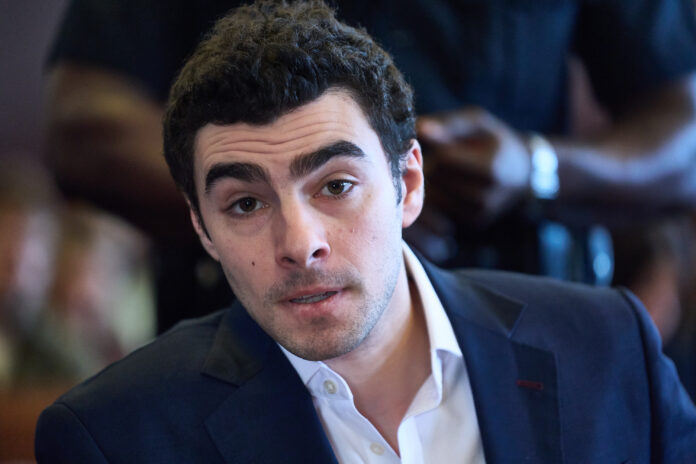
(New York) Luigi Mangione is accused of disguising himself, traveling to Manhattan, lying in wait outside a midtown hotel, and shooting Brian Thompson in the back as Thompson walked to a business conference. He allegedly left behind a notebook describing his plan to “wack” a health insurance executive, ammunition inscribed with the words “delay,” “deny,” and “depose,” and a 9mm handgun matching the murder weapon.
He also left behind a widow and two sons — one nineteen, one sixteen — who will spend the rest of their lives without their father. Paulette Thompson’s first words to the press, still in shock, were: “I just found this out and I’m trying to console my children.” Those boys will grow up with a hole in their lives that no verdict will ever fill.
And now, Mangione’s lawyers are maneuvering to use New York’s double jeopardy protections to ensure he faces only one trial instead of two. They are doing everything possible to delay the state trial until after the federal case begins — because once a federal jury is sworn in, New York law may bar the state from trying him at all.
It is a clever legal strategy. It is also a moral disgrace. Because the legal architecture Mangione is exploiting was built for one purpose: to protect Black Americans from being murdered with impunity.
THE HISTORY WRITTEN IN BLOOD
The reason the federal government can prosecute someone independently of a state — the doctrine known as “dual sovereignty” — exists because, for over a century, state courts in America were not just failing Black victims. They were collaborating with their killers.
Emmett Till was fourteen years old. In August 1955, while visiting relatives in Money, Mississippi, he was accused of whistling at a white woman. Roy Bryant and J.W. Milam kidnapped him from his great-uncle’s home in the middle of the night. They beat him until his face was unrecognizable. They shot him in the head. They tied a seventy-pound cotton gin fan to his neck with barbed wire and threw his body in the Tallahatchie River. His mother, Mamie Till-Bradley, insisted on an open casket so the world could see what had been done to her child.
Bryant and Milam were tried for murder. The all-white jury deliberated for sixty-seven minutes — and some jurors later said it would have been faster, but they took a soda break. Both men were acquitted. Months later, protected by double jeopardy, the two killers sold their confession to Look magazine for four thousand dollars, describing in graphic detail how they tortured and murdered a child. They faced no further consequences. Ever.
Medgar Evers was the NAACP field secretary in Mississippi — a man who spent his life fighting for the right of Black Americans to vote, to attend school, to exist as citizens. On June 12, 1963, he was shot in the back in his own driveway while his wife and children waited inside the house. Byron De La Beckwith, a proud white supremacist, was tried twice. Both times, all-white juries deadlocked. De La Beckwith walked free and boasted about the killing for three decades. It took thirty-one years — until 1994 — to finally convict him.
On September 15, 1963, members of the Ku Klux Klan planted dynamite beneath the Sixteenth Street Baptist Church in Birmingham, Alabama — a church where the civil rights movement gathered to organize. The explosion killed four girls: Addie Mae Collins, 14. Cynthia Wesley, 14. Carole Robertson, 14. Carol Denise McNair, 11. They were in Sunday school, putting on their choir robes for a sermon called “The Love That Forgives.” Despite the FBI identifying the chief suspects almost immediately, Alabama filed no charges for fourteen years. One suspect died without ever being charged.
In the summer of 1964, three civil rights workers — James Chaney, 21, a Black man from Mississippi; Andrew Goodman, 20, a white student from New York; and Michael Schwerner, 24, a white activist from New York — drove to Neshoba County, Mississippi, to investigate the burning of a Black church. Deputy Sheriff Cecil Price, a Klansman, arrested them on a fabricated charge, held them until dark, then handed them over to a mob. All three were shot and buried in an earthen dam.
Mississippi refused to bring murder charges. Not one indictment.
The federal government stepped in, charged eighteen men under federal civil rights statutes, and in 1967, an all-white Mississippi jury convicted seven of them — the first Klan convictions in state history. Without dual sovereignty, every one of those killers would have walked free.
THE MORAL QUESTION
This is the legal tradition Luigi Mangione is attempting to exploit.
These protections were not created for abstract legal theory. They were created because Mamie Till had to bury her mutilated child and watch his killers sell their confession to a magazine. Because Medgar Evers’ children listened to the gunshot that killed their father in their own driveway. Because four little girls in Birmingham never came home from Sunday school. Because three young men drove into Mississippi to fight for justice and were handed over to a lynch mob by a uniformed officer of the law.
Dual sovereignty exists because America needed a failsafe — a way for the federal government to deliver justice when state systems were rotten with racism and refused to protect Black lives.
And now a wealthy, Ivy League-educated man accused of premeditated murder wants to turn that failsafe into his personal escape hatch.
Let’s be clear about what is not being said here. Mangione has a right to mount a legal defense. Every defendant does. Nor should double jeopardy protections be abolished. They serve an important purpose.
But we are entitled to notice the staggering irony. We are entitled to feel something when a privileged man from a prominent family leverages protections that were built on the bodies of Emmett Till, Medgar Evers, and four children in a Birmingham church basement. We are entitled to point out that Brian Thompson’s two sons — his boys who will never hear their father’s voice again — deserve every avenue of justice that the law allows.
The dual sovereignty doctrine carries within it the screams of children pulled from rubble, the silence of a mother standing over her son’s open casket, the desperate courage of three young men who drove into Mississippi and never came home. That history has a weight and a sanctity that should give any decent person pause before trying to twist it to their advantage.
Luigi Mangione should think very carefully before he asks that history to work for him. He should realize that he has caused two young men to be orphans and he is a coward to cry double jeopardy here to save his skin.