
 Vos Iz Neias
Iran Showcases Its Submarine Fleet, But Operational Issues Hamper Its Effectiveness
NEW YORK(VINnews) — As the U.S. aircraft carrier USS Abraham Lincoln and its strike group continue to patrol the waters of the Persian Gulf, an Iranian drone that staged a show of presence was intercepted and destroyed en route toward the carrier.
The real story, however, is unfolding dozens of meters below the surface, where Tehran is implementing an asymmetric naval doctrine designed to challenge American dominance along the world’s most critical energy corridor.
Iran is not attempting to build a navy capable of confronting the U.S. Fifth Fleet head-on. Instead, it is deploying a “silent swarm” of submarines aimed at turning the Strait of Hormuz into a strategic trap, exploiting the fact that oil and goods worth more than $1 trillion pass through the narrow waterway each year.
Iran’s Revolutionary Guards media recently released a new AI-generated video depicting a simulated attack and the sinking of the USS Abraham Lincoln. Iran currently operates one of the largest and most diverse submarine fleets in the Middle East, estimated at between 28 and 30 vessels.
This pathetic AI-generated clip visualizes a fantasy scenario where the Islamic Republic in Iran sinks the USS Abraham Lincoln. It shows them magically blinding US radars, swarming the fleet with speedboats, and forcing a retreat using submarines and mines. pic.twitter.com/VGKuvJM7s6
— Armin Navabi (@ArminNavabi) February 6, 2026
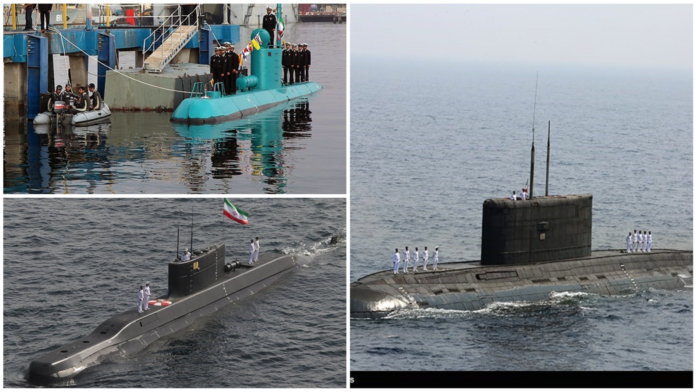
At the core of this strategy are approximately 20 Ghadir-class midget submarines—small but lethal platforms that Iranian commanders nostalgically compare to World War II-era German U-boats.
Weighing just 125 tons, these submarines were specifically designed for the shallow, complex waters of the Persian Gulf. They are capable of resting on the seabed, blending into background noise, and becoming extremely difficult to detect even by advanced sonar systems. Despite their size, they are armed with heavy torpedoes and can also launch Jask-2 cruise missiles from underwater, enabling surprise ambushes followed by rapid withdrawal.
Operating alongside them is the Fateh-class submarine, Iran’s flagship domestic production and the bridge between midget and heavy submarines. The Fateh is a semi-heavy platform equipped with modern combat management systems, electronic warfare capabilities, and an underwater endurance of up to 35 days. Iranian planners aim to create constant uncertainty for adversaries, calculating that even a limited incident, such as a small submarine striking an oil tanker, could send global energy prices soaring by tens of dollars per barrel.
Completing the fleet are Iran’s so-called “heavy” submarines: three Russian-built Kilo-class diesel-electric submarines, each 74 meters long, capable of launching torpedoes, missiles, and deploying naval mines.
Yet when the layers of propaganda are peeled back, the picture appears far less threatening. Despite rhetoric about naval power, Iran’s submarine fleet faces significant technological and physical limitations. The Russian-built Kilo-class submarines are largely ineffective within the shallow waters of the Persian Gulf, forcing them to operate mainly in deeper waters away from the primary theater.
Moreover, despite repeated declarations about ambitions to build nuclear-powered submarines, experts say such goals remain far beyond Iran’s current technical capabilities. The entire fleet remains dependent on diesel-electric propulsion with inherent operational constraints.
Ultimately, there is little reason for excessive alarm. Iran continues to struggle under heavy sanctions that hamper fleet maintenance, and a significant portion of its larger submarines reportedly spend extended periods out of service for repairs. Opposing them are U.S. and allied anti-submarine warfare systems, widely regarded as the most advanced in the world and specifically adapted to counter threats in shallow waters.
Iran’s undersea force may constitute an operational nuisance and a tool of psychological warfare, but it falls far short of altering the maritime balance of power against Western technological superiority.