

by Rabbi Yair Hoffman
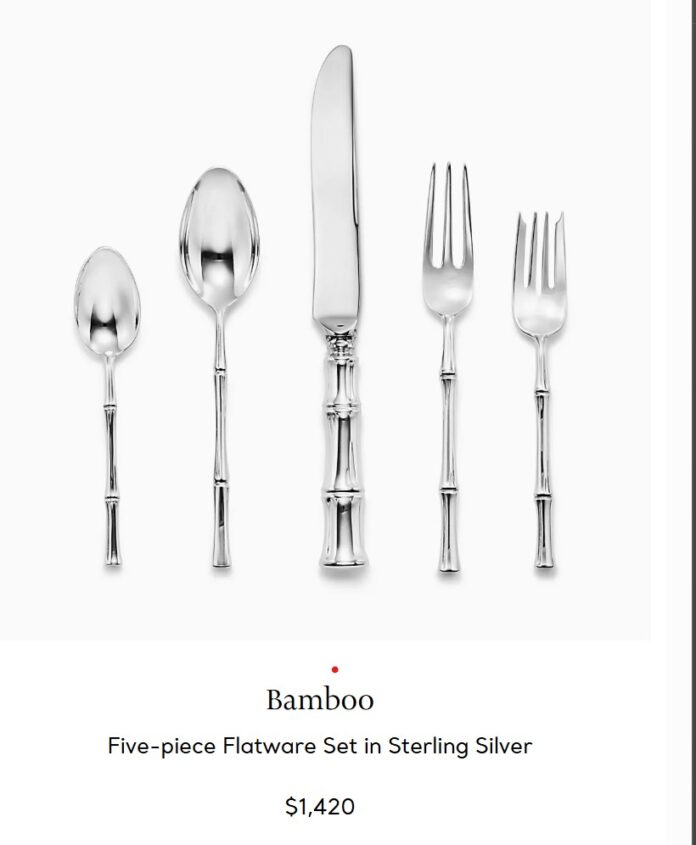
Tiffany’s sells one five piece sterling silver set of Bamboo flatware for $1420. Imagine, for a moment, that you just needed to purchase the smaller fork and imagine further that they would break up the set. Try the following social experiment: Approach a yeshiva student or Bais Yaakov girl and ask them how he or she would name that smaller fork to the gentile saleswoman at Tiffany’s – without using the word, “smaller.”
A large percentage would respond, “the fish fork.” Some, however, would respond, “the salad fork.” The question can be characterized as a simple yardstick to determine how exposed our children are to the general culture around us.
For students reading this column who do not understand this last paragraph, Torah observant Jews only call it a fish fork because of the halachos found in Orech Chaim 173:2 and in Yore Deah 116:2.
The Gemorah in Psachim (76b) tells us that one must not eat fish together with meat because the odor is irritating and can cause disease. The Gemorah explains that the disease is “davar acher.” Rashi identifies it with a type of leprosy.
The Poskim state that this is true for both beef and fish (See Pischei Teshuvah 116:2).
The issue is not discussed in the Rambam, but is cited in Shulchan Aruch (Yoreh Deah 116:2). The reason of tzaraas is cited in Shulchan Aruch.
CURRENT MEDICAL THOUGHT
Current medical thought is that eating fish and meat together does not constitute a medical danger. The Gemorah, however, clearly saw it as a danger.
DOES THE PROHIBITION STILL APPLY?
Fascinatingly enough, at times, the Shulchan Aruch will say when the teva has changed and that we no longer observe a particular halacha that is associated with a health concern. In Yoreh Deah 116 he writes that the prohibition of exposed liquids (where snakes may inject or spit poison) no longer applies where snakes do not access our homes. The Shulchan Aruch does not make an exception regarding meat and fish, but the Magain Avrohom (OC 173) actually does. The Yad Ephraim in YD (116), however, writes that the prohibition remains in effect even nowadays according to most Poskim.
The Ch’sam Sofer (YD # 101), who personally observes the halacha, offers two reasons why the Rambam did not list the halacha. Firstly, it could be that the Rambam held that the issue only referred to one specific type of fish. The other possibility he mentions is that perhaps the teva, nature, has changed and it is no longer medically accurate.
It is permitted, however, to cook fish in a meat pot (or vice versa) – even if it was used that day (Taz YD 95:3), as long as it is completely clean. If the food being cooked, however, has a davar charif – something sharp – then it should not be eaten (See Darchei Teshuvah 95:27).
If fish sauce fell into a meat dish, we do say that it is negated in a volume of sixty to one – even though there is a principle of Chamirah sakanasa m’isurah (See Nekudas HaKesef YD 116, Chochmas Adam 68:1). The Taz ( YD 116:2), however, disagrees with this view. Most Poskim follow the view that it is negated (batel).
WERE THERE OTHER CULTURES THAT UNDERSTOOD IT AS A DANGER?
The Ayurveda is a system of medicine that existed in ancient India. While nowadays much of it is considered as a type of pseudo-science, this was not always the case. In ancient India, the practitioners of Ayurveda were able to cure deviated septums with rhinoplasty, they were able to suture wounds without significant infection, surgically remove kidney stones and gallstones. In the two thousand years since, however, three things have happened:
1] western medicine has eclipsed Ayurvedan medicine, 2] Ayurvedan medical insight has devolved and declined and 3] the world of microbes have changed.
It is this author’s belief that Chazal were aware of much of Indian culture as well as much of ancient Ayurvedan thought. We find many incidents or stories in the Midrashim and in Gemorahs that also appear in ancient Indian sources including both the Jakata and the MahaBharata (see, for example, Esther Rabbah 3:2 and l’havdil Jakata 30; Taanis 20b and lhavdil Mahabharata 12: 4198).
In short, Chazal were familiar with many cultural references that were extant in India.
The medical knowledge extant and practiced by the Ayurvedan associated the mixing of different protein types together with grave danger – including fish and meat and different types of meats as well. And while nowadays, virtually all medical opinions discount any danger associated with such mixtures, it is possible that this was not always the case.
WHAT ABOUT FISH AND MILK?
It is perhaps not so well-known, but the Shulchan Aruch (Yore Deah 87) writes that one should avoid eating fish with milk because of the danger involved.
This is not on account of halacha, because the Mishna in Chullin (103b) clearly states that all meats are forbidden to be cooked with milk, aside from the meat of fish and kosher grasshoppers.”
But some of the commentators believe that this is a typographical error. The Shach writes that it is actually a typographical error. He cites as a proof to this position that in the reference that Rav Karo cites he refers to the prohibition of meat and fish. The Levush repeats the wording of Rav Karo, however. The Rama in his Darkei Moshe writes that he has not seen people being careful about this. The indication is that he is not understanding it as a typographical error.
The Chida backs up the Shach’s position that it is an error.
The Lubavitch community is also stringent and does not allow fish and cheese to be consumed together. Rav Ovadia Yoseph zt”l writes that the Sephardic custom is to prohibit eating fish with milk.
There is a remarkable historical note regarding the fish-and-milk question. As mentioned, the Shach argues that the Shulchan Aruch’s mention of fish and milk as dangerous is a typographical error. However, the Levush — Rav Mordechai Yafeh (1530–1612), this author’s ancestor and the greathalachic authority of Prague and Grodno — repeats the wording of Rav Karo without emendation, treating it as an intentional ruling. Whether Rav Yafeh had access to a more accurate manuscript, or whether he independently agreed with the medical concern, is a question that has intrigued Poskim for centuries. What is clear is that the Levush considered this a genuine halachic concern — not a printer’s error — and his view has lent support to those communities, particularly among Sephardim and Chassidim, who remain stringent on this matter to this day. One might also add that the Rabbeinu Bachya, writing in his commentary on Parshas Mishpatim (Shemos 23:19) some two centuries before the Beis Yosef, had already written that “the doctors feel that fish and cheese that are cooked together can cause bad health and tzaraas.” This demonstrates that the concern predates any possible typographical error in the Beis Yosef by a significant margin, lending further support to the Levush’s position
The author can be reached at [email protected]