
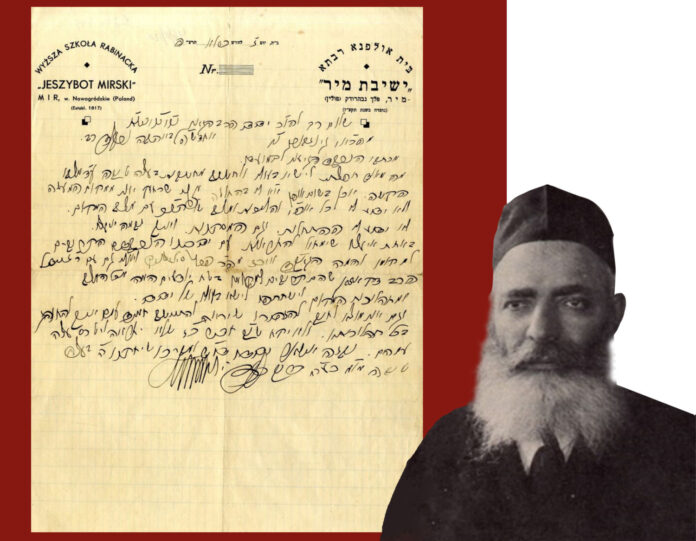

by Rabbi Yair Hoffman
Every so often, individuals emerge in Jewish history who, by dint of their personality and intellect, literally change the topography of Torah life. One such person was Rav Yerucham Levovitz. In the annals of Torah education, no single title has become so completely identified with one man as the title “The Mashgiach.” Among the hundreds of talmidim who passed through the Mir Yeshiva in the interwar years, and among the thousands who inherited their tradition, one did not need to specify which mashgiach was meant. “The Mashgiach” meant Rav Yerucham Levovitz—and no one else. It was not merely a title of respect. It was a statement of fact: in the minds of those who knew him, Rav Yerucham had so perfectly embodied the role of spiritual guide and mentor that he had become inseparable from it.
Almost all of us were shaped by someone, who was shaped by someone that came under his influence. It is somewhat strange, however, that very little has been written in English about this remarkable Mussar giant. Rav Yerucham’s influence on the Mir Yeshiva—and through the Mir, on the entire post-war Torah world—is almost impossible to overstate. He served as mashgiach from 1908 until the outbreak of World War I in 1914, accompanied the yeshiva through its wartime exile, and then returned to the position in 1923, serving until his death on the 18th of Sivan, 5696—June 8, 1936. In those years, he shaped the character and spiritual life of the yeshiva so profoundly that even today, nearly a century later, the Mir’s identity bears the imprint of his personality and teachings.
The Making of a Mussar Giant
Rav Yerucham was born in approximately 1873 in the town of Lyuban (Luban), near Slutsk, in the Minsk province of the Russian Empire. His father, Reb Avraham, was a cheder Rebbe. Little is known about his earliest years. As a youth, he studied in the yeshivos near Pohost (Fahust) and Halusk, near Minsk, and then in the Bobruisk yeshiva.
During this early period, the young Rav Yerucham was sent on a remarkable mission of pidyon shvuyim—the redemption of captives—deep into the heart of Russia. The person who was imprisoned was a Talmid Chochom, and Rav Yerucham extended every effort he could in freeing him. Rav Yoseph Leib Nendik, an early student of Rav Yerucham, once said that his Rebbe attained his greatness on account of this extraordinary act of self-sacrifice for another Jew. It was a revealing episode: even before he had received his formal training in Mussar, the young Yerucham displayed the selfless devotion to others that would define his life.
From Bobruisk, Rav Yerucham made his way to the Slabodka Yeshiva, where he became one of the prized students of the Alter of Slabodka, Rav Nosson Tzvi Finkel. The Alter recognized in the young Yerucham a soul of extraordinary potential and devoted himself to his new student with unusual intensity, passing on to him his great love of Mussar and his vision of what a Torah personality could become.
At Slabodka, Rav Yerucham also developed a close relationship with Rav Yitzchok Blaser (Rav Itzele Peterburger), one of the greatest students of Rav Yisroel Salanter himself. Rav Yerucham adopted Rav Blaser’s method of Mussar study, adding yet another layer to the rich tapestry of influences that would shape his unique approach. Through Rav Blaser, Rav Yerucham became a living repository of the teachings of Rav Yisroel Salanter, the Sabba of Kelm, and the Alter of Slabodka—three streams of the Mussar tradition converging in a single individual.
Like the other yeshiva boys in Slabodka, Rav Yerucham relied upon the essen teg system, eating his meals at the homes of various host families. Some lived in Slabodka itself, while others lived across the bridge in Kovno. Slabodka—technically meaning “suburb” in Slavic, originally called Vilyampoleh—was connected to Kovna by a famous rickety wooden bridge over the Vilaya River that cracked almost every year on account of the melting ice. The Alter used to say of this bridge that “it was always meant to be a one-way bridge—from the turbulence of Kovno to the spirituality of Slabodka.” The trip to Kovno for meals was not difficult during the summer, but during the winter it was often hazardous. The bridge would weigh down with ice and the top layer of the river would freeze as well. To eat in Kovno during the winter meant staying there over Shabbos, and the boys who did so would sleep on a bench in one of the local shuls. Those who did not get chosen for Shabbos meals would go to the Water-Carrier’s Shul in Kovno, where challah and fish were distributed for free.
Kelm
The Alter of Slabodka recognized that Rav Yerucham needed exposure to a different stream of the Mussar tradition. In 1897, at the Alter’s urging, Rav Yerucham left Slabodka to study at the Kelm Talmud Torah—the legendary institution founded by Rav Simcha Zissel Ziv, the greatest and most systematic thinker among the direct students of Rav Yisrael Salanter.
The Kelm Talmud Torah was unlike any other institution in the Torah world. Entry was extraordinarily restricted; new students were admitted only after a rigorous evaluation process that could take months. When Rav Yerucham first arrived, he was permitted to enter the yeshiva but was not allowed to remain in the beis midrash while Rav Simcha Zissel delivered his shmuessen. This probationary period lasted seven months. Only after the Alter of Kelm gave his formal approval was Rav Yerucham accepted as a full member of the Talmud Torah.
By this time, Rav Simcha Zissel was in failing health, but he still continued to give to his talmidim. He had a special group of students with whom he shared his most remarkable insights—they were called the Devek Tov—and Rav Yerucham was admitted to that elite circle. In the months that followed, Rav Yerucham absorbed an approach to Mussar that would define the rest of his life. What did he learn in Kelm? He learned, above all, that Mussar is not mere moralizing or emotional exhortation. It is a rigorous intellectual discipline—a systematic study of human nature, of the workings of the soul, of the relationship between knowledge and action, between understanding truth and living by it. The Kelm approach demanded meticulous self-examination, precise thinking, and an almost scientific attention to one’s inner life.
On Erev Tisha B’Av, Wednesday, July 26, 1898—shortly after reciting Shma—Rav Simcha Zissel was niftar. Rav Yerucham’s sense of loss was profound. Though he had spent fewer than eight months under the Alter of Kelm’s direct tutelage, the experience transformed him. Rav Tzvi Hirsch Broide, the Alter of Kelm’s own son-in-law, later said that Rav Yerucham was his shver’s greatest talmid. Later in his own teaching, Rav Yerucham would replicate the Devek Tov model, sharing special ethical insights with select talmidim in the intimate manner that the Alter of Kelm had employed—the student becoming the teacher, the tradition passing forward.
Rav Simcha Zissel had kept detailed records of how he spent every hour of his day, and Rav Yerucham adopted this practice for the rest of his life, maintaining a personal log that tracked his waking hour, how long it took him to dress, how much time he spent in the beis midrash, when he ate, and when he slept. This was not obsessive behavior. It was the application of intellectual rigor to the most important subject of all: the formation of a human being in the image of his Creator. As the Sabba of Kelm himself had taught: Chanoch lanoar al pi darko, gam ki yazkin lo yasur mimeno—and what does this mean? “If one masters self-education in his youth, then even as he ages he will grow in that manner.” The discipline of self-knowledge was not an exercise for beginners. It was a lifelong practice.
Eight Years of Preparation
After his time in Kelm and a brief period under Rav Nachum Velvel Ziv, Rav Simcha Zissel’s son, Rav Yerucham married his wife Rivkah, a relative of Rav Simcha Zissel, from the town of Ozovnet. He was then offered several positions as a mashgiach ruchani. He declined them all. He felt that deep lomdus—mastery of Talmudic learning at the highest level—was an indispensable prerequisite for anyone who wished to guide others in the path of Mussar. A mashgiach who could not hold his own with the finest Talmudic minds in the yeshiva would lack the intellectual authority that the role demanded.
Rav Yerucham therefore returned to Kelm and to intensive Torah study, spending the next eight years in virtual seclusion, covering the entire Shas and Shulchan Aruch with the thoroughness and analytical depth that characterized everything he did. Only after this extraordinary investment in his own growth did he feel prepared to take on the responsibility of guiding others. The lesson was one he would later impart to his own students: before you can teach, you must first master. Before you can lead, you must first become. He desired to run a yeshiva in the time-tested manner of the yeshivos of old—tzu halten a yeshiva oif a fartzeitigen oifen—and he understood that such a task required a foundation of total mastery.
Radin and Kelm
Rav Yerucham’s first major appointment came in approximately 1903, when he joined Rav Yisrael Meir Kagan’s Kollel Kodshim in Radin. Soon he was appointed the Mashgiach of the yeshiva in Radin. The very first shmuess he delivered there was on the subject of emunah—faith. Among the young students who heard that shmuess was Rav Yechezkel Levenstein, who would himself become one of the towering mashgichim of the twentieth century. Decades later, Rav Levenstein testified that from the moment he heard that shmuess, he resolved never to experience a moment of hesech hadaas—a lapse of attention—from the reality of Hashem’s presence, for the rest of his life. One shmuess. A lifetime of transformation. That was the power of Rav Yerucham.
At Radin, Rav Yerucham formed a close friendship with Rav Naftoli Trop, and together they molded and shaped great talmidim. He maintained a lifelong close relationship with the Chofetz Chaim, seeking him out for deeper questions regarding the running of a yeshiva. Throughout his years at the Mir, he would continue to consult the Chofetz Chaim on the most sensitive matters of yeshiva leadership.
From Radin, Rav Yerucham became the mashgiach at the yeshiva in Kelm. He would travel back to his home in Ozovnet for the Yomim Tovim. In 1908, a son was born to him; he named the child Simcha Zissel, after the Alter of Kelm—a testament to the depth of his devotion to his teacher’s memory. That same year, he received a letter inviting him to come to the Mir and serve as mashgiach alongside the new Rosh Yeshiva, the Alter of Slabodka’s son.
The First Years at the Mir
In 1908, Rav Yerucham came to the Mir Yeshiva as mashgiach. Rav Eliezer Yehuda Finkel, the Rosh Yeshiva, appointed him to a position he was to retain for the rest of his life. The Alter had been asked to help the Mir establish a Mussar program, and he responded with characteristic decisiveness: he dispatched ten of his top students from Slabodka to serve as Mussar role models in the yeshiva, and he sent Rav Yerucham to lead them.
The early years were challenging. The Mir in the pre-war period was still finding its identity in the Mussar world, and not all the students were receptive to the new emphasis on ethical self-development. But Rav Yerucham’s personal example—his extraordinary piety, his intellectual depth, his genuine warmth toward every talmid—gradually won over even the skeptics. When World War I broke out in 1914, Rav Yerucham accompanied the yeshiva into exile in Poltava, sharing in its wanderings and suffering, his presence a source of spiritual strength through the darkest years.
One stop of the yeshiva during its wartime wanderings was in Stavitz—the town where a young Rav Avrohom Yeshayahu Karelitz, the future Chazon Ish, then in his thirties, had resided. Rav Yerucham and the Chazon Ish developed a warm relationship during this period. Years later, the Chazon Ish wrote fondly in his Kovetz Igros (Volume I, Letter 154) about “the Saba of the Mir Yeshiva”—a term of deep affection and respect for Rav Yerucham.
Between the Wars
After the war, Rav Yerucham traveled to Slabodka in order to re-establish that great citadel of Torah during the German occupation, holding it together until the Alter of Slabodka was able to return from the Ukraine. He also served briefly as the mashgiach of the Ponevezh Yeshiva. But Rav Leizer Yudel Finkel, who understood that the Mir’s ascent to greatness required the mashgiach’s return, brought him back to the Mir in 1923.
The year 1923 marked the beginning of the Golden Age of the Mir, as the greatest students of Torah began to gather. Bochurim came from all over—from Western Europe, from Chassidish families in Poland and Hungary, and from the United States. They grew and were shaped and molded into giants of Torah under the meticulous watch of Rav Yerucham. It was a decision that would prove to be one of the most consequential in the history of Jewish education.
In 1925, the Chofetz Chaim expressed his wish to immigrate to Eretz Yisrael. Rav Chaim Ozer Grodzinski, recognizing that the Jews of Europe needed the Chofetz Chaim in Europe, organized a delegation of the greatest Torah leaders to dissuade him. Rav Chaim Ozer asked Rav Yerucham to join that delegation alongside Rav Boruch Ber Leibowitz, Rav Pesach Prusskin (who would later be Rav Moshe Feinstein’s Rebbe), Rav Elchonon Wasserman, and Rav Eliezer Yehuda Finkel. That Rav Yerucham was included in such company—among the acknowledged leaders of the generation—spoke volumes about the stature he had achieved.
The Shmuessen
The heart of Rav Yerucham’s work at the Mir was the shmuess—the formal Mussar discourse delivered to the assembled student body. Rav Yerucham gave shmuessen four times a week: regular discourses on Monday and Wednesday to the full yeshiva, and more intimate talks at his home on Friday evening and Motzoei Shabbos. These shmuessen became the signature experience of the Mir Yeshiva, the element that more than any other defined its character and drew students from across the world.
What made Rav Yerucham’s shmuessen so powerful? Those who experienced them speak of an atmosphere that was almost otherworldly. The talmidim would crowd around the mashgiach in the beis midrash, sitting as close as they could, straining to hear every word. And they had to strain, because Rav Yerucham began his shmuessen in a voice so quiet that it was barely audible. He did not declaim or thunder. He did not employ the fiery rhetoric that characterized some other Mussar teachers. Instead, he spoke as though he were thinking aloud—as though he were addressing himself, working through a problem of enormous complexity and importance, and the students had the privilege of listening in.
Perhaps no account captures the experience of a shmuess more vividly than that of Rabbi W. Wolf Wernick, a talmid who set down his memories in writing. His description transports us into the Mir on a Motzoei Shabbos, into the world of those five hundred young men who gathered in the darkened beis midrash to hear their Mashgiach speak.
It began in the boarding houses. In a dark and barely furnished room, over the shalosh seudos table, one of the students would ask the question: “Er zogt?—Will the Mashgiach speak?” “Where?” At times, when he did not feel well, he spoke at his home. But in most cases, the yeshiva was the place. Hurriedly, the scanty food—the leftovers of the afternoon Shabbos meal—was eaten. They bentsched and were off. In pairs of twos and threes, from all sides of the street, from alleys and little passageways between the typical small, dilapidated European houses, the yeshiva students hastened in the direction of the yeshiva. The liveliness in their walk was due to the eagerness with which they awaited the Mashgiach’s talk.
Opposite each other at the head of the yeshiva lane stood the houses of the Rosh HaYeshiva and the Rav. Quickly, the students passed through the big wooden doors that separated the yeshiva estate from the faculty’s abodes, up the lane and into the yeshiva. The beis midrash was enveloped in darkness, except for the little lamp-light coming from above the amud near the bimah. One vast hall divided into three long aisles of big wooden benches—in the center aisle near the front where the bimah stood, a square was formed and occupied by the students. An assemblage of about five hundred, well arranged from all sides, awaited the Mashgiach. From afar, they appeared as silhouettes against the light blue walls.
Suddenly, the sound of shtenders being moved—those in the front, acting as vanguards, making way for the Mashgiach to enter. He took his seat behind the bimah and soon became the focus of every eye.
Silence. The Mashgiach’s voice rose and the words were heard: “A man never so much as moves his finger, but it has been so decreed from above.” He paused and thought. A deadly silence settled on the yeshiva. No one stirred. He was crouched at his elbows on the edges of the shtender, swaying to and fro. The Mashgiach was old, sixty or more, his beard white with a silver whiteness. The hair on the side of his head, protruding from underneath his black hat, was like newly fallen snow. His face was that of a man who had endured many hardships, but his eyes—unlike the eyes of men of his age—were black and glowing. They showed cleverness. In them, one could see the experience acquired over twenty-five years in the yeshiva world as mashgiach of the Mir, Radin, and other yeshivos—the one from whom all mashgichim attained their instruction and guidance.
Then the tension relaxed. A warmth began to glow within him. By degrees his voice rose; his face kindled; his very soul resolved into his speech. The Divine Presence hovered over him and he drank in its sweetness. The way he spoke gripped the heart of everyone. His voice dilated with the full knowledge of irrefutable proof. Beads of sweat stood out on his forehead. He swung to and fro on his shtender, clasped his hands together and brought them up to his chin. He shut his eyes, stood still, and began intoning.
At the end of his speech, he rose and walked over to the bimah and with great enthusiasm explained, argued, and proved his point, reading the sonorous phrases and following their echoes with delight, as though he himself were not excluded from the philosophic lesson taught. Then he nodded with his head. “A guten.” This signified that the inyan—the discourse—was concluded.
The students left and took their seats. They meditated over his deep thoughts and tried to apply to themselves the lesson in ethics. About fifteen minutes afterward, the Mashgiach went over to the amud and, with the traditional Kelemer pathos, began: “Vehu rachum yechaper avon—And He, the Merciful, will forgive transgressions…” And the Motzoei Shabbos Maariv began, carrying the spiritual charge of the shmuess directly into the prayers.
The content was as distinctive as the delivery. Rav Yerucham’s shmuessen were built on the foundation of rigorous textual analysis. He would take a passuk in Chumash, a teaching of Chazal, a comment of Rashi, and subject it to the same kind of penetrating, multi-layered analysis that the greatest Talmudic minds applied to a sugya in Gemara. His emphasis on unveiling the true intention of Rashi became legendary—he would demonstrate, with stunning precision, that what appeared to be a simple comment on the text actually contained worlds of insight into human nature, divine providence, and the spiritual life. Rav Leib Malin, one of his most devoted talmidim, later said that in Rav Yerucham’s Mussar shmuessen he found not only ethical and educational messages but also a derech halimud—a method of Torah study.
Rav Yerucham would often give a moshol drawn from real-life incidents. He explained that when he had visited the spas at Marienbad in Czechoslovakia, the new arrivals would come bathe in the mineral-rich and curative waters first and only then arrange for their lodgings. Talmidim of the Mir who had become Rabbonim and taken other positions of Torah instruction would often return to the Mir for Elul and the Yomim Noraim. They would arrange for lodging and then come to the yeshiva. By Torah, Rav Yerucham taught, it should be no different—the healing waters of Torah study come first; everything else follows.
The published collections of Rav Yerucham’s teachings—Daas Torah, a six-volume commentary on the weekly parashah; Daas Chochmah U’Mussar, a multi-volume collection of his shmuessen; and Sifsai Daas on Pirkei Avos—remain staples of yeshiva libraries and Orthodox Jewish homes to this day. But those who heard the shmuessen in person testified that the printed page could capture only a fraction of their impact. The experience was not merely intellectual. It was the encounter with a living embodiment of everything he taught.
A Father to Every Talmid
Rav Yerucham’s relationship with his students went far beyond the public shmuess. He viewed each and every talmid in the yeshiva as his own child. The Gemara in Sanhedrin (19b) teaches that whoever teaches his friend’s son Torah, it is as if he gave birth to him. The traditional understanding of this idea refers to the reward one receives for teaching another person Torah. The Slonimer Rebbe, however, gives a different understanding: the successful learning that the child experiences can only happen if the teacher displays the love of a parent toward that student. Only then can the child fully experience true learning. For Rav Yerucham, this was not a homiletical flourish. It was a literal description of his relationship with his talmidim. He knew each one intimately—his strengths, his weaknesses, his struggles, his potential. He gave private counsel with the sensitivity of a master psychologist and the love of a father.
He kept in touch with his talmidim by letter long after they left the Mir. When Rav Shimon Schwab received his first shteller as a Rav and subsequently became engaged, Rav Yerucham sent him a letter of Mazel Tov and then traveled to serve as his mesader kiddushin. On another occasion, Rav Yerucham instructed a young man who was fearful of the Russian draft to register at a particular city. He then personally contacted the doctor responsible for the medical exam and ensured that the talmid received an exemption. These were not extraordinary acts for Rav Yerucham. They were the natural expressions of a teacher who genuinely considered his students his own children.
The American bochurim who came to the Mir in the late 1920s and 1930s were a particular challenge and a particular triumph. These were young men who, as one account memorably put it, “knew of baseball and hot dogs”—products of a modern, secular culture vastly different from the world of the Lithuanian yeshiva. Rav Yerucham took these young Americans under his wing and transformed them into G-d-fearing bnei Torah. He had an uncanny ability to find the right path to every talmid’s heart, to speak to each person in the language they could understand, to challenge them at precisely the level they needed to be challenged. The American students, many of whom went on to become pioneers of Torah education in the United States, remembered their time with Rav Yerucham as the defining experience of their lives.
The Kelm Legacy in the Mir
Rav Yerucham brought to the Mir a distinctive approach to Mussar that blended elements from all of his great teachers. From the Alter of Slabodka, he absorbed the emphasis on gadlus ha’adam—the inherent greatness of the human being created in the image of G-d—and the conviction that Mussar should elevate rather than crush the spirit. From the Alter of Kelm, he learned the importance of intellectual precision in the study of human nature, the discipline of meticulous self-observation, and the integration of Mussar with the deepest levels of Torah learning. From Rav Yitzchok Blaser, he inherited the direct transmission of Rav Yisroel Salanter’s original vision of Mussar as a movement of genuine inner transformation.
The synthesis was uniquely his own. Rav Yerucham’s Mussar was neither the ascetic self-denial of Novardok nor the primarily emotional approach that some critics associated with the early Mussar movement. It was intellectual, analytical, deeply rooted in the text of Torah and the teachings of Chazal, and at the same time profoundly personal and transformative. He taught his students to think—to think about themselves, about their assumptions, about the gap between what they knew to be true and how they actually lived. He demanded authenticity above all else. Superficial piety, rote observance without inner life, the performance of mitzvos without genuine understanding—these were the enemies he fought with every shmuess.
The Unique Role of the Mashgiach at the Mir
What made the Mir unusual among the great yeshivos of the interwar period was the extraordinary authority that the mashgiach wielded in the internal affairs of the institution. In most yeshivos, the Rosh Yeshiva was the dominant figure, with the mashgiach serving in a supporting role—important but clearly subordinate. At the Mir, the dynamic was different. Rav Leizer Yudel Finkel, in an act of remarkable humility and strategic wisdom, assumed primary responsibility for the yeshiva’s finances, fundraising, and external relations, while deferring the spiritual and educational leadership of the yeshiva to Rav Yerucham.
This arrangement was not born of weakness on Rav Leizer Yudel’s part. He was a Torah giant in his own right, and his shiurim were renowned for their analytical brilliance. But he recognized that Rav Yerucham possessed a unique gift for molding souls, and he had the wisdom to step aside and let that gift flourish. The result was that the mashgiach’s shmuessen—not the Rosh Yeshiva’s shiurim—became the primary draw for many students who came to the Mir. The charisma of the mashgiach, the depth of his Mussar, the transformative power of his personal example—these were what made the Mir the Mir.
The senior talmidim of Rav Yerucham, known reverently as the “lions of the Mir,” occupied a special position in the yeshiva’s hierarchy. They served as informal mentors and guides to newer students, assigned arrivals to their respective chaburahs, and carried an authority within the yeshiva that reflected the extraordinary devotion they felt toward their teacher. Rav Shmuel Berenbaum, who arrived at the Mir after Rav Yerucham’s passing, testified that the reverence for the mashgiach was still palpable years later. Rav Leib Malin saw Rav Yerucham as such a towering figure that, as one source recounts, he felt like dust before him—“to the point where had the Mashgiach instructed him to go into a fire, he would have done so.”
An Angel of Hashem
Rav Yerucham’s personal piety was the foundation of everything he taught. He demanded of himself far more than he demanded of others, and those closest to him knew that the man behind the podium was, if anything, even greater than the teacher who stood before the yeshiva. A story was told of the end of one Yom Kippur, after a long day of fasting, praying, and serving Hashem with extraordinary intensity. As the students filed out of the beis midrash, one talmid lingered behind, hiding under a bench. He watched as Rav Yerucham, believing himself to be alone, began to pace the length of the empty hall. Back and forth he walked, pointing to himself and repeating the verse from Bereishis: “Perhaps my father will feel me and I shall be a mocker in his eyes.” Even after a full day of the holiest avodah of the year, Rav Yerucham feared that his service had been insufficiently sincere, that he had fallen short of the truth that Hashem demands.
It was not without reason that his Rebbetzin Rivkah said to her children on the day of his passing: “Know, my children, that your father was a malach Elokim—an angel of G-d.”
Illness and Passing
In his later years, Rav Yerucham’s health declined significantly. The truth was that every time a wagon arrived in the town of Mir, the noise and vibration would cause Rav Yerucham tremendous pain and agony. It is likely that the Mashgiach had an undiagnosed brain tumor that caused these painful headaches.
Furthermore, the relentless demands of his position—the shmuessen, the private counseling, the emotional burden of carrying the spiritual welfare of hundreds of students—took their toll on a body that had never been robust.
The political situation in Poland added to his anguish. Soon the evil of National Socialism was rising across the border, and even within Poland, those who opposed the Nazis wished to demonstrate their own antisemitic credentials. On March 20, 1936, the lower house of the Polish Parliament—the Sejm—passed an amendment severely restricting kosher shechita, pushed by Janina Prystorova, wife of the Polish Senate’s president. A week later the Polish Senate adopted the bill. This assault on one of the most fundamental practices of Jewish religious life caused the Mashgiach great anguish.
On the 18th of Sivan, 5696—June 8, 1936—Rav Yerucham Levovitz was niftar from complications of a stroke. He was approximately sixty-three years old. The funeral drew the entire yeshiva and much of the Torah world of Poland and Lithuania. The Mir had lost its soul—the man who, more than any other, had shaped its character and defined its identity. He was buried in the town of Mir, Belarus.
The void was immense. Rav Shlomo Wolbe, who would become one of the pre-eminent Mussar masters of the post-war generation, later testified that a single Mussar shmuess of the Mashgiach had given him the strength and fortitude to withstand the fearful years of the Second World War. Rav Wolbe, who helped thousands of refugees in Sweden and was deeply involved in the rescue effort for the bochurim of the Mir, traced his ability to sustain others back to the spiritual resources he had received from Rav Yerucham. One man’s teaching, internalized by one student, rippling outward to touch thousands of lives—this was the measure of the Mashgiach’s influence.
The Legacy
The list of Rav Yerucham’s talmidim reads like a roster of the builders of post-war Torah Jewry: Rav Chaim Shmuelevitz, Rav Dovid Povarsky, Rav Nochum Partzovitz, Rav Leib Malin, Rav Abba Berman, Rav Zelik Epstein, Rav Shimon Schwab, Rav Shlomo Wolbe, Rav Aryeh Leib Bakst, Rav Chaim Wysoker, Rav Binyomin Zeilberger, Rav Yechezkel Levenstein, and many, many others. One of his talmidim, Rav Chaim Shmuelevitz, married Rav Leizer Yudel’s daughter in 1929 and six years later joined the hanhala of the yeshiva in 1935.
Rav Yerucham’s own son, Rav Simcha Zissel Halevi Levovitz, founded a yeshiva in Boro Park, Brooklyn, and devoted himself to publishing his father’s writings. His son-in-law, Rav Yisroel Chaim Kaplan, served as Rosh Yeshiva at Beis Medrash Elyon in Monsey. Ten of Rav Yerucham’s senior talmidim would later convene to establish Yeshivas Beis HaTalmud in Brooklyn—an institution that sought to perpetuate the unique synthesis of lomdus and Mussar that had characterized the Mir under the Mashgiach’s guidance. Led by Rav Leib Malin and Rav Chaim Wysoker, Beis HaTalmud became a living monument to Rav Yerucham’s educational vision.
Following the Mashgiach’s passing, his senior talmidim—the “lions of the Mir”—undertook the sacred task of publishing his words. Working from their own notes and those of their colleagues, Rav Simcha Zissel Levovitz edited and published the first volume of Daas Chochmah U’Mussar in Vilna in 1940, in the very shadow of the approaching catastrophe. The talmidim continued publishing additional pamphlets throughout their years of exile in Shanghai, as if to affirm that even in the most desperate circumstances, the Mashgiach’s Torah would not be silenced. In all, Rav Simcha Zissel would publish his father’s shmuessen and thoughts in nine seforim, which are found in virtually every yeshiva library in the world.
The appointment of Rav Yechezkel Levenstein as Rav Yerucham’s successor as mashgiach of the Mir brought a worthy inheritor to the position. Rav Levenstein, who had been transformed by Rav Yerucham’s very first shmuess in Radin decades earlier, carried the tradition forward through the yeshiva’s harrowing wartime journey and into the post-war era at Ponevezh. But among those who had known the Mashgiach, there was a universal recognition that Rav Yerucham was irreplaceable—that the Mir under his guidance had achieved a level of spiritual intensity that could not be fully replicated.
Rav Yerucham Levovitz gave the Mir Yeshiva its soul. He transformed it from a great institution of Talmudic learning into something more: a place where the study of Torah and the refinement of character were fused into a single, seamless whole, where the quest for knowledge and the quest for holiness were one and the same. That vision—transmitted through his talmidim to their talmidim, and through them to yet another generation—continues to animate the Mir and the broader Torah world to this day. In the deepest sense, the Mashgiach never left the Mir. His presence abides.
The author can be reached at [email protected]