

By Rabbi Yair Hoffman
What follows is a new suggestion – a new angle on how we can look at Parshas Shekalim that will improve the lot of Klal Yisroel.
The Gemara in Shabbos (31a) teaches that when a person arrives at the Beis Din shel Ma’alah, one of the six questions he is asked is: “Tzipisa liyeshua?” – “Did you yearn for the redemption?” It is a question not about what we accomplished, but about what we longed for. Did the geulah burn inside us? Did we ache for the rebuilding of the Beis HaMikdash?
Rav Aharon Kotler zt”l in Mishnas Rebbe Aharon Vol. III p. 48 explains that living without the Beis HaMikdash is an entirely different type of life. It is as if we have been turned into a beast longing once again to be human!
This Shabbos we read Parshas Shekalim, the first of the four special parshiyos read this time of year. And if we look carefully, we will discover that this seemingly straightforward parsha – about a half-shekel coin – is, from beginning to end, saturated with the theme of tzipisa liyeshua. Every part of it calls out to us: yearn for geulah. Long for what will be again. Let’s trace the thread.
The Torah Reading
On Shabbos Parshas Shekalim, two sifrei Torah are taken out. In the first, we read the regular weekly parsha. In the second, for maftir, we read the opening six pesukim of Parshas Ki Sisa (Shemos 30:11–16), which describe Hashem’s command to Moshe regarding the machatzis ha’shekel – the half-shekel that every male Jew aged twenty and above was required to contribute annually for the communal korbanos in the Beis HaMikdash. Rich and poor alike gave the identical amount. No more and no less.
When Rosh Chodesh Adar itself falls on Shabbos, three sifrei Torah are taken out: the first for the weekly parsha, the second for Rosh Chodesh, and the third for Parshas Shekalim.
Sefardim read the haftorah of “Vayichros Yehoyada” (Melachim Beis 11), while Ashkenazim begin from “Ben sheva shanim Yehoash b’malcho” (Melachim Beis 12:1). The haftorah describes the generous contributions of the Jewish people for the repair of the Beis HaMikdash during the reign of Yehoash – a fitting parallel to the half-shekel collection.
Why Now? The Longing Built into the Calendar
The Mishna in Megillah (29a) teaches that Parshas Shekalim is read on or before Rosh Chodesh Adar. The Gemara (29b) explains: from Rosh Chodesh Nissan, the communal korbanos had to be purchased from the new collection of shekalim. Chazal instituted the announcement a full month in advance, following the principle of “shloshim yom kodem ha’chag.”
But notice something remarkable. We are reading about shekalim that we can no longer give, for korbanos that we can no longer bring, in a Mikdash that no longer stands. The very act of reading Parshas Shekalim is an exercise in longing. The Sefer HaChinuch makes this explicit: “And now, in our sins, when we have no Mikdash and no shekalim, all of Yisrael has adopted the practice of reading this parsha each year as a remembrance of the matter.”
A remembrance. A zeicher. Every zeicher in Jewish life is an act of yearning – a refusal to forget, a declaration that what was lost is not gone forever, but will return. When we read Parshas Shekalim, we are expressing the deepest tzipisa liyeshua: we remember because we believe it will be restored.
Let’s also examine our weekday shmoneh esreh. We say, “Es Tzemach Dovid avdecha satzmiach.. Why? the answer follows: Ki liyeshuascha kivinu kol hayom! It is the yearning for ge’ulah that will bring it about! Is there any better proof that we should look at parshas Shekalim from this point of view – of yearning for the Geulah?
Why Only Half? The Incompleteness That Drives the Yearning
Why a half shekel? If the Torah wanted each person to contribute a specific amount, why not simply call it a “shekel”? Why emphasize that it is only half?
Rabbeinu Bachya explains that the half-shekel represents the incompleteness of the human being. A person is composed of a neshamah and a guf. Each on its own is only half the picture. The Sefas Emes (Shekalim, 5647) deepens this: the Midrash’s fiery coin from beneath the Kisei HaKavod represents the neshamah, while the physical coin below represents the guf. Together, they form a complete shekel – a complete Jew.
On a communal level, the half-shekel teaches that no individual Jew is complete alone. We need each other to become whole. The funds went toward the korbanos tzibbur – the daily tamid and mussaf – brought on behalf of the entire nation as one. Significantly, the tamid itself was split into two halves: one lamb in the morning, one in the afternoon (Bamidbar 28:4). Two halves, joining to ascend heavenward.
But this also speaks directly to our theme. In galus, the Jewish people are the ultimate “half.” We are a nation without our Beis HaMikdash, a people severed from the fullness of avodas Hashem. The korbanos tzibbur that the shekalim were meant to purchase – the tamid, the mussaf, the korbanos of Yom Tov – we cannot bring any of them. We are, collectively, a “half-shekel” waiting to be made whole. The machatzis ha’shekel, read every year, is a reminder of our incompleteness – and a cry for the geulah that will restore us.
The Fiery Coin: The Passion That Brings Kaparah
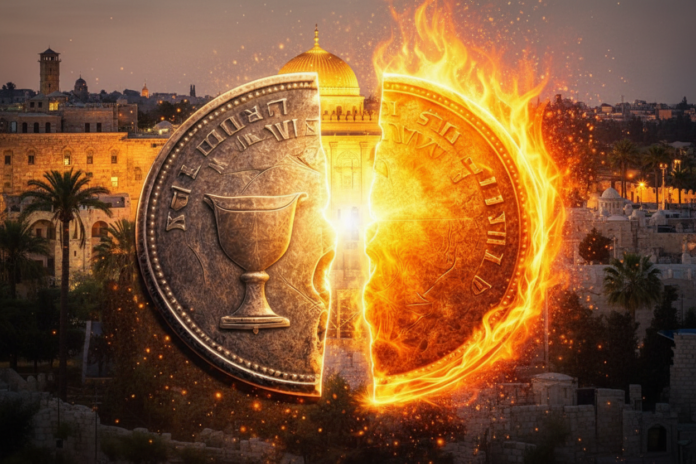
The Midrash (Bamidbar Rabbah 12:3) relates that when Hashem told Moshe about the machatzis ha’shekel, Moshe had difficulty understanding. Hashem showed him a “matbei’a shel aish” – a coin of fire – from beneath the Kisei HaKavod, saying, “Zeh yitnu.”
Many mefarshim ask: Moshe certainly knew what a coin looked like! His difficulty was conceptual. The Torah says the half-shekel serves “l’chapeir al nafshoseichem” – to atone for your souls. Can a piece of metal truly bring kaparah?
The answer is fire. The word kesef (money) shares a root with kissufin – longing, yearning. When a Jew gives the half-shekel with a burning inner fire – with a tzipisa liyeshua, a passionate longing for the end of the galus and the return of the Shechinah – then even a small coin becomes a vehicle for kaparah. The fire of the heavenly coin represents the yearning with which the mitzvah must be performed. It transforms the physical into the spiritual.
This could be the secret of the “coin of fire.” It was not merely showing Moshe what the coin looks like. It was showing him what the coin must feel like – a burning desire for closeness to Hashem and for the ultimate geulah.
Counteracting Haman’s Shekalim
The Gemara (Megillah 13b) cites Reish Lakish: “It was revealed and known before Hakadosh Baruch Hu that Haman would one day weigh out shekalim for the destruction of Yisrael. Therefore, He preceded their shekalim before Haman’s shekalim.”
Haman offered Achashveirosh ten thousand kikar kesef to annihilate the Jews. But the merit of generations of half-shekel donations served as a spiritual shield. The Midrash records Hashem’s response: “Evildoer! You give what is Mine against what is Mine? Their shekalim preceded yours!”
Haman described the Jews as “m’fuzar u’m’forad” – scattered and divided (Esther 3:8). Their vulnerability lay in disunity. The half-shekel was the antidote: every Jew recognized that he was only “half” without his fellow. Mordechai and Esther rekindled this achdus – “Lech k’nos es kol ha’Yehudim” – and it was this achdus – this unity that defeated Haman.
And what is achdus if not a form of yearning for geulah? When Jews come together as one, they are rebuilding, in microcosm, the unity that will characterize the era of Mashiach. The Purim story itself was a harbinger of geulah – and indeed, the second Beis HaMikdash was built shortly thereafter.
The Machatzis HaShekel Today
Although we cannot fulfill the actual mitzvah without a Beis HaMikdash, the minhag of giving a zeicher l’machatzis ha’shekel is practiced across all communities, based on Maseches Sofrim (ch. 21) and cited by the Rema (O.C. 694:1). The custom is to give three half-coins of the local currency, since the word “terumah” appears three times in the pesukim. One must say “zeicher l’machatzis ha’shekel” – not simply “machatzis ha’shekel” – lest the coins inadvertently become hekdesh.
Rav Ovadiah Yosef (Yechaveh Da’as 1:86) writes that the money should ideally support Torah institutions, noting that Chazal teach (Berachos 8a) that since the churban, Hashem has nothing in His world but the four amos of halacha.
Think about that formulation: “zeicher l’machatzis ha’shekel.” We are giving a remembrance of a mitzvah we cannot fully perform. Every time a Jew places those three half-coins into the tzedakah plate on Erev Purim, he is making a statement of faith: I remember what was, and I yearn for its return.
The Fiscus Judaicus: When Yearning Was Turned to Ashes
Perhaps no historical episode illustrates how the forces of galus tried to crush our yearning more than what the Romans did with the half-shekel after the churban of 70 CE.
For centuries, Jews had lovingly sent their annual half-shekel to Yerushalayim. Josephus records that “many tens of thousands” of Babylonian Jews would escort the shekalim convoy to the Beis HaMikdash. The money purchased the tamid, the mussaf, and all the communal korbanos. It was the physical expression of yearning made real – of a Jew’s bond with the avodah.
After the churban, the Emperor Vespasian decreed the “Fiscus Judaicus” – requiring every Jew in the Roman Empire to pay two denarii (the equivalent of a half-shekel) annually. But instead of going to Hashem’s house, the money was redirected to Avodah Zarah Mamash – the temple of Jupiter Capitolinus in Rome – the central shrine of Roman idolatry.
The very same amount. The very same coin. But now given by coercion instead of love, directed to avodah zarah instead of avodas Hashem. The Romans understood what they were doing. They were trying to extinguish the yearning itself – to say to the Jews: your Temple is gone, and now your sacred coin belongs to Avodah Zarah.
They expanded the tax beyond recognition. The Torah’s machatzis ha’shekel applied only to men aged twenty to fifty. The Roman version was imposed on every Jew – men, women, children as young as three, the elderly, even slaves. Under the Emperor Domitian (81–96 CE), the collection became a vehicle for terror. The Roman historian Suetonius records that as a young man he witnessed a ninety-year-old man publicly stripped and examined in a crowded courtroom to see if he was circumcised – to determine if he owed the Jewish tax. The Roman senator Titus Flavius Clemens was put to death on the charge of “drifting into Jewish ways.”
Even after Domitian’s assassination, his successor Nerva merely softened the abuses; the tax itself continued for centuries. It was revived again in 1342 by the “Holy” Roman Emperor Louis IV, who imposed the “Opferpfennig” on Jews, collected on Christmas Day, claiming he was the “legal successor” of the Roman Caesars and thus the rightful recipient of the Jewish Temple tax.
Chazal’s Sobering Insight
Remarkably, Chazal themselves saw a connection between the Roman tax and our own shortcomings. The Mechilta (Yisro 12) expresses the idea that the Fiscus Judaicus was a form of Divine punishment for Jews who had not properly fulfilled the mitzvah of the half-shekel when the Beis HaMikdash stood.
In other words: when we stopped yearning – when we gave the half-shekel mechanically, without the inner fire, without the tzipisa liyeshua that was supposed to animate it – the mitzvah lost its protective power. And the identical coin returned as an instrument of punishment. The lesson could not be more pointed: the yearning is not incidental to the mitzvah. It is the mitzvah.
The Contrast: And Yet, Who Endures?
The Fiscus Judaicus is a footnote of history. But perhaps we should use it to further instigate our tzipisa liyeshuah. The machatzis ha’shekel lives on in every shul in the world, every Erev Purim, every Shabbos Parshas Shekalim. The empire of Rome crumbled; the half-shekel endures. Why? Because the yearning endures. Because Am Yisrael never stopped longing for the geulah.
The Tefillah That Says It All
Sefardim have a beautiful custom of reciting a “L’shem Yichud” before the maftir reading of Parshas Shekalim, concluding with the words: “Uv’chasd’cha tivneh Beis HaMikdash bimheirah b’yameinu” – “And in Your mercy, may You rebuild the Beis HaMikdash speedily in our days.”
This is the culmination of everything Parshas Shekalim represents. We have read about a mitzvah we cannot perform. We have given a coin that is only a zeicher. We have remembered a Beis HaMikdash that lies in ruins. And now we turn to Hashem and say: Please. Rebuild it. Let us give the machatzis ha’shekel again – not as a memory, but in actuality. Let us bring the korbanos tzibbur again. Let us be whole again.
A Message for Our Times
Parshas Shekalim arrives at the threshold of Adar, the month of joy and of the miracle of Purim. Its message resonates powerfully today, perhaps more than ever. We live in a time of extraordinary challenge for Klal Yisrael. The yearning for geulah should not be an abstraction or a formality. It should be a fire – the very fire of that matbei’a shel aish that Hashem showed Moshe.
Every dimension of Parshas Shekalim calls us to this yearning. The reading itself is a zeicher – an act of remembrance that is also an act of faith. The half-shekel reminds us of our incompleteness in galus. The fiery coin teaches us that the yearning itself is what transforms our mitzvos into instruments of kaparah. The connection to Purim shows us that achdus – the unity born of recognizing that each of us is only “half” – is the key to defeating our enemies and hastening the geulah. And the bitter history of the Fiscus Judaicus warns us what happens when we allow the fire to go out.
The Chofetz Chaim, in his sefer Tzipisa Liyeshua, taught that yearning for Mashiach is not merely a hope – it is a transformative force, and it may be the very merit that brings the geulah. When we sit in shul this Shabbos and hear the maftir of Parshas Shekalim, let us listen with new ears. Let us hear in those six pesukim as a call to yearn – to long for the day when we will once again bring our half-shekel to a rebuilt Yerushalayim, when the tamid will once again rise from the Mizbei’ach, and when Hashem’s Presence will once again dwell among us.
Tzipisa liyeshua? Did you yearn for the redemption?
Parshas Shekalim answers: Yes. We yearn. And we will not stop yearning until the geulah comes, bimheirah b’yameinu.
The author can be reached at [email protected]